





Eye For Film >> Movies >> Lali (2026) Film Review


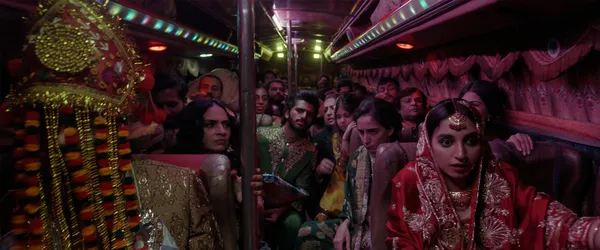

Lali brings a breath of fresh air by flipping the tired “monster-in-law” trope on its head. In Sarmad Sultan Khoosat’s dark comedy, the real villain is not the mother but the man-child she has raised. Following the marriage between Zeba (Mamya Shajaffar) and Sajawal (Channan Hanif), the Pakistani director suggests that the old “marry the son, marry the mother” is not necessarily a curse. Sometimes the mother is the only person who won’t confuse masculinity with maturity.
The usual stigmas attach themselves to Zeba first. She is on her fourth prospect after three previous fiancés died, enough for the family and wider community to treat her as marked, as if misfortune is something she carries. Enter Sohni Ammi (Farazeh Syed), Sajawal’s mother, a force to be reckoned with, commanding, unsentimental when she needs to be, and anchored by an outsized heart. Her affection for Zeba is not performative. It is practical, protective, and oddly tender, the kind that shows up as insistence rather than speeches. Determined to see the marriage sealed, she hands the groom’s best friend a gun for the wedding ritual, only for it to misfire and catch her in the thigh. Even as the wound is stitched and relatives crowd the corridor in alarm, she turns the hospital room into a command post: “The vows have to be taken today. The bride goes with us today. That’s final.”

That stubbornness also comes with history. In an aside that lands like a wound turned into a joke, she tells Zeba that her family would not let her elope with her true love. Speaking of her husband, she says, “standing next to me, he was bad for my beauty”. It is a line that carries a whole past, colourism, coercion, resentment, the way romance gets policed into bitterness. Lali holds these details lightly, but they matter, because the household’s superstitions are never really supernatural. They are inherited.
As the plot turns, Sajawal’s immaturity and insecurity become the true contaminant. A birthmark on his face has sharpened his self-consciousness into a permanent flinch, and it is easy to see how quickly that private shame turns outward as control. He is easily nudged into petty patriarchal tantrums, proof that toxic masculinity is the curse that outlives every other superstition. Even his social circle mirrors him, a cluster of neighbouring friends who move as a pack, boyish and performative, always together, always egging each other on. Against that noise, Zeba never becomes a martyr. The story does not treat her faith melodramatically or reduce her to a symbol. It gives her agency, tact, and steel. The women in Lali are fierce and unafraid to stake their claims inside a system designed to shrink them.
Visually, the narrative commits to its palette, the redness hinted at by the title, but also to the everyday customs and Islamic practices of Punjab without treating them like specimens for foreign consumption. Khoosat has spoken openly about the pressure of “reverse engineering” work for a global audience that expects certain themes from Pakistan, societal misery, collective suffering, controversy. His aim, he says, was to “bend the genre and identity of our cinema”.
Lali shows that life doesn’t have to be funny or frightening. It can be both at once, and no society is miserable all the time, not even one outsiders are trained to see only through suffering. It knows there is power to be claimed by the people power works against. It pleases its crowd, then, as it changes register toward the end, deliberately withholds that pleasure.
The final movement lands with a twist so late it feels engineered by Sajawal’s insecurity, a last-minute mythmaking impulse when he can no longer speak plainly about what he suspects and what he fears. A red blanket, already weighted with family grief and male storytelling, becomes the stage for an explanation that is as convenient as it is humiliating. What matters is not whether anyone believes it, but that he needs it, because it lets him relocate suspicion and shame onto an external force.
In the end, the red blanket becomes a blanket statement, an alibi in cloth that lets a weak man dress jealousy up as destiny and cruelty up as cosmic law. The exorcism is not spiritual. It is simply refusing to play along.
Reviewed on: 19 Feb 2026


Director: Sarmad Sultan Khoosat
Writer: Sarmad Sultan Khoosat, Sundus Hashmi
Starring: Rasti Farooq, Channan Hanif, Juggan Kazim, Mamya Shajaffar
Year: 2026
Runtime: 116 minutes
Country: Pakistan
Search database:
