





Eye For Film >> Movies >> Trial Of Hein (2026) Film Review


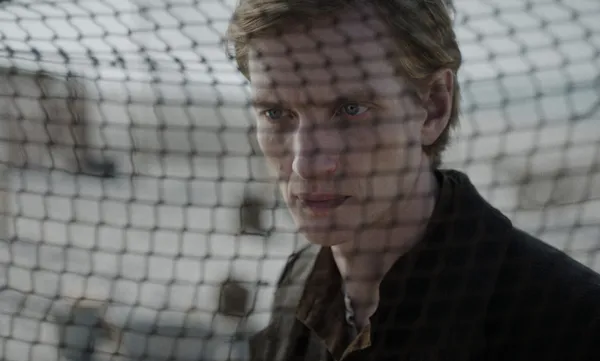

LP Hartley’s line: “The past is a foreign country; they do things differently there” could have been tailormade for Kai Stänicke’s feature debut, which follows a man trying to return to a place that turns out to be far from familiar.
Construction is a key element of Stänicke’s drama, from the memories that the central character, Hein (Paul Boche, who has the intensity of a young Christopher Eccleston), has built for himself to the emotional wall he finds has been put up by his community, or perhaps merely maintained, in his absence. It’s also physically represented since, as Hein sails back to the remote island village where he grew up, after 14-years on the mainland, the camera rises up to show us that we are viewing a set. The houses are just backless facades, though all the other elements of the film are naturalistic. This decision – inspired, the director acknowledges, by Lars Von Trier’s Dogville – has the additional effect of reinforcing how easy it is for humans to ‘believe’ a story, even when we can see the join. This Berlinale Teddy award-winner is shot with a handsome but windswept bleakness by Florian Mag, Damian Scholl's elegant score reinforces the pervading sense of melancholy.

The mood matches the cool reception that awaits Hein, as his mother (Irene Kleinschmidt) is sliding into dementia, meaning she fails to recognise him, while his sister Hediee (Stephanie Amarell) was too young when he left to have any reliable recollection. Worse still his best friend Friedemann (Philip Froissant) also tells people he doesn’t think it’s him. The doubts are coupled with the inward-looking nature of the community – a fear of outsiders just one of the themes striking a chord with the modern world despite an undefined but non-recent period setting and the use of older German, although that won’t be readily apparent to non-native speakers.
The solution, village elder Gertrud (Julika Jenkins) tells him, is to hold a trial in the course of which his memories will be measured up against those of the villagers to see if they tally. Even as a former girlfriend, Greta (Emilia Schüle), seems as though she may still be an ally, questions begin to mount about the fictions everyone creates for themselves in order to maintain the status quo and the way denial can shape our memories.
Truth and lies are shown not to be as fixed as might be imagined, especially when it comes to notions of self-identity. Stänicke leans quite heavily into his metaphors, including a central card game, called Lies, where players have to guess the moment their opponent is cheating. But what gives Stänicke’s film the edge is the clever way he shifts the focus so that the narrative becomes less about the community than Hein himself. Tension mounts as the young man realises that rather than questioning the part others are playing in his predicament, the role he is playing himself is what matters.That the secrets come out are not particularly revelatory is largely beside the point, since the crux of the drama hinges on whether Hein will stick to the script.
Reviewed on: 26 Feb 2026


Director: Kai Stänicke
Writer: Kai Stänicke
Starring: Paul Boche, Stephanie Amarell, Philip Froissant, Emilia Schüle, Jeanette Hain, Zhenja Isaak, Aaron Hilmer, Andreas Nickl, Maju Margrit Sartorius, Philip Günsch, Emil Hauss, Frederick Lepthien, Emilia Packard, Irene Kleinschmidt, Lena Maria Eikenbusch
Year: 2026
Runtime: 122 minutes
Country: Germany
Search database:
