





Eye For Film >> Movies >> The Dutchman (2025) Film Review



It has been 62 years since Amiri Baraka’s play Dutchman premièred at Greenwich Village’s Cherry Lane Theatre. In early 2025, when director Andre Gaines and his co-writer Qasim Basir began work on this film, which is more an extension of the theme than a straight adaptation, one might have been forgiven for thinking that race relations in the US had improved. Schools are officially integrated. Mixed race marriages are no longer banned. The law prohibits discrimination in housing, and so forth. Under the surface, however, nothing was quite as equal as it seemed; and since Donald Trump commenced his second term as President, racism has become much more overt, with protections rapidly being whittled away. How does one account for this complex landscape within the tight structure proposed by the original?
From the start, the adaptation feels overloaded, trying too hard to do too much. In this regard it resembles its central character, Clay (André Holland), who is pressed to read the play by the counsellor (Stephen McKinley Henderson) who is trying to help him and his partner Kaya (Zazie Beetz) repair their relationship after she has committed a minor transgression. The psychiatrist functions as one of a pair of shamanic characters; along with an older woman (Sally Stewart) whom Clay meets in a train station, he guides the protagonist through his adventure in what might be an act of compassion or might be a form of exploitation required for them to achieve their own goal: the destruction of a demonic predator.

That predator is – as those familiar with the play will immediately guess – a skinny, red-lipped white woman called Lula (Kate Mara). There’s a risk that describing her in this way will enable white viewers to more comfortably perceive her as something other, not truly representative of them – and her sexual aggression is liable to see her othered by way of misogynistic stereotyping anyway – but in scenes where she casually inveigles herself into a Black space, it’s clear that some of the people there recognise her particular threat as one which has been wielded by white women against Black men for centuries. Mara rivals Jena Malone in Antebellum for unabashed creepiness rooted in feminine affectation.
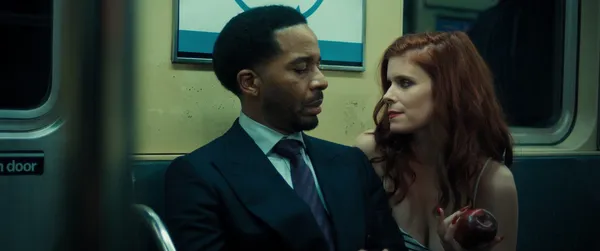
Lula and Clay meet, as in the original, on the underground. He’s reading as advised. She seems, at first, just to be looking for attention or a casual fuck. Their banter, as she squeezes into his personal space and uses mentalist tricks to convince him that she knows a little too much about him, gradually makes way for reciprocal flirtation. Then the two narratives properly diverge as, unlike his predecessor in the play – and in acknowledgement of how expectations have changed – he lets her take him back to her apartment, where she gives him a swift lesson in the real power dynamics of white supremacist culture.
As the story spools out from there, exploring the ‘what ifs’ of the original, Gaines makes various attempts to address its themes of ‘twoness’, with a nod to shifts in thinking about what it means to be an American and to be an African American. The expansion of the story allows for the introduction of several other Black men, presenting an indirect challenge to Lula’s stereotyping of Black masculinity – ahead of Clay accidentally making himself into an unlikely stereotype for someone in his otherwise socially privileged position. Having reached this point, however, the story begins to meander, and it takes a bit of a deus ex machina – one might generously call it magical realism – to get it back on track.
The use of a stage as a metaphor at this point is tricky because to the extent that Black men in the US (and UK) face constant scrutiny, the same is true of women, especially when they are overtly sexual like Lula, and there’s no room to acknowledge this or explore its potentialities, which risks viewers either condemning her for the wrong reasons or becoming unduly sympathetic to her. Effective Gothic elements such as Clay’s watch stopping as he leaves the psychiatrist’s office would be better served if used more sparingly.
The ending is a little too convenient to take seriously. Perhaps it’s a consequence of the regression we’ve seen since the film was written, but it’s hard to believe that it would be sufficient in reality to achieve what it does. One can understand the desire to break with the prescription of tragedy in stories about Black men in conflict with whiteness, the desire to create or demand new possibilities through political acts of imagination, but the danger in the cinematic medium is that it will come across as too conventional in other ways, thereby trivialising what has gone before.
There’s a lot of very good work in The Dutchman. Holland does a good job of making his naïf character feel real, of finding complexity within him even when he’s quite thinly written. Some observations of the new traps set by what might seem to be progress are well handled. It’s a shame that the mishandled elements do so much to undermine this. If you’re willing to accept its imperfections, it’s still well worth a look.
The Dutchman screened as part of the Glasgow Film Festival.
Reviewed on: 04 Mar 2026


Director: Andre Gaines
Writer: Qasim Basir, Andre Gaines, Amiri Baraka
Starring: Kate Mara, Zazie Beetz, Aldis Hodge, André Holland
Year: 2025
Runtime: 88 minutes
Country: US
Search database:
