





Eye For Film >> Movies >> Zen And Sword (1961) Film Review


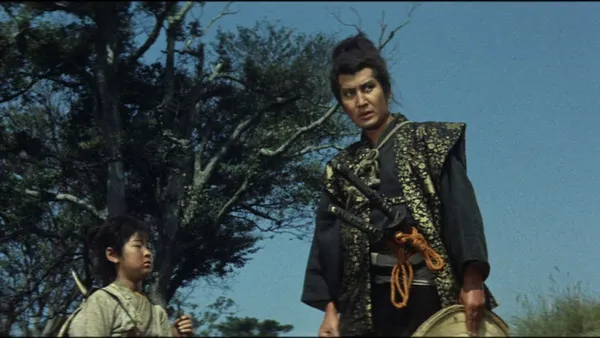

Often branded in the west as Zen And Sword, the five parts of Miyamoto Musashi can easily be seen as one film. The five parts - Miyamoto Musashi; Miyamoto Musashi II: Showdown At Hannyazaka Heights; Miyamoto Musashi III: Birth Of The Two Sword Style; Miyamoto Musashi IV: Duel At Ichijyo-Ji; and Miyamoto Musashi V: Duel At Ganryu Island - are an adaptation of the biography Miyamoto Musashi (aka Musashi) by Yoshikawa Eiji. They run into each other like chapters rather than exist as stand alone works.
The historical character of Miyamoto Musashi is important in Japan's reinvention of the Samurai. For the 250 years that followed the Battle of Sekigahara in 1600 CE, Japan remained free from war. This raised a question: what is the purpose of a warrior class in an age of peace? In truth most of the Samurai families would become the backbone of a very well armed civil service. Ten generations would work to keep the Hans running smoothly during the Edo period. The Daimyō would still need solders, elite guards and agents to enforce his will. With so few seeing much real combat, their martial traditions and skill were preserved in the warriors' mythologisation. Much of what we associate with the Samurai, their codes of honour, artistic perfection of technique, and Zen Buddhist outlook, came to the fore in the Edo period. Miyamoto Musashi work the Book Of Five Rings is important in the building of that mythology.
Zen And Sword starts with the aftermath of the Battle of Sekigahara. It is dark, wet; a muddy sludge covers everything, from abandoned weapons to corpses. Miyamoto Musashi (Nakamura Kinnosuke), at this point called Shinmen Takezō, comes across his badly wounded friend Honiden Matahachi (Kimura Isao). Takezō had roped his friend from his village into war with talk of heroism and adventure. It is Matahachi that has an arrow right through his leg. It is a common theme in this film that other people suffer the consequences of Musashi's actions. The pair are sheltered by two women, Okō (Kogure Michio) and her acquired daughter Akemi (Oka Satomi). The women have been surviving by looting the corpses of the fallen. Okō and Matahachi become romantically entangled, while Akemi falls for Musashi.
Bandits attack. Musashi kills most and then rides down their fleeing leader and beats him to death. While he is doing this the other three pack up and leave. Abandoned, he heads back to his old village. Obaba (Naniwa Chieko), Matahachi's mother, thinks he got her son killed. She wants revenge. Matahachi's betrothed, Otsu (Irie Wakaba), is in love with him. The authorities are hunting down everyone who was on the losing side at Sekigahara, and the Buddhist priest Takuan (Mikuni Rentarō) is set on redirecting his violent tenancies into something more spiritual. At the end of the first part of the saga, Musashi retreats into a temple library to spend the next three years contemplating Zen Buddhist writings.
Other than the concluding part, Miyamoto Musashi V: Duel At Ganryu Island, this this is the only time in ten hours of film that we get a distinctive ending.
When he emerges from the temple, renamed Miyamoto Musashi, he has decided to perfect the art of killing and become one with the sword. Throughout the rest of Zen And Sword, Musashi kills people and the violence begets violence. Sometimes it is to restore honour, sometimes it is straight up revenge. Obaba's desire for it is all-consuming. She can't contemplate her son not being dead, even when all the evidence points to him living with Okō. In the first two acts, much of Musashi's violence has the justification of women in peril. He massacres the bandits or plans to free his imprisoned sister. She was arrested and held as bait for him. We never see her on camera and he never gets round to busting her out.
Even before Miyamoto Musashi III: Birth Of The Two Sword Style, this changes. Musashi is no American action hero. He does not need a kidnapped daughter of murdered wife to justify violence. All he needs is becoming spiritually one with the sword. He kills to perfect the art of killing. When confronted with the consequences of his actions he always has a form of words that vindicate: the boy was being used as a weapon so killing him was okay. He is a philosophically justified serial killer.
It is clear that director Tomu Uchida is not fully comfortable with Miyamoto Musashi, man and myth. He shows us the consequences: the blinded man. He ends Musashi's spiritual journey with an uncomfortable satori. The sword is just a weapon, it has no soul, there is nothing mystical about killing.
Uchida's direction is distinctive, making great use of nature and landscape. The way that he uses mud and water in the wake of the Battle of Sekigahara and in the battle with the entire Yoshioka school in Miyamoto Musashi IV: Duel At Ichijyo-Ji should be seen by anyone who is even thinking of making a war movie. His handling of character is also commendable. He keeps Obaba on a knife edge between comic relief and tragedy. First you find her humorous and seconds later feel a little guilty about wanting to laugh. To top it off there is Adachi Reijirō's fight choreography in parts III and IV. He worked on the original 1963 13 Assassins.
Reviewed on: 05 Mar 2026


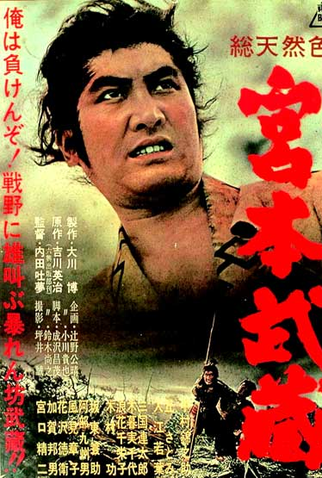
Director: Tomu Uchida
Writer: Masashige Narusawa, Naoyuki Suzuki, Eiji Yoshikawa
Starring: Kinnosuke Nakamura, Akiko Kazami, Wakaba Irie, Isao Kimura, Chieko Naniwa, Kusuo Abe, Rentarô Mikuni, Tokubei Hanazawa, Michiyo Kugure, Minosuke Bandô, Satomi Oka
Year: 1961
Runtime: 110 minutes
Country: Japan
Festivals:
Search database:
