




Eye For Film >> Movies >> Barbara Forever (2026) Film Review


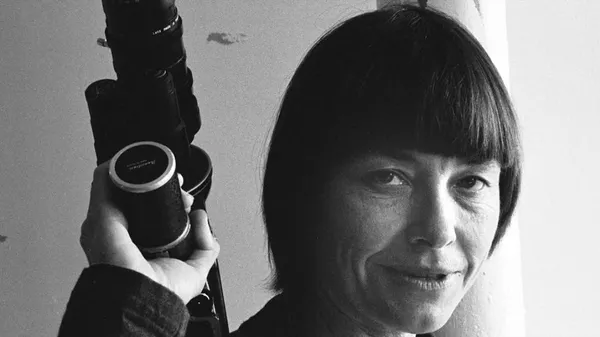

Brydie O’Connor follows up her documentary short Love, Barbara with Barbara Forever, her feature debut on Barbara Hammer, the American avant-garde director whose nearly 100 experimental films across five decades helped shape lesbian and queer cinema as we know it. Built from archival footage, excerpts from Hammer’s work, and Hammer’s own voice, the documentary is guided by her presence even as illness begins to mark and weaken it. Hammer died in 2019 from ovarian cancer, but O’Connor’s portrait is animated by her refusal to be spoken for. This is not simply an account of Hammer. It is a work that lets her keep narrating herself.
Its emotional and conceptual starting point is the period shortly before her death, when Hammer sold her archive to Yale’s Beinecke Rare Book & Manuscript Library. O’Connor understands the weight of that gesture. What does it mean to turn a life into an archive while still alive enough to feel the strangeness of it? What does it mean to persist not just in memory, but as holdings, catalogues, and artistic legacy? Hammer is entirely unembarrassed by the scale of the question. She wants to live forever, and she makes that wish concrete by bequeathing herself to posterity. The documentary follows, too, the labour of that afterlife through Hammer’s partner Florrie Burke, who continues the work of keeping her memory and influence in motion.
What emerges over the course of O’Connor’s feature is not a saintly monument but a vibrant, difficult, funny, and unsentimental person. Hammer does not narrate her life from the pedestal of belated institutional acceptance. If anything, she uses the moment to remind us how much resistance met her at every stage. She speaks about artistic awakening, about learning the word lesbian in her thirties and how transformative language could be, but also about exclusion from an art world that consistently privileged male avant-garde filmmakers. The documentary preserves her frustration with gatekeeping institutions, from museums to funding bodies, and recalls her account of being blacklisted by the National Endowment for the Arts. Even in a work shaped by tribute, Hammer remains sharp enough to indict the systems that only learned how to celebrate her after years of marginalising her.
That tension gives the portrait much of its force. O’Connor is not only documenting an extraordinary life, but asking what it means for queer artists to survive into history at all. Hammer herself puts it plainly when she asks who makes history and who gets left out: “old lesbians and old gay men, people of colour, transgender, bisexual, even asexual histories.” The point is not simply that these lives were underrepresented. It is that they were often denied the dignity of being recorded in the first place. In that sense, this is as much about historical repair as it is about remembrance.
That politics of visibility extends to the body itself. Hammer speaks about how much it bothered her that people would turn their heads away from nude bodies on screen, as though nakedness were the indecency rather than the fear and censorship surrounding it. Since her work is full of nudity, O’Connor does the right thing and refuses to tidy Barbara up for posterity. She does not flinch, cut away, or excise those bodies to make Hammer more palatable. In that sense, the documentary honours not only her life but her gaze. It also exposes how much many of us have been trained by puritanical ratings regimes and inherited prudery to experience nudity as automatically excessive. By simply staying with these images, the work makes that training visible and, to a degree, begins to undo it.
One of its quiet achievements is the way it offers something like queer wisdom without announcing it as such. Contemporary queer culture, for understandable reasons, often shines its brightest light on youth, becoming, and self-invention. There is less room for queer old age, for what it means to endure, to remain difficult, to continue changing, to look back without sanding off contradiction. Hammer offers precisely that. She appears here as an artist, a lesbian, a patient, a partner, a political irritant and a woman who never stopped insisting on her own visibility. There is grace in that, but also instruction. Barbara Forever reminds us that it is never too late to name oneself truthfully, and that words can alter a life more profoundly than force ever could.
There is also something moving in watching younger generations inherit what Hammer fought to make possible. O’Connor does not flatten her legacy into vague influence. She lets us feel both the distance travelled and the distance that remains. It is easier, perhaps, to imagine oneself as a queer artist now than it was in the worlds Hammer moved through. But this portrait is too clear-eyed to mistake progress for security. If it leaves one feeling grateful, it also leaves behind anger at how much brilliance had to fight so hard simply to exist in public.
As critics, we spend much of our time trying to explain what makes a work succeed or fail, what feels urgent and what feels secondhand. Barbara Forever certainly succeeds as a portrait, but what lingers most is its ability to widen one’s sense of film history itself. Hammer was not merely a neglected figure waiting to be rediscovered. She was central all along, and O’Connor’s real achievement is to make the omission feel less like oversight than indictment. The least this sends you back to is Hammer’s work. The more difficult thing it does is send you back to your own blind spots.
Reviewed on: 05 Mar 2026