 |
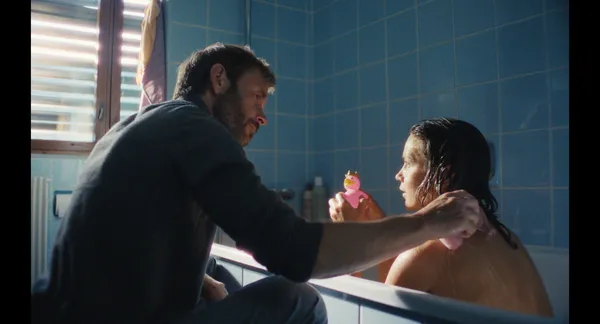
| Jan Gunnar Røise and Gina Jaqueline as Richard and Stella. Marlene Emilie Lyngstad: 'I attempt to deal with things that frighten me and things that make me sad, because this is a way of controlling my own fears' Photo: Thomas Dyrholm |
Catching up with Lyngstad at San Sebastian Film Festival, where Cute had its world premiere, she explained what drew her to such a tough topic.
“I think in my work in general, I attempt to deal with things that frighten me and things that make me sad, because this is a way of controlling my own fears. I think that trying to understand these things makes me tackle them better in life. This subject is very taboo but I think it is important to make a distinction between the action of abusing children and having an attraction to children, but never wanting to act upon that. For people who have this attraction, but also have a moral compass, this is, of course, a very hard life.
“I think the dilemma that it poses – that you are living with the shame that somehow is justified – I think that's a very interesting existential dilemma. How can you live with that shame, because you cannot eliminate that shame, in a sense.”
We see that embodied by Richard, who while visiting the doctor to pursue chemical castration is still obviously experiencing sexual feelings towards his stepdaughter, even if she is unaware of it. Røise’s commanding central performance conveys the thrill he feels, for example, as the little girl puts make-up on him to the viewer, without his character having to say anything. One of the film’s more disturbing aspects is just how normal a life Richard is leading, even as he is constantly struggling internally with his urges. Lyngstad conducted considerable research before the film, and says she wanted to show that often paedophiles are a long way from the lone monsters you might imagine.
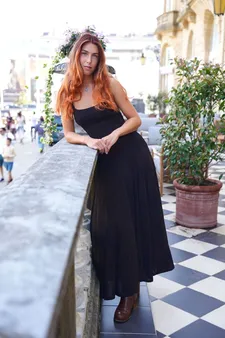 |
| Marlene Emilie Lyngstad in San Sebastian Photo: Courtesy of San Sebastian Film Festival/Samai Collado |
“That's, of course, the big dilemma for Richard. He's well spoken, he looks good, he has a good job. He functions on every level, but nobody really knows him so he can never have a real relationship with people because they will never know the authentic him, so he feels alienated from everyone.
“That's, of course, the opening with Stella – he gets the hope that she might accept him in a sense.”
Lyngstad says she was able to talk to the men after finding a webpage called “virtuous paedophiles”.
She explains: “It’s a community for men and women – although there are not that many women who are open about it, at least – where they connect and try to find a way to live with this shame. I wrote to them and they opened up and we had some conversations. They were anonymous in the beginning and then someone also wanted to meet me in real life because we had built the trust.
“What really interested me with these conversations was that they were very eager to actually talk about their lives. It was very obvious to me that they really wanted to confess and tell me about the moral dilemmas that they were in, and they wanted to hear my opinion on it because it's very rare that they talk to other people that are not themselves attracted to children. It meant a lot to them to talk to someone that didn't have this interest because they needed guidance in certain issues because they do live in an echo chamber inside this community.”
Lyngstad also notes the connection between childlike behaviour and certain entrenched pornographic tropes.
“In terms of the internet, the connection between eroticism and not real children, but childishness is actually very mainstream in the world of porn.” she says “It's very, very common to see grown-up people with bunches and acting very childishly and the babysitter is a very normal situation in porn films. So I was very interested in this because it is the biggest taboo we have, of course, with paedophilia but it's also a very, very common sexual fantasy with grown-up people pretending to be in this dynamic.”
She also talks about the “whole fascination for cuteness”, adding “In Japan you see this term ‘kawaii’ [which translates as ‘cute’ but is focused on a childlike innocence] that has taken over completely. You can buy cute objects, cute pencils, cute clothes, and it's very common for grown-up people to want to buy these sorts of objects. I was very interested in what kind of longing was behind this demand from the population – that a lot of older people have this kind of longing to regress to an easier stage of life, which is the child stage.”
The cuteness is present in the film from the start, as mass-produced socks with a childlike motif are seen being mass produced. Stella’s room, in particular, is packed with these sorts of objects, and is a notable achievement from production designer Sara Helene Tilgaard Rasmussen, who previously collaborated with Lyngstad on her short Norwegian Offspring.
She was a part of the project from the scriptwriting phase, says Lyngstad. “So she started collecting objects early on because this idea of ‘cuteness’ was the seed for the film. So she made a lookbook, where she wanted to like objects that had cuteness, but also grotesqueness. So, she wanted to find patinated textures and this fluffy cuteness in a more torn and worn way, where it gets a bit harsh. We talked a lot about this cuteness phenomenon in theory and tried to make that into the aesthetic of the film.”
The cute objects were, in fact, how Lyngstad first encountered her star Jaqueline, who would go on to take the central role of Stella. Now a social media influencer, she was previously an OnlyFans creator, who had experience of this sort of Lolita age-play work.
Lyngstad recalls: “I contacted her in the beginning because she was a collector of these ‘cute’ objects, so many of the objects in the film are hers. I wanted to know where that fascination came from and then I realised she had experience of the OnlyFans platform in her past. She was a consultant for this part, because I wanted to hear about her experience with customers. So she was a research subject in the beginning but then I realised she was more than that because she also had this amazing presence in front of the camera. So I invited her to a casting.
“It was very interesting because I think she had a much more black and white opinion about these men. It was hard for her to distinguish between the ones that would act [on their urges] and the ones that had doubts. I thought that was very interesting to have that view because she was reading the script through the whole process.”
All the scenes are reliant on context, so that the young actress who plays Richard’s stepdaughter is never in a scene that she wouldn’t have viewed as simple innocent play. However, the trickiest moment is when Stella almost tries to infect the youngster with her own eating disorder, instructing her on how to make herself sick.
Lyngstad says they got the emotion by changing the subject of the scene the first time around.
“It was about a grown-up that wanted her to cut her hair, but she didn't want to cut her hair. So, it was the same scene, but it was not about eating and that stuff, and it was also very important that when we went on to take it to ‘If you eat chocolate, you get big’ we kept it in this fairy tale language, so she never says, ‘You will get fat’. It's like you will wake up tomorrow and be super big and that's absurd. So she didn't make that connection in a sense. I also know that her parents had a conversation with her afterwards that some grown people have an illness where they don't see the difference in their body and they think they are very big when they are actually very small. We tried to make the scene as absurd as possible so that it would be just like a game for her to do it.”
On the collaboration in general she adds: “It was 50% about casting the child and 50% about casting the parents. We had the parents in from early on in the casting and they read the whole script and we went through it, and they were collaborators through the whole process.
“They also saw the film in the editing room so that they felt that they had an understanding of the whole context of the film.”
Lyngstad has just become a mum this year herself and the director says the preparation for and experience of that did affect her as she was making the project “in two different ways”.
She adds: “In one very translated way, this project with the character of Stella – a grown-up who wants to be a child, who understands that she might need to grow up – is also what you think about when you become a mother.
“And I started to make this film when I was 26, now, I'm 29, so it's like, you go from being young to a bit more mature in this process. So, of course, that was a big part of the whole writing process. Then, of course, the responsibility for a child and how extremely vulnerable this period is of your life was very evident for me. How can we as grown-ups make sure that childhood is protected because we can clearly see that you carry it in your grown-up life.”