




 |
| Death Of A Yellow Bird |
The story of a terminally ill man who retreats to his childhood home in the woods to come to terms with his lack of a future, only to be drawn into a mystery by the ghosts of his past, Death Of A Yellow Bird is an incredibly personal piece of work and it’s this that give it a lot of its power. I feel that it’s respectful to discuss this as honestly as possible, so when I meet with star Ari Millen, director Cody Calahan, producer Chad Archibald and producer/cinematographer Jeff Maher, shortly before their première at Fantastic Fest, I explain that I spent several years of my life caring for someone with a potentially fatal illness, and now live with one myself. What stands out to me about the film is how well it captures the different perspective on life that such experiences create, something rarely encountered in cinema.
“I had it easy because I was living it, says Ari, then apologises. “Yeah, but that's not meant to be a joke.”
I assure him that I understand.
“I mean, this could have been it,” he continues. “This could have been the last thing that we did. So it was very much important and we poured ourselves into it, as if it were the last thing. But, you know, we've all had 20-plus year careers so far, and so we're passionate about this. And this was certainly, for me, my first experience with going all in, surrendering completely to a project and trusting the people around me to pick up the slack where I couldn't contribute or where I didn't know what to do. I could rely on these other three to very much carry my baggage for me.”
“There was only three of us on set,” Cody explains. “It started when I was going to Ari's chemo sessions and were just talking about our past and we started talking about the ideas for this movie. At first I bought two cameras because I thought I was going to just shoot it – it was just going to be me and him. Then we realised quickly that in order to achieve what we want to achieve, we wanted to bring in Jeff, because I've been making movies with Jeff forever. He knows everything about me. He knows all my insecurities, all the other things that people don't know. And the same with Jeff and Ari – they have that relationship, and we all have that relationship with Chad as well.
“So everybody on it already didn't have anything to hide. We could all just be ourselves. And as kind of crazy as any of the pitches I had for what the film was going to be, I never had anything but support from them. I think that was important, too, going into telling such a personal story for me and a personal story for Ari also, that we treated the subject matter with a lot of respect, so it was important that we figured out a way to make a horror film that could also be cathartic at the end, because it felt like our mission to to try and sort of heal, in a way.”
“I remember one of the things that Cody had sent to me near the start was just that,” says Chad. “The reason why this whole movie came together, you know – obviously the main reason is what Ari was going through, the love that Cody and Ari had for each other and the fact that they always wanted to do something like this, and if it was ever going to happen, it needed to happen now. I remember Cody asking me about it, and I remember him saying that we don't even know if this movie's ever going to get done. You know, this is about the process. ‘This is about the journey, and this is about the experience that Cody and I are going through.’
“We had just come off a movie where we had 60 people on set and all the bells and whistles, and going into something like this where truly the most important thing was creating a space that Ari felt comfortable – again, not to make the best movie in the world, but to go through the experience that Cody and Ari had always wanted to go through together since they were kids. You know, their journey started with the two of them creating movies in the backyard as children, with a VHS camera. So that was something that right from the beginning was such a powerful concept to wrap a movie around. And it's so rare to ever see a film where an actor is so closely going through what the character is that, you know, it. It felt special for the start.”
Ari says that it helped him to be able to explore some of the issues in the film through a different person and that different person’s experience.
“Picking up on what they were with, Cody and Chad were just saying, we're at that age now where we are now experiencing mortality in a real way. I joked that I had a compressed midlife crisis in the sense that everything just sort of happened to me. All these major life events happened to me at once. But, you know, everybody [here], we've all dealt with loss in some way.
“Now that we're getting to the second half of our lives, and to Cody's point about everybody knowing each other's insecurities, I think that what made this so special is that because it was such a pared down crew, we could actively be extremely experiencing those insecurities in real time, but then articulate that to each other and work through it in real time as we were shooting it. And that lends itself to the final product. The brain sometimes only lets you process certain things at certain times. There's no way the doctors didn't tell me certain things, but I didn't hear them until after I woke up after surgery. Throughout having my follow up appointments, everybody else here knew the reality that I didn't know.
“Cody told me during the editing process, but certainly not during filming, his intention for writing this. He told me it was deeply personal. I credit him and these guys in this film with helping me get through it. I don't think I would have without this film. So there was absolutely a catharsis for me to be able to play this role with some of the closest people to me in my life.”
I ask Jeff about the visual language of the film.
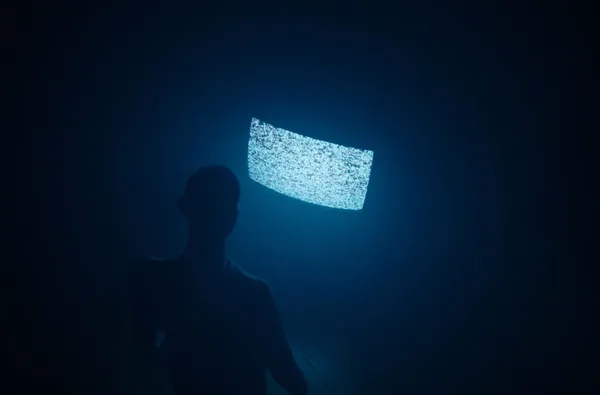
“I was shooting all of the winter stuff, so we really got into this cold, bluish aesthetic. It's almost like a dream,” he says. “Everything feels like an echo. And then the cinematographer who shot Undertone, Graham [Beasley], came on to shoot the summer portion. I wasn't there for that, so I thought that was really cool because he came in and had his own interpretation of that portion of the film.
“I think we also did some cool things with lenses. We shot anamorphic. Cody had this idea to take an anamorphic lens, but with it sitting right, you can squish the film and give it this kind of interesting look. Sort of our interpretation of a memory, again this kind of dream logic.”
I say that I’m interested in the use of VHS in the film, and the way that its materiality lends itself to its use as a medium through which Ari’s character can communicate with ghosts.
“Originally in the script, it was a cassette recorder that he was going to use,” says Cody. “Then the people who had bought my childhood home that me and Ari grew up in, they called me, and they had actually found a VHS camera, our old camera, in the shed. And so once that became part of it and I started weaving that device through the movie, it changed everything. I kind of always felt that if there were ghosts that were going to communicate, it would be through something analogue. There's something about that that felt more realistic to me, because that was always a thing with this movie: as unrealistic as ghost stories can be, I was trying to make something as grounded as possible.”
Looking ahead to the première, which has now taken place, he shared a final thought.
“I think it's going to be hard to show something so honest, but I think it's as hard as it's going to be, it's really important. So I think it's going to beautiful.”