




 |
| Welcome To Tool Shed |
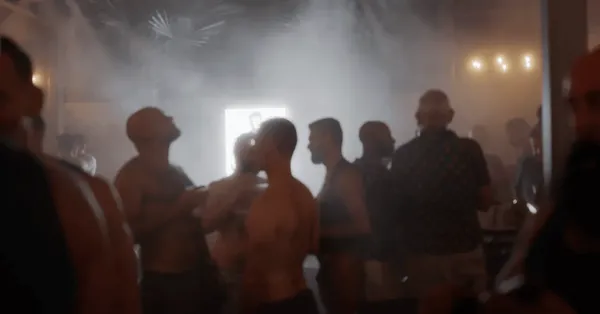
Daniel Talbott and Andrew Klaus-Vineyard's LGBTQ+ short documentary Welcome To Tool Shed, explores how the leather bar, has become a sanctuary for the queer community in Palm Springs. The film gives a voice to those queer senior citizens that survived the AIDS epidemic, who never expected to be able to pass on their wisdom or queer history to the younger generation. With growing hostility towards the queer community in Donald Trump's America, the documentary takes on a prescient political agenda.
Talbott has previously directed the feature film, Midday Black Midnight Blue, about a man continuing to grieve the loss of a woman he loved decades after her death. He has also directed the short films Light and My Age Now, both stories that follow gay young men struggling with their sexuality. Klaus-Vineyard's previous credits include the short films Unknown At Large and This House is Not a Home. He has a number of other short films at various stages of production.
In conversation with Eye For Film, Talbott and Klaus-Vineyard discussed cinema's spiritual side, the project's personal roots, the human versus the political, and the queer experience.
The following has been edited for length and clarity.
Paul Risker: How would you describe your relationship to cinema?
Daniel Talbott: The true answer is, and I hate it when people say stuff like this, but along with my family and my close friends, it is my life. I'm obsessed with it. I go to sleep thinking about it and I wake up thinking about it. And if Andrew and I had $2, we’d make a film [laughs].
Theatre, TV and film really saved my life as a kid. They gave me my first real home. So, whenever I'm feeling shitty, I'm scared or vulnerable, if I step into a theatre anywhere in the world and I smell that popcorn, it's like I'm home. I've always had that sense and so it means a lot to me.
Andrew Klaus-Vineyard: I've always said that going to the movies was my church. I grew up in a really small town. I was an avid reader; I was into visual art, music, theatre and film, in a place where that wasn't prevalent, and so, the arts were my lifeline. And it's what I've done my entire life since. I wake up thinking about film. I go to bed thinking about film and I even listen to film podcasts in my sleep with headphones.
PR: Some share a kinship with art, especially those that feel like outsiders or have been bullied. However, such enthusiasm can be subject to ridicule.
AKV: A lot of filmmakers talk about film being spiritual. Kenneth Anger talked about how his films weren't films. Instead, they were rituals captured on film, or they were spells unto themselves. For some of us, there's something about that 24-frame flicker that just speaks to our soul.
DT: I grew up in a rural working-class place. For me and my first really big love, it gave us permission to think that we were okay, and that we were not the only folks out there that liked boy-on-boy action.
I remember seeing Beautiful Thing, which we just showed at our cinema series event. I'm such a massive fan of Jonathan Harvey, the play and the film, and it was the first time my guy kissed me in public. We were in San Francisco when we went to see it, and I just remember him kissing me in the street afterwards. It was such a huge moment in my life and that film gave us permission.
I feel like I have learned so much more about characters, culture and humanity from watching a film like Sirāt, for example. I love globetrotting with film, and it's really important to me.
AKV: Growing up in the rural south, Gregg Araki is where I saw other queer punk kids. Those were my peers, not the people that were actually around me.
PR: Do you think that filmmakers are inherently interested in human nature? Is curiosity an important aspect of the creative persona?
DT: That's what the filmmakers I love do best. Sadly, and I'm only going to speak for the US, but there are some folks out there that are not doing it – they're doing it for other reasons like fame and Porsches. Those are not the filmmakers I love and gravitate towards. The ones that I am blown away by look through a very singular lens that's searching for community. While they're always looking through this beautiful and singular lens, they're looking outside themselves to the world in a singular way. And there are so many incredible filmmakers working right now that do that, and they constantly blow me away.
AKV: I'm loathe to quote Picasso's famous line about telling a lie to tell the truth, but that's what art is.
The filmmakers that I gravitate towards, there's a sense of empathy and effort to understand, even in genre films — I'm a genre nerd and I love horror. I grew up on Clive Barker, so there was the idea that normies were the monsters and the monsters were just people who wanted to be left alone and understood. For a queer kid, Nightbreed is a weirdly subliminal text for a lot of horror nerds, because you're out there looking for your community. And that's part of what going to the movies is — it is a community or it should be. That's something we do with our curation series. We try to create a community for queer filmmakers and film fans, because we miss going out and talking after a movie, and so, we created a space where that can happen.
PR: What was the genesis of Welcome to Tool Shed, and what compels you to tell this story now?
DT: The film started because of Larry Kramer, who was someone I loved very much and considered a close friend. He died during the pandemic. When I met people who knew him in Los Angeles, they kept talking about this bar called the Tool Shed.
My grandmother lives in Palm Springs and so, the next time I went out there, I went to find this bar because it was such an important place in Larry's friends' lives. They were these incredible ACT UP and queer activists, novelists, writers, and essayists. And I'm not part of the leather scene, but when I found this bar, I just fell in love with it.
I love the people and what I found was most of them were those survivors that had lost everyone to AIDS. So, the bar was like this window into people that had lost everything. How do you survive that, and how do you still make a new life and family? That was the genesis of the film.
AKV: I actually remember sitting on the patio of the bar at the Christmas party we were down there for when Daniel said, "We should make a documentary about this place." I agreed, and then I forgot about it for a couple of weeks. And then I remember sitting in Little Dom's and Daniel asked me, "So, are we gonna make this movie?" I was like, "Okay" and we've been off and running ever since.
PR: You give a voice to people, who, as you say, have a perspective to share.
AKV: We have our first generation of openly queer senior citizens and, because of the HIV/AIDS years, a lot of them didn't think they would ever live to be senior citizens. And as they always have, they're laying the groundwork for the rest of us.
Queer aging is a subject that has a lot of issues, because openly queer relationships have only been in the mainstream for a short window of time. Something that comes up in the documentary, and it came up in every conversation we had was the fear that the younger generation aren't listening. They don't realise the dangerous times we are living in, or how recent some of our freedoms are. For example, marriage equality is 11-years-old in America. So, it's important to get that perspective from those that have institutional knowledge. And I hate to say 'educate', but it is about educating those coming after us.
PR: The idea of one generation passing the torch to another is a familiar narrative, as is the inherent friction between the generations.
DT: Every culture passes on its wisdom and its history. And it's wonderful to have openly queer people that can pass on our history because, previously, it had to be done quietly, in back rooms, in whispers and in these wonderfully made-up languages. But now, we can go have lunch with these amazing queer guys in Palm Springs, and they tell us stories. It's like, yeah, we've been around a long time, and we're going to be around forever. And this film is just a physical reminder of that, and a powerful one.
AKV: It' a privilege and an honour to get to share their stories with everyone. We're such a youth-obsessed culture, and it's a nice reminder that these people didn't just survive, they were vibrant and thriving in their later years — they were still sexual, and they were still out there building a community. And it reminds me of how as queer people we so often have to build our chosen families. It's improving, but we don't always have that guaranteed family structure. So, to hear these stories and see a community that really shows up for and takes care of each other, that is someone's family.
The moment the bar opens, it becomes like a community centre for the queer community. They always say the dance floor is the church, and I would say the rest of the bar is like the church's multipurpose room.
PR: The documentary starts out as a look back at this bar's story, that then brings in bigger issues such as the AIDS epidemic and the Trump Administration. The film becomes richly layered with themes, some of which you've already identified. The impression I had of Welcome to Tool Shed is the way it opens itself up to a broader conversation.
AKV: We evolved in the edit as it became clearer how slippery things were getting in the US and how quickly things were falling apart and being dismantled around us. So, it became even more political than it was in its inherent nature, because it felt so urgent. It felt like we needed this film, and we also wanted to make a film about right now and to share it right now. You think of the old John Waters films where he would hear a news story, and they'd shoot the film before the six o'clock news could air the story. It felt like that's what we were doing. We had to get it out there because it felt so urgent.
DT: Queerness is political; there's no way around it. But our focus was always on the people first and foremost. Our plan was to do a short version that was about the politics so we could respond in real time to what's happening in the US. And what's interesting is, we've had a lot of backlash about that because the Trump administration is cutting so much funding for queer arts organisations, nonprofits, and film festivals. We've had two major queer film festivals go down in the US this year alone: Seattle and aGLIFF, which is in Austin, Texas.
I've gotten private notes from friends that are programmers saying, "I love this film, but we can't program this. We can't have this out there right now because we're already in such trouble financially." It's interesting that we did the political route for the short, but we'd love to go back if we can, with all the other crazy projects we're trying to make and do a feature version of this that leaves out all the news and really is about the people, because that's what we started with.
With digital, we can work quickly and comment faster than we used to be able to. I'm really proud that we made a political short doc that isn't smart or sophisticated and really is on the nose. I wanted to say what's happening in the characters' own words and in their own time. And Andrew wanted the same thing.
The response has been interesting. There are people that say it's too political, but I think we need to be louder now more than ever before and not shy away from having that conversation, because it is happening. And they're doing a great job at rolling our shit back in the US — they're trying to, and they want to. So, you have to say it.
AKV: I think the film for me is both a love letter and an alarm call. And we try to amplify the alarm.
Welcome to Tool Shed premièred at the 2026 Cannes Film Festival and has since played at Palm Springs International ShortFest.