




 |
| The Lorraine Photo: Tribeca Festival |
On April 4, 1968, Martin Luther King Jr was assassinated outside Room 306 of the Lorraine Motel, in Memphis, Tennessee. For many, the Lorraine is synonymous with this traumatic event, burying beneath it a richer history. Now, documentarian Sam Pollard’s The Lorraine, written and executive produced by Alvin Hall, sets out to reclaim the motel’s story through the voices of those who lived in it.
Pollard and Hall celebrate the entrepreneurship of Walter and Loree Bailey, the original proprietors of the Lorraine, who were able to turn their dream into a reality. Listed in The Green Book, the Lorraine was a safe haven for Black travellers during the Jim Crow era, and its guests included civil rights leaders and among its countless musical artists, the 'Queen of Soul' Aretha Franklin.
Pollard has collaborated with Spike Lee, producing When The Levees Broke and 4 Little Girls. His documentary MLK/FBI used newly declassified files to reveal the FBI’s aggressive surveillance campaign against the Civil Rights leader. Pollard also directed the documentary Citizen Ashe, about the three-time grand-slam tennis champion Arthur Ashe, who was the first Black man to win the Wimbledon title. His other credits include documentaries on legendary percussionist and activist Max Roach, Sammy Davies, Jr., and the first Black mayor of Atlanta, Maynard Jackson Jr. Hall previously executive produced the short film, Driving The Green Book.
In conversation with Eye For Film, Pollard and Hall discussed the motel’s rich history, pulling out those small human moments and bringing together memories of drama, pain, and laughter. They also spoke about transforming trauma, and the enduring legacy of the Lorraine.
Paul Risker: What sparked your interest in this project and led you to decide to tell this story now?
Alvin Hall: Back in 2015, the BBC commissioned me to do a program called The Green Book, and during the production we stopped at the Lorraine Motel, Memphis, Tennessee. I met Carolyn Bailey Champion, and she told me the story about her mother's death. Then, in 2019, I did a road trip from Detroit to New Orleans, to do a podcast called Driving The Green Book, and again I stopped at the Lorraine Motel.
I met Dr. Noelle Trent, and she not only told us the story about the death of Carolyn Bailey Champion, but also the songs that had been written at the Lorraine Motel. And from that conversation, I realised it was so much more than the one moment of April 4, 1968. So, I decided to start to do some research, and that's what led us to create this film.
Sam Pollard: Four years ago, Alvin and executive producer, Joe Wemple, came to a screening of my documentary [The Drum Also Waltzes] about the legendary percussionist and activist Max Roach. We started a conversation, and they reached out to me to see whether I wanted to come on as a director, and I had no hesitation.
Alvin was a wealth of knowledge. He sent me a bunch of different books about the period of segregation, a Green Book, and information on what it was like for Black people and the Lorraine Motel. So, we were off to the races, and I have to say that Alvin Hall was dedicated, dedicated, dedicated to making this documentary happen, as a writer, researcher, executive producer, and as a guy who found the money.
PR: I’ve heard that a documentary from the conception to securing distribution, can take upwards of five years. The reality of the filmmaking process must at times be an exhausting grind.
SP: I came onto the project about two and a half years ago and, for me, this is pretty fast in terms of turnaround. I know Alvin’s probably dealt with it for a longer period of time, and so, I'm going to let him pick it up from there.
AH: For me, it actually started when I was doing the podcast because that gave me a rich knowledge. Then I went to the Schomburg Center for Research in Black Culture, and it became a passion project for me. And one of my characteristics is that I don't let things frustrate me. I focus on the future and all those possibilities. So, this was a creative endeavour to apply my creativity and to try to give Sam what he needed to be able to do the film, by continuing to research and raise the money.
I'm pretty disciplined, so I just kept things in their little slots, and I'd work on each one a little every day and none of the bad things would accumulate. I used to always say when raising money and people would say “no”, I was in the same position I was before I asked them. I just kept going forward.
PR: If the identity of the Lorraine Motel has been reduced to this one single event, your documentary offers a friendly gesture, peeling back its rich history by listening to the stories shared by your cast of interviewees.
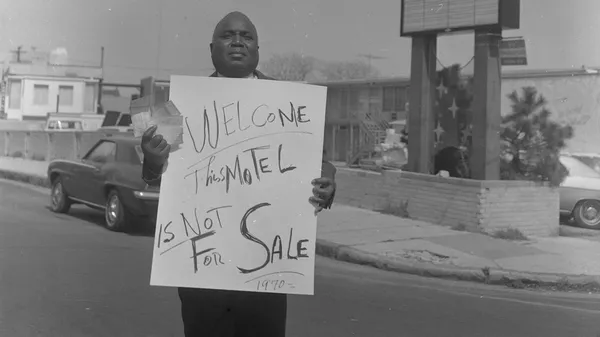
SP: Well, when people think of the Lorraine Motel, the first thing that comes to mind is April 4th, 1968, the day Dr. King was assassinated. Now, when Alvin did his research and he presented it to me and the other members of the team, what we learned was there was a rich history from the Thirties, through the Forties and Fifties, up until Dr. King's assassination. After the assassination, the motel loses its glitter, but another man, D’Army Bailey, comes along with a group of collaborators and decides he wants to turn the Lorraine Motel into the National Civil Rights Museum. And he was going to do it by hook or by crook.
He was able to raise the money to buy the motel, and he was able to find people to help him build that museum, which stands today. So, that's what became fascinating about telling the story. That one moment that most people know about when you say “Lorraine”, had a richer and more complicated history before and after Dr. King's assassination. It was also about two wonderful people who had a dream and made it happen. And the wonderful thing about making documentaries is that you have an opportunity to pull back the layers; to really dig into a story, so it doesn't become about one moment.
AH: Everything Sam said was just perfect. I was sitting here thinking, it's exactly what I think and what I feel. We had the opportunity, through the immense amount of research, to find out so much about the Baileys, the life they created there and the many things they tried to do. What we had to find was the way through the whole story and Sam is brilliant at selecting the parts to emphasise in the film. And that's what we really worked hard toward, because we didn't want it to be about this one day. We wanted it to be about the whole history of the place, both before and after the assassination. This was so people could understand the resilience at the front end, but also the resilience that the people of Memphis had after the assassination to save the building from demolition, turning it into the National Civil Rights Museum. Sam found the right story.
SP: The other thing that's always important in making a documentary like this is making sure you find a bunch of interviewees and contributors who can help give you the story on these different levels. Alvin was extremely important at being able to point us to Dr. Noelle Trent, Deanie Parker, Adrienne Bailey, the widow of the D’Army Bailey, Jesse Turner Jr., Eddie Floyd and Carla Thomas. All these people brought different shades and textures to the telling of the story. And that's what you look for when you're making a documentary: people who can give you drama, pain and laughter. That’s what our interviewees and contributors gave us.
AH: We forget how vivid the Lorraine remains for these people. In every interview, they had some of the most amazing memories about this place. So, it was central not only to their lives, but also to something deep inside of them — their identity, their profession, their ambition. The Baileys represented something to them and these memories remain. We were lucky to capture those memories and those stories at this time.
PR: The success of the film is picking out those small human moments, like how the swimming pool became an oasis for the Black community, or the menu preferences of the celebrity guests. One should never underestimate how the small moments in life matter.
AH: The full breadth of the experience, whether it was Aretha Franklin coming there for catfish or Maurice White who lived down the street and went swimming in that pool, those are the moments that people remember. Or Mary Ellen Ford on the night before King was assassinated, bringing burgers to all of them as they sat in the room. Those are the little things that show the texture, how people live, and what they like. People can identify with those everyday moments, and that’s what makes the film really incredible and touching.
PR: I’m particularly interested in how people come to define the space they occupy, which is the crux of the documentary. I can’t help but think, however, that the spatial retains some autonomy, and as much as people can tell its story, so too can it tell theirs.
SP: Well, that's what makes the film interesting, is you're in a space where you bring all these different people, all these different perspectives, all these different feelings, and it helps you shape this powerful and very important narrative. It looks like a place that, as I said at the very beginning of this conversation, when you say Lorraine, most people, particularly in the Black community, all remember April 4, 1968.
What our job was to do was to make you understand that before April 4, 1968, there was this rich legacy that was being passed down by Walter and Loree Bailey. Then after the assassination of Dr. King, there's another legacy in the National Civil Rights Museum.
We interviewed Justin Pearson, a young State Representative who wasn't around when King was assassinated. He understands the legacy and the importance of the Lorraine and The National Civil Rights Museum. And that's what we want to accomplish: understand the past, understand what happened on April 4, and understand where we are today at the National Civil Rights Museum, which was once the Lorraine Motel.
AH: Justin Pearson ends the film. He says, "We have something here. It's a beacon; it’s a light.” That simple phrase will make viewers think about the Lorraine Motel, I think, in a much more inspirational way. Yes, it was the place of trauma in American history. Yes, we lost somebody who was going to lead us to something better. But the new generation of people like Justin Pearson will embrace that message in a different way and lead us to a different type of life, perhaps. Still, it’s about transforming trauma into life, trauma into inspiration, and I think that's what this film will help people to feel and see.
The Lorraine premiered in the Spotlight Documentary section of the 2026 Tribeca Film Festival.