 |
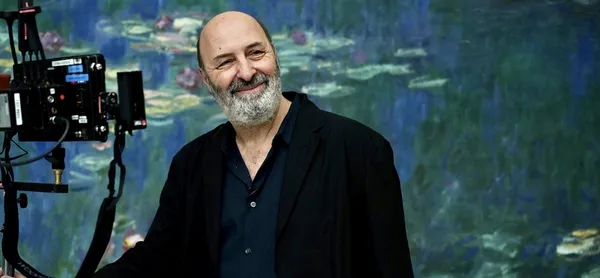
| Cédric Klapisch: 'I guess it is impressive when you look back and discover that nine million people have paid to see my films around the world, outside France' Photo: UniFrance |
The signs started with his inclusion last year in the Cannes Film Festival’s official selection, albeit out of competition, with Colours Of Time (and the reason for our encounter in Paris), then earlier this year he received at the Ministry of Culture UniFrance’s French Cinema Award, paying tribute in the words of the citation “to a leading French personality who has made a significant contribution to promoting French cinema around the world”.
Klapisch, with a twinkle in his eyes, defiantly hopes he has not become part of the “establishment”. He continued: “I’m not complaining about the prize and the emergence of a certain acceptance. I’m glad my films in the main have proved popular and have travelled well around the world and audiences actually enjoy them. I guess it is impressive when you look back and discover that nine million people have paid to see my films around the world, outside France. Having said that I still feel I want to remain on the edge.”
He admits that he has now reached a certain comfort zone. “When you make one film after the other you don’t really have time to take stock. I’ve now made 15 films and that’s not counting various TV excursions, such as Call My Agent and Salade grecque, but I didn’t realise I was creating this whole ‘thing’. Maybe at the start I was not taken seriously because I tended towards comedy rather drama but there was always something serious behind the comedy.”
In Colours Of Time (La Venue de l’avenir) Klapisch takes on an ambitious challenge flipping between past and present as four cousins inherit an abandoned house in Normandy. They follow the traces left by their ancestor Adèle resulting in a meandering journey through 19th century Paris and the unraveling of family secrets.
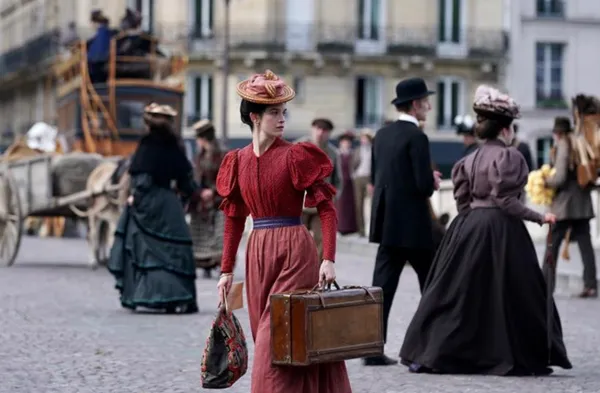 |
| Suzanne Lindon in Colours Of Time 'She has this mix of strength and fragility, which is a rare combination and really what I was looking for in the character' Photo: UniFrance |
The director who had never made a period drama previously, became mesmerised by the process. “Pierre-Yves Gayraud was in charge of costumes and Marie Cheminal was in charge of set design. Diving into the aesthetics was amazing but it required a large team and a lot of patience. I’d never worked this way before; working as you go along with a certain spontaneity. It was a pain-staking but rewarding process, which is ultimately the charm of the film.
“I’m a Parisian with loads of books about its history and recreating period Paris was one of the attractions as well as the contrasts between the two periods. Then people were discovering things like photography and cinematography and they thought that painters would disappear. So we are at very similar period of creativity where we know a lot of things are going to change but we don’t exactly know how and what.”
Klapisch worked on the script with long-time collaborator, the celebrated novelist Santiago Amigorena. They grew up together, went to the same school in the up-scale neighbourhood of Neuilly-our-Seine, and later shared family holidays. “We started off writing it together with only the vague idea that I wanted to do a period film. After three days of work we both decided that it would be more interesting to switch from one period to another – and it was also far more audacious. I think the end result proves that the film is more interesting. What we had to work out was how the two periods would mesh together without being too abrupt,” said Klapisch.
“As for working with Santiago, we have know each other since schooldays and we don’t even think of the process. It’s very easy because we know each other well enough to say if we think the other’s contribution is lousy! It may look from the outside like a strange combination but it appears to work. And we’re collaborating now on a new film that’s set in the world of TV series.”
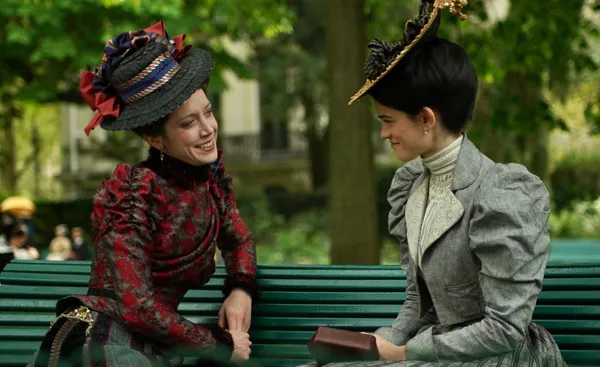 |
| Sara Giradeau and Suzanne Lindon in Colours Of Time Photo: UniFrance |
Klapisch credits his early years in New York as opening him up to the international appeal of film-making. He obtained a Master of Fine Arts degree at New York University, wrote his thesis on Woody Allen, and directed several short films before returning to France. On the home front he’s married to fellow filmmaker Lola Doillon with whom he has a teenage son Emile. The pair met on the set of one of Klapisch’s greatest hits Pot Luck (L’Auberge espanole) and have been together ever since. Pot Luck became an iconic film for Erasmus students and was followed by two sequels Russian Dolls and Chinese Puzzle as well as a TV series Salade grecque. In the early 1990s he created a cult coming-of-age hit with Le Péril Jeune (Good Old Daze) in which he discovered Romain Duris, one of his favourite actors.
He has resisted the idea of directing an upcoming film of the Netflix series Call My Agent (Dix Pour Cent) for which he masterminded the first two seasons. “Sometimes that can work, but I said No, because I think you can push an idea too far and it becomes just a way of milking the money”, confirmed the perpetual outsider.
Colours Of Time is released by Studiocanal in UK and Ireland release from 17 April. It is released in Argentina release from 11 June