 |
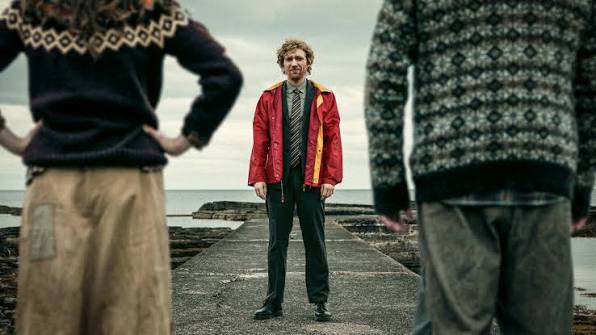
| The Incomer. Louis Paxton on shooting in northern Scotland: 'To be honest, it was always windy but I chose to shoot up there because the locations gave us so much' Photo: Courtesy of Sundance Institute |
The Incomer is also set on a Scottish island, though this one is small and unnamed and has a population of two. Thirtysomething Isla (Gayle Rankin) and her slightly younger brother Sandy (Grant O’Rourke), thanks to the death of their parents while they were young, exist in a sort of arrested development, with a deep distrust of the outside world a daily life that revolves around their own lore. This attitude does not bode well for local council worker Daniel (Domnhall Gleeson), who has reluctantly headed to the island to evict them. But soon Daniel – who has a different sort of loneliness to the siblings – begins to form a friendship with the pair, as their way of life again comes under threat from less sympathetic outsiders.
Paxton says he had a fascination with islands as a child and was a frequent visitor to Orkney, with the myths from there feeding into the film. Among the traditional stories that is drawn on for the film, is that of the Finfolk – water-dwelling shapeshifters who are known to deceive and kidnap humans. In The Incomer, Isla frequently talks to a Fin Man (John Hannah, in impressive seal-like make-up), who repeatedly tries to tempt her to get into the water.
Paxton explains: “I've been going to the Orkney Isles since I was very young. My mum's family are from up there, and she now lives there. So we spent lots of summers up in Orkney, exploring the Neolithic dig sites and half-sunken shipwrecks and just sort of hanging about and beaches and enjoying ourselves. It was a lovely time.
“I grew up reading local folktales and stories. As I got older I became more interested, and I started reading folklore from around the world. But I realised that Finfolk were quite specific to the north of Scotland and, to some extent, Scandinavia but there's versions of them all over the UK. Cornwall has a kind of ghoul that will drag you to your death. And, in a way, they're sort of like selkies or other kinds of aquatic creatures, which were, I guess, a warning against going anywhere near the sea, trying to explain why so many sailors died.
“The romanticism of that and the mystery and the history kind of baked in with the actual lives that these people lived on islands that were once inhabited was all incredibly interesting to me and that's where the idea came from.”
Scots star Hannah, 63, certainly proved to be incredibly game, given that all his scenes were shot on location, with him up to his neck in the chilly waters of northern Scotland.
Paxton recalls: “We asked him, hoping that there was an outside chance he would do it, but kind of feeling like he’s not going to be up for this, but he just loved the script and he loved the character. I met him and tried to find ways to say to him, ‘Are you sure you're okay with being in the actual sea because we don't really have the budget to put you in a tank? We can't shoot a blue screen or whatever’.
“We had to do it practically and he was like, ‘I'm up for it’. Thankfully he's really fit. He cycles a lot. He had to do quite a lot of work. He was in the North Sea, which is freezing. He had a wetsuit on but if you’re sitting and not moving around, you still get cold very quickly and he was in this kind of inlet where there was a lot of surge and we had these kinds of anchors that he could hold on to. So he's in the water in a wetsuit in full make-up and holding on to these weights – it was sort of nerve-wracking watching him, but he's an incredible actor. He's really experienced, but he was just so lovely to work with and so chill and never complained once. Honestly, it was a dream to work with him.The only sad thing was it was only two days that we had to shoot all of his material.
“Those were some of the hardest scenes to shoot partly because the tide dictated when we could shoot there as well. There was just always a ticking clock and if the conditions weren't quite right then we had to scrap it and start again another day. But thankfully we got it all.”
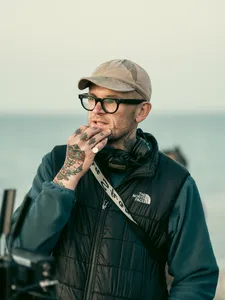 |
| Louis Paxton Photo: Courtesy of Sundance Institute |
“We had an amazing sound recordist, Colin Gregory,” says Paxton. “I’d talked about this up front. I was really concerned that I'd seen a lot of films shot near the sea, particularly, where you could tell, they'd had to use ADR quite a lot to replace the dialogue and that is, you know a tool that's widely used and really effective. I find, in comedies particularly, it can slightly kill the immediacy of the dialogue and the delivery. So we discussed early on that, and actually there's very minimal ADR in this. That’s as a result of the amazing sound that he recorded using really clever techniques and staging things in a way so we were never in the full brunt.
“To be honest, it was always windy but I chose to shoot up there because the locations gave us so much. I was really pleased in the end that we were able to keep the vast majority of the actual location performances.”
Another unusual element of The Incomer is the use of animation to illustrate some of Isla’s stories. That was done by veteran Scots animator Selina Wagner (Spindrift), who also often draws on folklore for her work.
Paxton says: “I knew that I wanted these sequences to be animated and I wasn't quite sure how. As it went on, I started looking at Scottish animators because I have no experience of animation – it's a real skill and a real art in and of itself. As soon as I started looking at animators, I found Selena's work and immediately felt like she’d been influenced by many of the same things I was. Then I found out she has a history up in those islands.”
Wagner grew up on Orkney, so her shared ideas about folklore proved a great fit for Paxton. He adds: “What I loved about her work was the texture of it and there was something childlike but also a real darkness to it and an edge and a sort of mysticism.
“She explained to me the different versions of what she could do. There's the version that takes a year to produce and then there's a version that takes less, but uses to some extent, generated imagery along with hand drawn imagery. Obviously I was drawn to the one that took the most amount of time but that wasn't entirely practical with our schedule because we couldn't really begin on the animation until we were into the edit.
“That was one of the trickier parts of realising the whole film, coordinating between live action and animation.
“Selina’s just incredibly talented and hard working. It was just a joy to work with her and there's loads of moments in the animation that were not scripted that she added, like the guy doing the helicopter with his genitals. It still makes me laugh and always gets a laugh whenever I'm in a cinema – that was her idea. I loved watching what she would deliver.
It’s interesting that the process was so collaborative, given that the film itself is about all the many forms of isolation. That concept is something Paxton wanted to tackle because he believes it’s a universal feeling we all struggle with sometimes.
“I was fascinated by the idea of these islands that were inhabited and, at some point, there had to be the fewest number of people living on that island before they completely evacuated them. What must that have been like, being the last people who were the last descendants of this ancestry?
“Not many of us can relate to that, but all of us can relate to feeling alone at times. Even in modern society, if you're surrounded by people, you can feel very lonely. I think, increasingly, that’s something that’s a real issue. If you look at the way we consume media now and how siloed people are becoming. It felt like it was something that was relevant, whether it was geographical isolation or self-imposed, like Daniel in the film, ultimately it was all about how through human connection we can overcome whatever issues we're facing,”
The Incomer will be released in the UK on September 4 and in the US on September 25.
Read the second part of our interview with Louis Paxton on the serious business of comedy.