





Eye For Film >> Movies >> Shame And Money (2026) Film Review


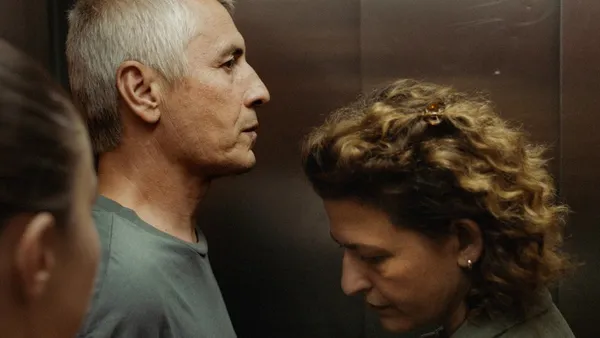

As Shame And Money played the 2026 Sundance Film Festival, where it won the World Dramatic Grand Jury Prize, some of the headlines declared that the slow-burning drama hit audiences with a dark take on “the global economy”. This is accurate, in as much as any film featuring a monetary transaction is about the global economy. And the film certainly has something to say about the class divide. But it’s also an extremely specific story about the fragility of financial security, and how if your livelihood disappears, it might be nearly impossible get an equivalent lifestyle back.
Made in Kosovo, the film examines how pride and embarrassment over money issues exacerbates the problem, leading to poverty, hopelessness and a pent-up rage that’s just waiting to break out. Director Visar Morina, who cowrote the screenplay with Doruntina Basha, has a gift for introducing points of contention and resentment and letting them simmer and build, sometimes quietly and sometimes awkwardly, until the only routes left are despair and violence.

The instability becomes part of the film’s structure. Going in, it seems to be about a family of farmers who live a modest but sustainable lifestyle off their land and the their cows’ milk, which they sell locally. The family fuck-up, Liridon (Tristan Halilaj), has got himself in a troubling situation and needs a large sum of money, so he starts lobbying the family members he thinks will be most sympathetic to put in good words with the others. But just when you think the story might revolve around Liridon’s predicament, it turns out he’s just a footnote, and the film will centre around Shaban (Kabashi), his wife Hatixhe (Kodheli) and his mother Nana (Kumrije Hoxa), as they’re forced out of their farm and into a life scraping by in the city.
There’s a stretch of black screen every time an abrupt change happens, signifying the start of a new chapter. In this first case, the family goes to live with Hatixhe’s sister Adelina (Fiona Gllavica) and her husband Alban (Alban Ukaj). Of course, Alban is being generous by letting the family come to live with them and offering them a job cleaning his nightclub, but at the same time they have no idea what their wages are or how many hours of work they have.
The title may seem a bit on the nose, but it certainly emphasises the themes, calling attention to them in both subtle and overt moments. Money is naturally an ever-present issue, but the shame manifests itself in different ways. When a character in the village buys a new car, he repeatedly points out that he bought it used for a good price, trying to shrug off that he has wealth to spend on niceties. When Shaban and Hatixhe arrive in the city, they’re too embarrassed to even ask Alban how much they’re making – a factor that’s even more concerning when they learn that the nightclub they’re cleaning isn’t open seven days a week, meaning their work isn’t steady enough to make the rent.
One of the biggest conflicts emerges as Shaban starts augmenting his income by picking up work on the street with a group of fellow downtrodden labourers willing to work under-the-table on the cheap. Alban is concerned that it makes him look bad to his neighbours if his brother-in-law is begging for work where all his friends and family can see it. Of course, the obvious workaround would be to give Shaban a raise in the nightclub job, but there’s a deadlock where Shaban won’t ask Alban for more money or accept a simple handout, and Alban will only offer Shaban funds in a theatrical manner. Meanwhile, Hatixhe is essentially working without pay as a hospice nurse for Alban’s invalid father, helping him use the bathroom and recover from falls.
The characters are often obstinate in their refusal to accept handouts, or even a raise or bonus if they feel it is out of pity rather than the value of work they’ve done. This basically turns their life into a series of losses. There’s no situation in which they can pull in a living wage and feel good about doing so, and that feels as rooted in psychology as it does in the global economy.
Such is the cycle of Shame And Money, where even a good faith offer is taken as a slight, and anything more generous may be incendiary. The ending lurches toward a narrative stalemate that puts us in limbo between the horrific and the mundane, leaving us to ponder what could qualify as a realistic happy conclusion.
Reviewed on: 14 Feb 2026