





Eye For Film >> Movies >> The Lights, They Fall (2026) Film Review


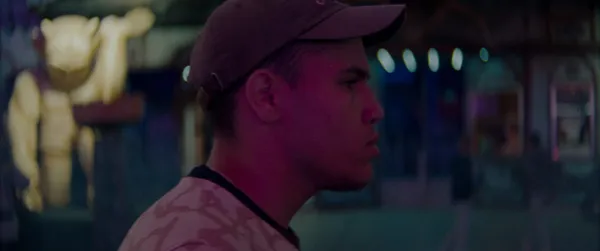

In Saša Vajda’s The Lights, They Fall, grief is not staged as confrontation but as evasion. Sixteen-year-old Ilay (Mohammed Yassin Ben Majdouba) drifts through Berlin’s outskirts while his mother Maria (Mahira Hakberdieva) lies dying offscreen for most of the running time, cared for by Ana (Flor Prieto Catemaxca), a Mexican palliative nurse. The absence is the structure. Ilay’s refusal to accept what is coming is not articulated in speeches or breakdowns, it is expressed as constant motion without direction, days filled with tasks and nights spent wandering like someone trying to outrun the idea of an ending.
The observation is patient to a fault. Ilay works at a logistics center, fulfils community service by planting trees, pawns what he can, first two smartphones and later a gold watch. In daylight he gathers with friends at a lake, close enough to other bodies to seem social, far enough inside himself to remain unreachable. At night he roams the city sleepless and vacant, more apparition than teenager, a figure moving through spaces that never become shelter. Vajda’s camera mirrors that state. It often lingers after characters leave the frame, holding on emptiness as if time were not progressing but pooling, indifferent to the people who have to live inside it.
Ilay’s mental stance is at times reflected in the physical world. One brief breath of escape arrives in the pawn shop, where he sits opposite a wall of clocks labelled for distant cities, Tokyo and Dubai among them, and Berlin as well, except the Berlin clock is missing. In a story set in present-day Germany, the local time is the one that cannot be read. It is a simple visual gag that lands as philosophy. For Ilay, time does not exist in a usable form. There is only waiting, and the deadening labour of pretending that waiting is life. The gesture repeats elsewhere. Outside the logistics centre, planes lift off into a larger world that remains strictly hypothetical, just as the clocks offer faraway cities only as names. You cannot board a take-off in the distance, and a clock will not transport you. The film keeps hinting at elsewhere, then shows how sealed his present is from it.
A similar moral clarity appears in small encounters with kindness. Ilay tries to buy a sandwich during his break and comes up short on the five-euro cost, and the vendor waves it away, no questions asked. Friends try to be there for him in the clumsy way teenagers do. Ana’s care work itself is a steady offering, even as her addiction shadows her and keeps reminding us that the caregiver is also someone in need of care.
But Ilay’s drift is not only passive. It turns strange. During a nocturnal outing he impulsively steals a dog, an act that feels less like delinquency than a misfired attempt at attachment, as if he can rescue something from disappearing. The closer his mother’s death nears, the more it becomes not an inevitability but a puzzle, a matter of mystery and speculation, something the mind can keep negotiating if it refuses the finality of the body.
That commitment to interior vacancy is the work’s insight and its hazard. The slow, contemplative pacing and the out-of-sync camera can produce a precise empathy for dissociation. They can also leave the viewer unmoored, asked to supply the urgency the material deliberately withholds. Yet the rigor curdles into inertia. The repetitions do not accumulate so much as stall, and the film’s refusal to vary its register turns Ilay’s dissociation into an alibi for thin dramatic development. What begins as a principled minimalism ends up feeling underwritten.
Reviewed on: 14 Feb 2026


