





Eye For Film >> Movies >> Frank & Louis (2026) Film Review

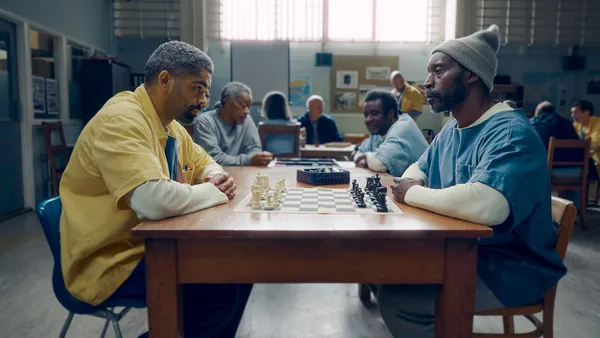

Prison dramas don’t come much more thoughtful, inquiring or humanistic than Petra Volpe’s latest. The Swiss-Italian filmmaker – co-writing with Esther Bernstorff – makes her English-language debut with a moving portrait of the justice system that considers rehabilitation and redemption without minimising the experience of the victims of crime. Frank & Louis, which premiered out of competition at Sundance, is also pertinent as it comes at a time when the US prison population is rapidly ageing due, in part, to the three-strikes laws which can end with people sentenced for life for minor offences.
Volpe, however, isn’t looking for any sort of easy point scoring regarding the politics of the situation making Frank (Kingsley Ben-Adir) a character who has served many years of a sentence for a serious crime, although he is now hopefully targeting parole. It’s for that reason he requests to join the prison Yellow Coats, a group of inmates who volunteer to help older prisoners who are suffering from dementia and other forms of memory loss with their daily business around the jail. His assignment is to aid Louis (Rob Morgan), a lifer with a violent reputation, who has early onset Alzheimer’s. Their relationship gets off to a poor start, not least because Louis is paranoid about Frank’s motivations – not without justification given the lack of sympathy the younger man initially displays. To begin with, he’s recalcitrant in the face of any offer to help with dressing or daily life but gradually a connection begins to form.
Where this might open the door to easy plot beats, melodrama and cliche, Volpe and Bernstorff – who spent years researching the real-life Gold Coats system at California Men’s Colony in San Luis Obispo – avoid all of that in favour of a more heartfelt exploration of what this sort of scheme really offers for volunteer and recipient. Frank, who has spent years essentially toughing it out, finds his guard begins to drop when faced with Louis’s genuine and increasing vulnerability.
Ben-Adir and Morgan are perfectly cast, with Ben-Adir allowing cracks in his character's steely veneer to gradually show while Morgan intelligently calibrates his character’s gradually loosening grip on reality. When Morgan looks at the camera we can feel the snap back and forth from the haze of Alzheimer’s confusion to moments of purgatorial lucidity. If both stars aren’t mentioned in awards talk next year, it will be a travesty.
Although a chamber piece, of sorts, Judith Kaufman’s camerawork has a fluidity that finds movement in corridors or the men’s exercise yard, which stops the action becoming static. The use of the prison’s corridors also acts as a reminder of just how vulnerable these men with fading memories are, asking what good it serves to keep them locked up when they have no real sense of where they are, and still less why.
A drama that is as much about the multi-faceted nature of humanity as the individuals involved, Frank & Louis refuses easy labelling. It doesn’t shy away from Frank’s ability to have done a terrible thing – with a scene involving his victim’s daughter at a parole hearing among the most moving moments – but it also shows his genuine care for Louis. This plays out in quiet moments of shared noodles or letter writing that emphasise connection with a minimum of fuss. Frank & Louis achieves a profound sense of sadness that encompasses sorrow for lives lost and taken in many ways by people, the system and fate. A pocketful of tissues is strongly recommended.
Reviewed on: 10 Feb 2026


