





Eye For Film >> Movies >> Bucks Harbor (2026) Film Review


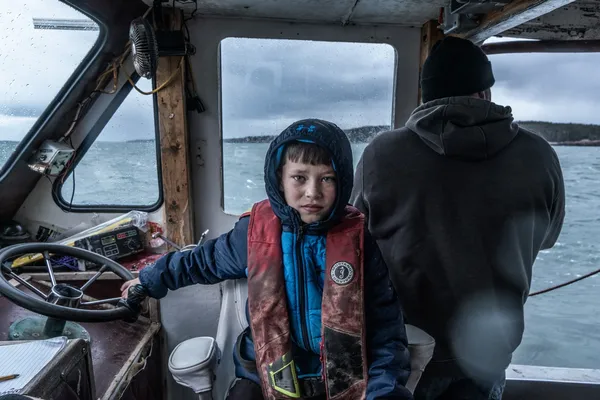

Set close to the easternmost edge of the United States is Bucks Harbor, Maine. Pete Muller’s directorial debut captures a community weathered by cold and by neglect, yet never reduced to its periphery. What unfolds is not a postcard of rugged coastal life, but a patient study of pressures that feel unmistakably national, financial precarity, addiction, and the slow grind of institutions that do not reach this far unless something breaks.
Muller follows four men whose lives suggest different, loosely sketched archetypes. There is the one failed by the system, a quick mind and real artistic impulse, stalled by money, schooling, and the narrow exits available. There is the loner with a record and a reputation that keeps repeating itself. There is the family man trying to do right by others while he is still repairing himself. And there is the outsider who complicates the town’s neat categories, a drag performer and TikTok presence who is also a straight family man, living proof that identity is messier than the labels a small place tries to enforce. Their stories do not merge into a single thesis. Instead, they echo across one another through the same elements: lobster fishing, seasonal exhaustion, and the daily work of staying sober, staying out, staying afloat.
The documentary is also sharper than it first lets on about timing and tone. The synergy between the director’s sense of humour in transitions and the subjects’ own sense of humour creates an almost comedic effect at times, not staged, just too perfectly human to be scripted. One man recalls resisting arrest and still owning the flashlight a policeman hit him with 35 years ago, and right then his phone rings and Siri announces, with deadpan precision, that his ex-wife is calling. It is funny, but it is also revealing, a life where history never quite stops interrupting the present.
The most striking interruptions are the underwater passages where lobsters drift through dark blue accompanied by serene music. Muller’s background as a photographer and visual artist shows in how these images are not decorative but structural. The lobster becomes more than local industry. It becomes a metaphor for survival as process. The molting moment of softness and exposure before the new shell hardens, mirrors the men’s attempts at remaking themselves after drugs, incarceration, alcoholism and childhood damage. Recovery here is not redemption as spectacle. It is vulnerability, repeated.
Yet Bucks Harbor is not only about men. Muller also attends to the women who keep the place running, mothers and wives whose labour is as hard as the men’s, often harder, and whose patience is not infinite. Some are openly disillusioned by the myth of men as the stronger gender, irritated by the weakness that surfaces when it matters most, when someone relapses, disappears, or needs to be carried through consequences they helped create. Their presence shifts the portrait from masculinity as identity to masculinity as a burden shared by everyone around it.
What emerges is a community in revision. A newer definition of manhood appears, less about being a sealed vessel and more about admitting wrong, asking for help, and learning humility without treating it as defeat. Muller places that shift against the physical reality of the work. Winter fishing is punishing, the ocean a kind of liquid misery moved by tides and wind, and even this old economy is threatened by warming waters. Yet Bucks Harbor does not posture as issue reporting. Politics hovers at the edge, readable if you want to, but never forced into the frame. The emphasis stays with people as they are, not as representatives.
The town’s periphery becomes its own atmosphere. Night scenes trace ghosts in snow kicked up by crosswinds under sodium vapour streetlights. The sense is not of romantic hardship, but of endurance shaped into a local language.
Bucks Harbor is a quiet triumph of humanity. Social identities are shells, useful, protective, and sometimes suffocating. Underneath them, what holds is simpler and harder earned: kinship, labour, and the communal instincts that keep a small place alive when the world feels very far away.
Reviewed on: 14 Feb 2026


