Lithuanian filmmaker Jurgis Matulevicius returned to Tallinn Black Nights Film Festival this year with China Sea, six years after his debut Isaac also premiered at the festival and went on to be his country’s nominee for the foreign language Oscar. His follow-up, based on his idea and written by Toxic filmmaker Saule Bliuvaite, is already off to a good start, picking up the Critics’ Picks Best Film accolade at the Estonian A-list festival.
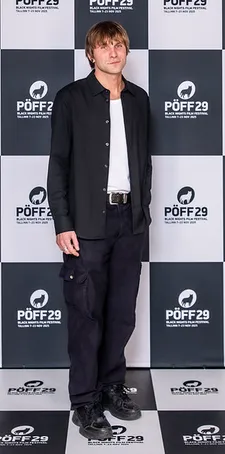 |
| Jurgis Matulevicius on the black carpet in Tallinn. 'I was inspired by this story to make a movie about a guy who is masculine to the max, who is angry, who is violent – but there’s another side of him I really wanted to explore' Photo: Courtesy of POFF/Erlend Staub |
The drama – inspired by the tragic story of a Lithuanian mixed martial arts fighter whose actions led to him being ‘cancelled’ – follows MMA champion Osvald (Marius Repsys), whose career hits the skids after his anger management issues outside the ring lead him to accidentally injure a woman in a brawl. Living in a Taiwanese restaurant – the China Sea of the title – thanks to his one remaining friend Ju-Long (Jag Huang), he attends anger management classes at the same time as trying to build a coaching career. Ju-Long may not have anger issues but addiction is also blighting his life, since his gambling habit means he’s on the hook to the local gangsters led by the shadowy Tourist (Vaidotas Martinaitis). A film that revolves around people being caught in various traps – often of their own construction – it also explores different forms of toxic masculinity and the difficulties of escaping cycles of violence.
We sat down with Matulevicius to talk about the film’s themes and the challenges of shooting certain scenes.
Your film was inspired by a true story, how did you come across that?
Jurgis Matulevicius: The funny story about this is that a producer came to me and told me about this guy who was a kickboxing superstar of Lithuania and he was very well known in Japan and in Asian countries. He was in bushido and he was the biggest superstar in Japan, people loved him there. The producer came to me and he said, “I met some guys who want to make a biopic about this guy”. It would have been a film that maybe praised him, so I instantly said, “No, I’m not going to make it because it's going to be a commercial film and I'm not doing that.”
But the thought stuck with me for a couple of months and then I started searching the internet about this guy and there's so many articles, videos and information about him because he was really well known in a good way and in a bad way.
This controversy clicked with me and I thought I need to make a movie about this guy because one part of him was a kickboxing superstar and the other part of him was a guy who can't control his anger and violence out of the ring and always gets into trouble.
So I was inspired by this story to make a movie about a guy who is masculine to the max, who is angry, who is violent – but there’s another side of him I really wanted to explore. Most [Lithuanian] men my age, in our 40s, grew up in poor neighbourhoods, surrounded by violence, anger and fear. And we looked at role models who were these toxic, violent men. And, for me, growing up was so hard because my role models couldn't show their feelings and I just did the same, I copied them.
This is a film about a guy who is in his 30s, but he's still this angry teenager, who was hurt a lot when he was a child and this psychological trauma just goes on and on. It’s a relic of the Soviet Union, because everybody had alcoholic fathers or a tough life. So this anger which was suppressed so much, shoots out in situations when you wouldn’t expect it.
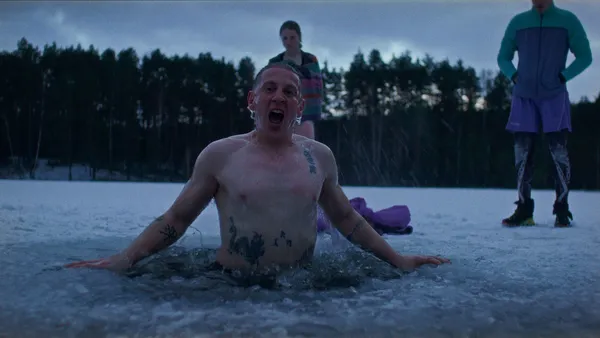 |
| Jurgis Matulevicius on shooting the ice hole scene 'The thing was, it was not one take, it was three takes' Photo: Courtesy of POFF |
The process was that I came to Saule with two ideas for two different movies. I was living in a neighbourhood where we had this restaurant, which was called China Sea. I was passing it every day and I saw this man, the owner, who was smoking a cigarette on the steps in front of his restaurant and he always had this plastic bag in his hand. I felt some loneliness in him and pain and I really was interested in life for immigrants in this small Baltic country. I was meeting restaurant owners and they were telling me about their life. So I told these two ideas to Saule and we tried to combine them.
I’m interested in the way you chose to depict the kingpin – the Tourist – in this. He’s very shadowy, you really don’t see too much of him, you keep the camera back from him.
JM: My idea was to show that the violence is here, it’s near. You can feel it breathing into your neck, but you can't actually see it because either it's behind the window or you hear about it on the radio or we see a report on TV or it’s a dreamlike shot because we have, for example, the kingpin with a katana in the pool.
We can see Osvald has anger management issues but we don’t see him fighting except at the very start. Although sometimes we see the aftermath of his anger – like the trashed gym room when he’s obviously had a meltdown between scenes.
JM: I also wanted to show this part of his life when he's starting to change. Something clicks in his mind and he understands more and he starts feeling new emotions. He falls in love with a woman but also the past kicks in that he wants to save her from something bigger than life, bigger than him. He’s starting to feel something new but he’s still unable to express it because it’s a completely new chapter for him.
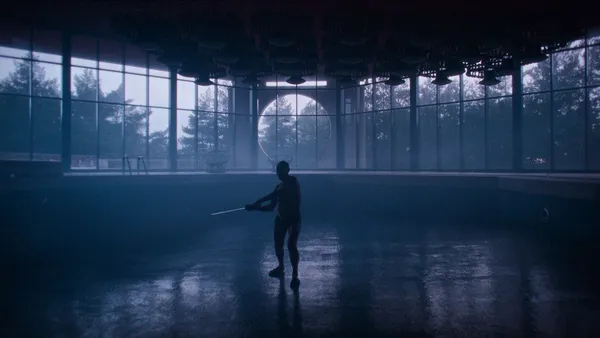 |
| Jurgis Matulevicius: 'My idea was to show that the violence is here, it’s near. You can feel it breathing into your neck' Photo: Courtesy of POFF |
From a shooting perspective, was it a challenge to shoot the scene where the characters jump into a hole that’s been cut in the ice?
JM: Marius Repsys is an actor but for 12 years he did martial arts. Martial arts preparation is so tough, they should be like lead inside because otherwise they will break because the punches are so strong, so you need to be physically and mentally prepared. I think this scene shows how you prepare, not only physically, but mentally. The thing was, it was not one take, it was three takes. We had a sauna nearby for them to warm up in but when I came and told them, “You know, guys, I'm really sorry but you need to go do it for the third time”. They were not happy. But they told me, “If you really need to do it, let's do it.”
And how was it to work with the dog, Asbo, which Osvald finds and adopts?
JM: I wanted a fighter breed, a pincher. The real guy had a dog and it was a Rottweiler but we got something similar. That dog was amazingly trained. So we made the actor spend some time with him but also, for me, it was easy because I'm a dog person – in my life, I’ve had five dogs already and I’m planning to have even more. So I know dogs and I think it was the easiest part.
Asbo kind of reflects Osvald. He's like this little dog which, when you leave him in the house, he destroys everything. But when you come back, he's sorry and he forgets it in 10 minutes.
You really get a sense of his energy management, or his lack of it, in the scene with the hole in the ice.
JM: He releases the animal inside of him. Yes, this scene I think is one of the most powerful in the film where you actually understand this man's tragedy that he has this beast trapped inside him and now he can't release it because he can't fight. He tries to direct his energy in different ways.
Tell me about casting Severija Janusauskaite as Skaiste, who Osvald begins to fall in love with.
JM: She was in Isaac as well. I needed a woman who is in her 40s. The character is a pop star who wanted to be big, but it didn't happen for her so she chose material things. She chose to be with a man who has money but he's violent. She makes the choice and she just closes her eyes to the violence. She’s not a part of it but she’s also not against it. That’s the core of her tragedy because she understands it and she wants to change but she’s comfortable in this position. I think, as a human being, when you feel like this, there’s no way out because you can’t run away, you can’t hide.
 |
| Jurgis Matulevicius on Skaiste: 'The character is a pop star who wanted to be big, but it didn't happen for her so she chose material things' Photo: Courtesy of POFF |
I think that his character is really interesting because he’s the only character who is very poetic in this movie. The last movie, Isaac, had many poetic characters, inspired by Tarkovsky and so on and this movie’s theme dictates that these are completely different people.
They're not smart, let's say, Most of them are like naive teenagers trapped in men’s bodies and only Ju-Long has this poetic aspect in him. He's also the only character I think who understands his wrongdoing and does something about it. All these characters are trapped by these circumstances. Osvald by his past case, Skiaste by the position she chose to be in and Ju-Long, I think he’s the saddest character of them all because deep inside he’s a good person but he’s also dragged down by everything. When you're living in this kind of world, if you're not mentally and emotionally strong it’s so easy for them to break you.
Is it too soon to ask what’s next for you?
JM: I’m working on a script right now and I’m writing it myself. It’s going to take place in between the 19th and 20th centuries in a very beautiful and harsh place in Lithuanian, called the Curonian Spit. You have the lagoon on one side and the Baltic Sea on the other and it’s like a piece of land, which in between those centuries was only sand. I'm writing a script about a village there and their houses are drowning in sand because the wind moves the sand. They’re struggling and it happens that a guy arrives and he becomes like a fake prophet for them and he starts to manipulate the villagers.