 |
| Psalms Of The People Photo: Glasgow Film Festival |
“I think it's the ideal festival for it in Glasgow,” says documentarian Jack Archer of his new film Sailm Nan Daoine, aka Psalms Of The People. “The festival itself has got so much international recognition as well, and it's just the perfect place to kind of bridge those two worlds: the international cinema world and the core Gaelic audience.”
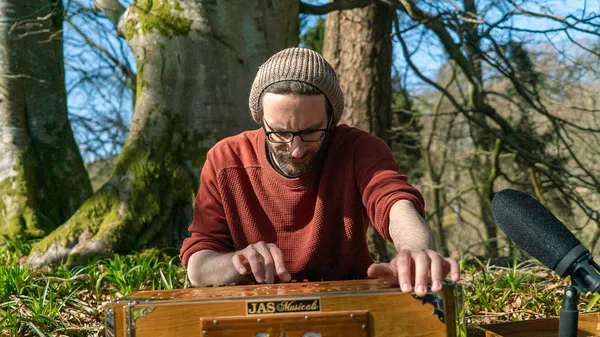
Made in Scotland’s second (but older) language, Psalms Of The People explores the Gaelic psalm singing tradition and its cultural connotations by way of a young enthusiast whom Jack happeneed to meet in the course of his work.
“This film really started because I knew Rob McNeacail from working on my last film, Bill Douglas – My Best Friend. Rob did the sound design for that. I realised he's a bit of a genius really in that the way that he approached sound was very unusual. He went out, got recordings off his own back with a recorder, stuff like that. He treated it incredibly seriously. And we got talking about lots of different subjects.
“Around about two years ago when the Bill Douglas film was premièring, we were chatting about arrangements for getting to the première and he said ‘Oh, I'm sorry that I've not been back in touch with these ideas that we've been loosely talking about, but I've been arranging my dad's memorial. Everybody in my village sang a psalm for his memorial and I think we did a pretty good job of it.’ He attached an audio recording of the community in Carlops, his friends and neighbours all singing this Gaelic psalm. It was very evocative.
“I'm aware of Gaelic psalms, but it's not something I knew a huge amount about. It just occurred to me that everything that we'd been discussing – things to do with language, culture, thinking in the Gaelic language and stuff like that – it all came through this thing of what he was doing in Carlops, which was teaching people how to sing Gaelic psalms. And so I went down a couple of months later to do a day's filming with them and I realised what an interesting thing it was.
“He’s got so much character, whatever he's doing, it's entertaining or fascinating in some way. Through making the taster with him, I learned a lot more about Gaelic psalms, and then I took it to BBC Alba and they were very keen on the idea. But then as we started making it, it became obvious that it was a film because, I suppose, the psalms themselves, they're not the kind of music that you can just chop up and montage to get space.
“The commissioner of BBC Alba, Calum McConnell, the note that he gave me was that he wanted there to be room to breathe – which is, to be honest, a very unusual move for a TV connection, and one that was absolute music to my ears. With that in mind, we developed it into a feature film. I would describe it as a bit like a musical. It's existing songs that you form a story around.”
How much was that story was something that he consciously shaped for the film, and how much was it simply following a journey that Rob was making anyway?
“There were certain aspects of it I think Rob would have done anyway,” he says. “He was very keen to go and meet with Calum Martin anyway, because, you know, Calum Martin is the big enthusiast for Gaelic psalms and bringing them to the world. So I would hope that Rob would have done that anyway. He has spent a lot of time in Kilmuir, at the north end of Skye. That's where he learned how to present the psalms. So those are things that he would have possibly done anyway. But the trip to Belfast and the trip to down to Queensborough, that was all about the film.
“There’s that amazing thing when you're making a film: you just get in touch with people and you say ‘Well, we're doing this film. Can we come and do something with you?’ And that was that. I mean, to me, I didn't want to make something that really explained a lot about what Gaelic psalms were. It was all about Rob. But at the same time, we didn't know that there was this connection with Irish music. Rob, his musical background is very much Irish music as well, and his way of looking at the world is kind of focused on the Gaelic world and all the stuff that connects Ireland and Scotland. So we knew that we had to go there. It was just very distant. We did get in touch with people, and they were so welcoming and just got what were doing.”
I meantion that, familiar thought I am with the history of Ulster Scots, I found it strange to see British flags and mural tributes to Loyalist paramilitaries all over the part of Belfast where they located Gaelic psalm enthusiasts. Was it a surprise to him? Did he see it as a positive part of the process of building bridges between communities?
“That was the thing,” he says. “I mean, I got in touch with Linda Ervine, who is quite a prominent unionist or from that kind of background, and she is a big advocate for the Irish language as well. That is a very interesting thing, because I think in Scotland, you know, we expect some things. The Gaelic world doesn't have that religious divide, we don't have that kind of division. Whereas I suppose in Belfast, the Irish language is a political kind of thing along those lines.
“It was something very interesting to take part in because I think the people that go along to that singing group and to the Torres center, a lot of them are from a Protestant background or a background where they're kind of interested in Scotland, you know, because of their heritage and things like that. When were there it was really interesting because we deliberately went up onto the hills above Belfast first. You know, we got off the plane very early because that was the cheapest flight, and it was three of us.
“We just went to there to get some shots and things like that. But seeing Belfast through Rob's eyes, you know, it's the center of the Gaelic world to him, and it starts to appear like that, especially when you've got that mist and in July, that kind of green and gray. But, yeah, he sees things through these old stories and stuff like that, but also this kind of modern way as well. And I love the bits where you've got those kind of bizarre...” He hesitates. “I mean, they are very odd murals, really. What I love about it is it appears on camera, certainly, that he's just kind of completely oblivious to it.
“Belfast is a friendly city, very friendly. But then you've got these monuments to this violent past, and I suppose part of the point that were trying to make when were editing it was that it's not that they're not important to people, but there's a lot that goes on in between these identities. So it's perfectly legitimate for you to be Protestant but interested in learning the Irish language and Irish music and things like that. That doesn't necessarily make you a Republican or a unionist, and life is much more complicated, I think, than just those particular labels.
“I think with Rob's own story, he was interested in exploring his Gaelic heritage because his father had just passed away. But there's more to his story than just the Gaelic side of his family. Everybody's quite complex in that way, aren't they?”
I tell him that I love the way that the story of Rob’s father, Aonghas McNeacail, is brought into it, just in little bits, but gradually building up a picture of him. Was that the plan from the outset?
“His father was a was a huge deal for Scottish literature, for the Gaelic world. You just couldn't overstate how important he was and still is. And in terms of Scottish literature and poetry, he is a very important figure. I didn't want Rob to be in his shadow, so I didn't want to sell this as this being about his son. That was quite important to me. But the of origin of him singing the psalms was quite important to mention. So when we had the first cut of the film, myself and the editor James watched the first cut together with Rob and interestingly, the note that Rob had was that he felt that his dad needed to be in it more.
“The way that we did that was just bringing in a few key still images. We discussed whether there was some possibility of moving archive, but I kind of think with a still image of someone like that, it kind of evokes what a memory of somebody is: that they're kind of there, but they're not there. And then we basically all three of us came up with the idea of the ending, of how it was going to be.
“The bit where he's singing a psalm in the cemetery, that was already there, but we created this sequence that combined the people in Carlops singing the psalm as well, kind of joining in. I went out and shot some imagery that went with the words, and we went back and forth a lot about the ending. It was, I think, because I think Rob did want to have some creative control over it but it was a bit of a struggle probably for him to acknowledge this is a personal story. And it's a difficult thing when you're working with a contributor...”
“...because somebody has to be in charge,” I suggest.
“Yeah. If you want to tell your own story then you can go on any social media and just write your own stuff. But at the same time, we listened very carefully to what he was saying about things. And yeah, it was a three way discussion between myself, James and Rob. But I'm very happy with the ending, with the way it is now, just because I think it brings together the story, it makes it personal, about his dad as well. I think it's something that people can relate to. I suppose the message of the film at the end is that culture is something that's given to us from our parents. What we do with that, we then take it on if you like, and it's a gift. And that applies to Gaelic psalms and the culture that goes with them, but it also applies to many things in life you can't take for granted.”
There's a lovely scene in there where Rob reveals that Calum Martin wants him to make Gaelic cool, and Rob is not sure he knows how to be cool. Was the film trying to make the psalms cool?
“Yeah.” He laughs. “I think the thing with Rob is in one way he's part of the culture and in another way he's not. I think the interesting thing about Paul and Rob talking about the psalms is that he's really enthusiastic. He described himself about as having the enthusiasm of a convert. And if you do something every week, you can't really describe what it is that makes it special – or you know, it's harder. Whereas I think he can do that. And I think he's also worried about how he comes across the people who are brought up in that tradition and steeped in that tradition.
“Certainly the experience I had when he was doing that on Lewis was that it was an overwhelmingly positive response, because of that enthusiasm. I think that’s because Rob just wears his heart on his sleeve. Everybody just goes along with him. He gains their respect because he's so emotionally honest and so patient with people. I also think that there isn't actually a lot of people who are able to use and get people along in that way. I suppose that the one person who can do that for sure is Calum Martin.
“Calum's background is not just that. He was a guitar player. He's into that kind of music as well. So I think that's probably why he identifies with Rob. They've got this wider musical interest.”
So what's the status of the psalm singing these days? Is it a growing tradition or is it just holding on?
“Well, that's the interesting thing. I mean, before I started making the film, I was aware of the tradition, and just thinking that it was something that happened. You know, if you went to Lewis or Harris or something like that, you’d hear people singing that on a Sunday the way they had done for a hundred years. But in actual fact, that isn't the case. The event that we were at was organized by Calum and others to bring together churches in Lewis to revitalise interest in psalm singing in Gaelic.
“A lot more of the services are in English now. I couldn't say whether it's a dying tradition, but it's certainly not a tradition that's growing. It's the twin thing, really, of the language and the religion as well. They're both, I suppose, not growing in the way that they were in the past, perhaps. I mean Calum, when he was a boy, Gaelic was the language that you'd speak in the playground but not in the school. And now it's a language you can speak in school but not the church.
“In some ways Gaelic education and stuff like that is now in a better state, but it was the Church that always kept Gaelic going. The way that psalms were sung was because people wanted it to be in a vernacular language. They wanted to be a language that people would speak. That's why it was translated into Gaelic. But I suppose what Rob is doing now is using the religious aspect, using this religious music to get people to speak in Gaelic. It's almost like it works both ways.”
Something that always strikes me about language learning is how useful it is to be able to watch films in the chosen language, so that one can listen at one’s own pace without worrying about how the other person's going to react if one can't think of a word. Does he agree that it's really valuable to have more Gaelic film and to get more stuff out there that people can see, so they can learn in that way?
“Absolutely,” he says. “I mean, for me, to learn a language, you need to be immersed in it. I find it very difficult to learn from a book or from Duolingo. You need that conversation, you always need to know the context. And I think the thing about film is that there's a lot. Within a good film, the story isn't being told by the words. It's being told by the pictures and the sound. You know the context anyway, and so the storytelling is more than just the words.
“It gives you the opportunity to understand a bit of the context and to pick things up. But at the moment the BBC charter is under review and as part of that Gaelic language provision. It's an absolutely vital service that they provide, when the funding they receive is a lot less than S4C or TG4 in Ireland. But what they do with it is just amazing.
“I suppose why I wanted to do this, though, was to do a kind of observational cinema documentary where it was a realistic way of speaking Gaelic. One of the ways that BBC Alba has to operate is to have good standards of Gaelic, and I suppose what I was interested in was that isn't the case for a lot of people. People live in this public world where they can’t speak dialect all the time and in an actual fact, sometimes they're speaking two languages in one sentence. So in this film, there's learners and there's imperfections. What I would say, though, is we did spend a lot of time and had a lot of feedback in the voiceover to make sure that was all correct. There had to be a kind of cohesion in that.
“It's perhaps messy, but in a good way. There's bits where he's in Ireland and he's speaking Gaelic and people are speaking Irish Gaelic. That's fascinating to me. It's a lovely mix, you know?”