





Eye For Film >> Movies >> The Mortuary Assistant (2026) Film Review



The art of adaptation for the big screen is always challenging. One might expect computer games to be simpler to handle than novels – they’re generally built around something closer to the right amount of plot, and many of the visual ideas are already present – but what works in one medium doesn’t always work in the other. Change key details and fans will be in uproar. Try to keep everything the same and the different dynamic that stems from lack of direct personal engagement can see it fall flat.
Jeremiah Kipp’s adaptation of 2022 game The Mortuary Assistant has been better received than many by fans of the original, perhaps in part because it’s a niche game which hasn’t attracted the smugly precious fanboy crowd. It’s structured around solving puzzles and people who enjoy that can grasp the complexity of translating it to another medium. Still, it struggles to get the atmosphere to work. There have been an awful lot of films using this type of setting in recent years. Kipp and screenwriters Tracee Beebe and Brian Clarke work hard to develop underlying themes around grief and addiction, but interweaving these with the immediate sources of tension which the story demands creates problems with pacing.

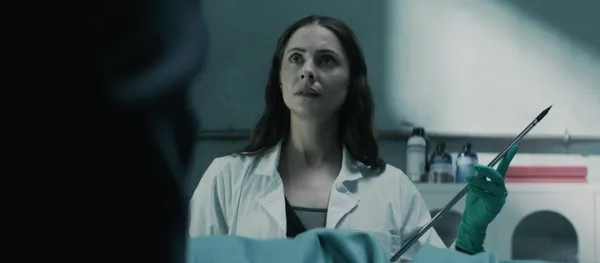
A great deal rests on Willa Holland’s shoulders in the title role. She is Rebecca, introduced in an intense opening scene as she completes her final supervised embalming procedure under the attentive eye of mortuary owner Raymond Delver (a perfectly cast Paul Sparks). They go on to discuss practical matters pertaining to her new position. There will never be a reason for her to go into the basement, he tells her, as Kipp frames the descending staircase in classic horror movie style. He also doesn’t want her to work night shifts. Something about the way he insists on this suggests there’s more at stake than just overtime payments. Nevertheless, it’s a rule he will soon break, asking her to come in at very short notice when he is unavailable and several bodies are being transferred from the city morgue.
There’s a cute underlying idea here: that morticians as a profession are aware of supernatural goings-on which they’re disinclined to mention to outsiders (after all, there are plenty of other unpleasant details which they keep to themselves out of professional courtesy), and which trainees are only inducted into once they have demonstrated a serious commitment. This is explained with relatively little exposition. Instead, Kipp gradually makes the audience aware that corpses are moving (something which, admittedly, might have been creepier had it already been explained that corpses do move, for all sorts of reasons associated with decay and the release of gases, adding an extra layer of uncertainty). By the time we get into the demonic mechanics of it, it feels, if anything, slight, with Rebecca’s terror demanding a more dramatic reaction.
A scene in which she encounters her sponsor and seems to lose control of her own mind increases viewer uncertainty. Holland does an impressive job of keeping viewers on her side despite becoming an unreliable narrator. Soon she is up against the clock, obliged to solve a mystery quickly in order to avoid being permanently possessed. To achieve this, she must face her troubled past (in which John Adams cameos as the dad she still desperately misses), as well as fending off immediate peril. Her persistence in continuing to answer the phone through all this, when the calls she gets are increasingly disturbing, speaks to the fact that she is still trying to behave professionally, perhaps partly as a distancing mechanism.
Whilst the central monstrous figure is overblown and a bit of a disappointment, there’s some really good low key effects work elsewhere in this. Together with the attention to detail in the clinical scenes, it goes a long way to ground the story and make it more chilling. The Mortuary Assistant doesn’t score on all points, but for those with a fondness for small scale, uncomfortable supernatural tales that will stay with them after lights-out, it’s not bad.
Reviewed on: 24 Feb 2026


Director: Jeremiah Kipp
Writer: Tracee Beebe, Brian Clarke
Starring: Willa Holland, Paul Sparks, John Adams, Keena Ferguson Frasier, Mark Steger
Year: 2026
Runtime: 91 minutes
Country: US
Festivals:
Search database:
