 |
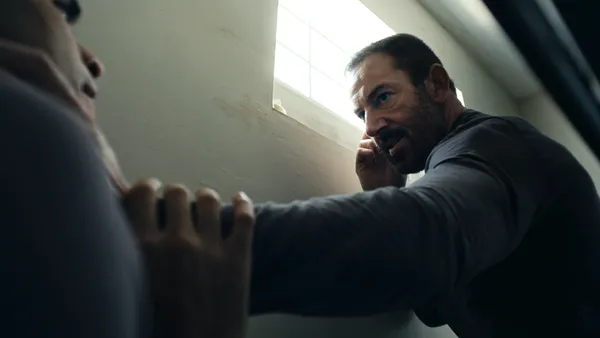
| Jailbroken Photo: courtesy of 2026 Jailbroken Film Ltd. |
Jailbroken, the opening film of this year’s Frightfest strand at the Glasgow Film Festival, is an accidental success which only came about because, according to writer Raymond Friel, “I had gone through a period of trying to write quite big budget things and not getting anywhere.” Deciding to develop a script which would naturally appeal to producers because it could be made on a very low budget, he chose a single location – a jail cell – and kept the number of characters to a minimum. “Actually for a writer, it can be really good giving yourself limitations,” he notes – and this tightly written, gripping thriller certainly supports that assertion.
Meeting shortly before the festival began, Raymond and I discussed his longstanding enthusiasm for prison films.
“I think it's a subgenre that a lot of people like,” he says, “even though there's actually very few good ones. There's a Sylvester Stallone one called Lock up which is terrible. You know, there are actually all these terrible films and yet I think a lot of people are automatically drawn to it as well because it's a nice genre. I mean, we’ve still got very good ones obviously, like Cool Hand Luke, going back to Newman, or Shawshank Redemption.
“I do think there is a political aspect to Jailbroken. It's very much a class versus identity politics thing. The older I get, the more I want to write something with substance, I suppose. I have taught in the Peterhead prison, so it was a world I kind of know. I know those types of men – although, to be honest, I probably met more criminals working in the film industry 25 years than in Peterhead.”
He already knew Vasily Chuprina, who stepped up to direct.
“We'd worked together before on a script which hadn't been made, but I thought he would be a good fit for it because he hadn't made a feature film before and this is a perfect script for first feature. Myself and Bryan [Larkin], the lead, we been friends for a long time, but he'd been away in China and South Korea having his career over there. When I was writing it, I was always thinking, ‘I need somebody who's got the physicality of an action star, but who can also act,’ you know, which is a tricky thing because actually it's mostly a bit about a guy who's used to being physical and being violent, who's now got to use his voice.
“I suppose the other thing which really triggered it is I love the idea of somebody who's not rehabilitated and is getting out of prison, who's almost proud of the fact that he's not been rehabilitated, but actually through the course of the film, he's forced to go through change. Writers always love the idea of change, redemption. And so by the end of the film, he's not getting out, but actually there's, I think, a suggestion that there's hope for him.”
Responding to his mention of The Shawshank Redemption, i ask him if that’s why Bryan’s character, Joe, has a poster of Al Capone on his wall. He laughs and says that he thinks that was Vasily’s idea.
“Having that poster caused a lot of problems because we had to do special effects because of when it was torn. But there's a really nice little interchange between Naz and Joe because Naz doesn't know who Capone is. He thinks he's a singer, which is a nice kind of generational thing.”
Naz, played by Armin Karima, is the new cellmate unexpectedly moved into Joe’s cell. He’s young, clueless and trying far too hard to look tough. Raymond himself was a lot less intimidated when spending time around prisoners.
“When I did my kind of session up in Peterhead, I actually found the prisoners great. I made a point of not finding out what they'd done. I didn't want to kind of have any preconceptions going in. I didn't want that to affect how I dealt with them. But no, they were great, actually. Really good to work with. It was pretty funny, actually – almost all of them, their favourite film was Goodfellas, and it was the Joe Pesci, Tommy character who's a complete psychopath that they liked. I had a better relationship with them than quite a few directors and producers and stuff I've stumbled across the last 25 years, to be honest.
“I think it was important for me when it came to writing the script that it wasn't that I taught there and then decided ‘Right, I'm going to write something about prisoners.’ It just happened organically. But having that knowledge was obviously a big help. I'm sure that was in my subconscious that, you know, these characters were out there that I could write authentically. I think that's the main thing if you’re writing a really tight film. The characters have got to be so believable, because you're not going to be able to put in a big car chase or explosions or something. The action comes from the characters and their motivations.
“Writers are always looking for locations where they can put characters who would never normally beside each other together. You know what I mean? So obviously a prison is the classic one. Normally if you meet somebody you don't like, you don't spend any time with them. Obviously if you're locked in a cell or whatever, you have to somehow navigate them, particularly one of them is going to be violent.”
Joes isn’t quite as tough and unshakeable as he makes out, he points out, referencing a moment when we learn how vulnerable he has been in the past. “He feels he's had to put on this character to survive, whether it's in the criminal world outside or in prison.”
We see him working out in his cell, I note, making an effort to present himself in a way he thinks will make the right impression.
“Yeah, well, it's all about front. It's all about people putting on personas to protect themselves, and in certain situations, you're going to have to appear harder than you really are, because if you don't, you'll get eaten alive. I mean, it's like one of the opening scenes of The Shawshank Redemption. You know, you've got all the new prisoners going in, and other prisoners are betting on who's going to be the one to cry first. There's all these rules of prison, but if you show weakness, then you're in a lot of trouble.
“But yeah, it's hard work putting on this persona, you know, which, I mean, to be fair, I think to a greater or less an extent, we all do that anyway. You know what I mean? Depending what the context is, whether you talk to your boss or your partner or your kids or whatever, maybe you're putting on a different version of yourself at all times. I was thinking it's kind of funny – my boys, when they were growing up, my wife got really upset when they started lying, which I thought was very interesting, because to me it felt like the reason she didn't like it because it was almost like they're growing up now, because we all lie constantly.”
We talk about how important family is to prisoners. Joe has split up with former partner Sara but still wants to build a relationship with their son. “For Joe at the start of the film, that almost represents his hope or his way out,” Raymond says. “This is the one place he's got to be excited about, and it's not just going for a mental bender with his pals. This is his chance for redemption as well, maybe where he's thinking at that point, there is something good about him which is going to be personified in his son. And definitely, from working with prisoners, that's a massive thing. It's about having something look forward to. And so many times as kids, they've had very little actual interaction with them, because they find it really hard on the outside, or did previously.
“They would say they tried to talk to them, but inside, that is all they live for. And it's like, ‘I'm getting through this stretch or this day because I'm going to see my son or daughter or whatever again.’ I know children are important for everybody, but that was, I think, a massive driver for a hell of a lot of prisoners. It's not just the love for the children, but it's also hope because that is the tantalising light at the end of the tunnel. I suppose that was in the back of my mind, powering that relationship. I tried to get across as well that it was difficult for Joe to speak to him. He doesn't know how to speak to the kids, you know?”
There are parallels in the way that he relates to Naz, after initially just being irritated by him.
“Yeah, I think definitely fathers and sons and those sorts of relationships are really strong throughout it. Naz does his own version of trying to put on a front when he comes in pretending to be a tough guy. That scene was always a really crucial scene in it because it's funny, but it's first time you see Naz, so it's really important. I remember because I wasn't on set, so I hadn't actually seen any of the rushes or anything. I didn't know what Armand was like in the role. I knew what Bryan was like. I obviously know of David Hayman, Douglas Russell and Shauna Macdonald, all brilliant actors. Armin was the one I really didn't know anything about. And even though Bryan was telling me he was great stuff, I still hadn't seen anything.
“It was a month or two after the shoot, I met Bryan for a coffee and on his phone he had a kind of very rough, edited cut of that scene. And it was just perfect. I didn't see any more because he nailed it. It was that vulnerability, you know? I knew that was going to work really well. And Armin was fantastic in it. He was exactly how he needed to be against Joel because he's got his own quest in the film. His quest in this film is to survive.
“The other major theme in it was that they're all pawns in it. They've actually got no power at all. Joe's trying to piece it together. It's like something he did. It's like he's got nothing. Which for me was leading to the whole idea of the class versus identity politics. Because it's not in any way left versus right or black versus white, it’s us versus them. You know, it's the oligarchy, the Epstein class, you know, that we see now. I don't know how much you've been keeping up to date with the Epstein files, but the fact you get Steve Bannon and Noam Chomsky yucking it up together, it's like, right, people are bastards, okay? And they're obviously using culture war stuff just to divide normal people so they can steal everything.
“That was really important, that it's not really them piecing together this thing that Joe's done or this person. They're just getting used. And again, I think that's part of Joe's journey. It’s all part of this forcing Joe to change by the end.”
We talk about the challenges involved in structuring the film.
“It was always at the top of my head that was this is a thriller,” he says. “Everything we've talked about here is hugely relevant but's not being thrust in your face, because at the end of the day, it's a genre film. We want it to be commercial. We want people to see it. That's the main thing. So it's going to have to tick all these dramatic boxes. Some of that can be quite technical, to be honest. You know, I've been working for 25 odd years, writing God knows how many scripts, so after working in the industry, you know, it's all about, you can't waste any time.
“With this film, I was always saying to the director, look, we need to cut as much as we can, because I said I’d overwritten stuff and I'll do that when I write anyway. I'll overwrite knowing that when it comes to the edit, we just need to cut everything down. I mean, even though I don't know how long it is now – 87 minutes? I would probably still take another few minutes off it. I say that with every film that I've been involved in.
“I think, particularly in this day and age, if you don't have Brad Pitt or Tom Cruise or whatever, you've got people watching the film, they've got all these other options to do with their time, and if you bore them for one minute, they're going to switch off. So, yeah, I mean, if you had more time and more money and bigger stars, you would maybe spend a bit more time developing the characters. But you can do that actually during the story. And I think for a low budget film like this, you've just got to grab them, which is why I think it's very early on – Naz appears five minutes in – there's already a bit of violence there. And then very quickly after that you get the abduction.
“Then it's all these other things that just like tick, tick, tick. There's not an actual ticking clock into film, but I was trying to create the sense of that. This is all so tight and it just gets tighter as the film goes on. But again, you know, in terms of how that actually works or not, at the end of the day, that's going to be down to the actors. They can make the audience believe them.
“The first time I talked to Bryan about the character, Bryan had all these notes about making him a nicer character at the start. And I was like, ‘No, Bryan. He’s a complete bastard. I know it's going to be really hard for you, but somehow you'll make an audience still sympathise with him. But this is kind of the point, you know? We don't want him rehabilitated at the start. We'll get there. And I'm going to leave it to you to do the hard work of it.
“How do you get the audience to sympathize with a character? Right. Okay. One way you might do it is you show them at the start of the film helping old ladies across the road or saving animals that have been wounded or whatever. Or if you've got a complete bastard, you just have terrible things happen to them, and automatically you still start gravitating towards them because of the situation they're in. A bit like the Ricky Gervais character in The Office, who's a terrible character who really doesn't have any redeeming features at all. And yet by the end of the series, the audience were rooting for him, because he was entertaining but also, we'd seen her how awful everything else everybody was.
“One way we can make the audience still keep up with this guy is when bad things start happening to him and you see that he's only got a phone. This is a guy that is used to fighting people but he can't fight anybody now. He's got to use his brain. We're starting to start to work things out which I think is a really interesting challenge for the character, for the actor and I think for audiences.”
He doesn’t know if he’d do another single location film, he says, but he’s pleased by how this one turned out. He’s also thrilled to be opening Glasgow Frightfest.
“I actually wrote Botched, a horror film, 20 odd years ago. That was in Frightfest London which was great, but actually I think this is the first ever Scottish film to open Glasgow Frightfest, so that’s brilliant. Obviously my sons are now old enough so they'll come along as well, which is going to be really good. I think it will be a fantastic night.
“Knowing it from going to the GFT as a punter so many times on and off through uni, and so many first dates, actually getting the red carpet and being there for my own film is brilliant. It's an amazing festival. It's really strong. It's just kind of snowballing there because they've got really interesting films. It seems like it's a really kind of buzzing, happening festival and it being on my home turf, so to speak, it's just brilliant.”