





 |
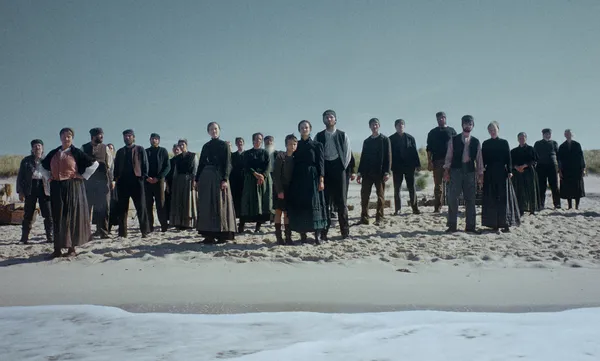
| Trial Of Hein. Kai Stänicke: 'I always wanted the story to be a parable and I wanted to have this universal quality' Photo: © Florian Mag |
The sense of dislocation is added to by the staging – which recalls Lars Von Trier’s Dogville – as we can clearly see the village is merely a set, homes facades with the backs missing. With this staging inviting us to consider how easily we suspend our disbelief, we watch as Hein struggles to be accepted. It’s perhaps no surprise that his younger sister As his sister Heide (Stephanie Amarell), who was just a child when he left, and his dementia-suffering mother (Irene Kleinschmidt) don’t recognise him, but that his oldest friend Friedemann (Philip Froissant) expresses doubt is a different matter. To establish whether he can stay, village leader Gertrud (Julika Jenkins) sets up a court to see if Hein’s memories measure up to those of the locals.
Trial Of Hein – which has the original title Der Heimatlose – had its world premiere at Berlin Film Festival, where it won a Teddy jury award, and we caught up with Stänicke ahead of the screenings.
Given that the film is, in many ways, about willingness to believe certain things, the use of the sets that declare themselves as that is an interesting choice that plays into that idea.
 |
| Kai Stänicke and Paul Boche present Trial Of Hein in Berlin Photo: Courtesy of Berlinale |
“It worked beautifully with the themes of the story – facades and performing. It’s like you're always on stage and you're always performing and you don't have any place to hide and you don't have any place to be yourself.”
Stänicke has said that he drew on his own experiences of growing up in a rural area, which makes the choice of it being a period piece interesting, as this is the sort of tale that could unfold at any time.
The director says he made the choice because “I always wanted the story to be a parable and I wanted to have this universal quality.”
He adds: “I wanted to take my experience and make it a universal one, a timeless one, and so, what was important for me was that you cannot pinpoint the exact time and cannot pinpoint the exact location. Where is this island? It's kind of like a fairy tale and this place is kind of like a metaphorical place. With this approach also the open houses and the theatre stage helped because it put more emphasis on the fact that this is not an actual place.”
The set up made me think of the LP. Hartley quote: “The past is a foreign country; they do things differently there.” It’s two types of foreign country that Hein is going to in a sense, one is the place he once knew and the other is to the past that he has forgotten, or at least that he remembers differently from the other residents.
“Yes, totally. I've never heard that before, but it's really interesting. He's coming back to his hometown but the film is about the journey to find himself and to see things about himself that he hasn't seen before.”
This idea of self-discovery gives a twist to the sort of Return Of Martin Guerre plot that people may have come across before. It’s not just that people don’t recognise Hein but he realises he also doesn’t recognise himself in a sense.
Truth and lies are slippery ideas in the film and something which is encapsulated by a card game the islanders play, called Lies, and which Hein was noted for being good at as a child. Stänicke says it is a genuine game in Germany, which he also wasn’t bad at playing and adds: “I tried to find something that symbolises this performance that Hein played when he was young and I had to find a visual cinematic way to portray this performance. Through this card game, he needs to learn again.”
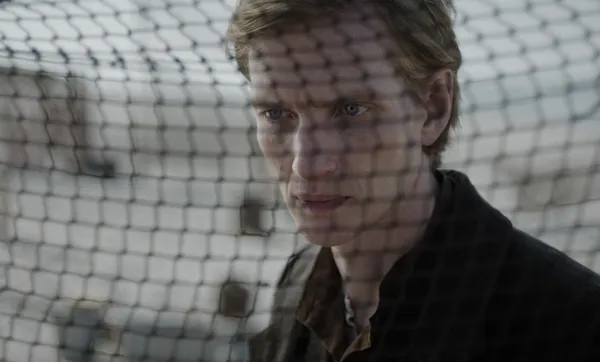 |
| Paul Boche as Hein. Kai Stänicke on the character: 'He's coming back to his hometown but the film is about the journey to find himself and to see things about himself that he hasn't seen before' Photo: © Florian Mag |
The film was shot on the Frisian islands of Sylt and Nordeney. Stänicke says: “It wasn't easy to find the right locations because, as it was written in the script, it was like this village in the middle of the dunes in the middle of nowhere – but dunes are protected areas so you can’t just go in and set up a village there. On Nordeney, we found this amazing spot which is in the city but it’s like a campsite surrounded by these high dune walls so you can’t actually see the city so that's why we were allowed to set up our village there.”
Shooting so close to the coast came with its challenges, not least the set, which needed to be secured against the rain.
Stänicke adds: “We didn’t have any cover if it was raining, so it was a huge risk and we didn’t have the budget to reschedule anything. Thank God, we were very lucky with the weather. We shot in September and October and how I envisioned the film in the beginning was more moody but when we started it was sunny every day. I was a bit conflicted about it because it was good for our shooting day and to get everything done and for team spirit but I had a different idea originally. But, seeing it now, especially in the drone top shots, the shadows are so beautiful and unique.”
The filmmaker says he was aware that because of the theatrical nature of the sets there was a risk of distancing the audience from the action but that he tried to counter that with the cinematography, costumes and acting.
One of the challenges for his stars, however, was the script itself. Stänicke explains: “We have this historic language, which is another thing that made it really hard for the actors to portray.”
The director says that was why rehearsals were crucial in order for him to connect with the cast and for them to connect with each other.
It’s interesting that the title is quite literal in English, while in German it is the slightly more poetic Der Heimatlose, which means “the displaced” – although Stänicke notes that there isn’t really a direct translation for “Heimat” in English.
“Heimat means a lot of things in German. Heimat is, of course, the place that you're from, your home, where you were born, where you grew up but it's also a feeling of belonging and it's a feeling of this is my place of origin and this is a place where I belong. Heimatlose means ‘the one without this place of belonging, without this hope’. This was the German title very early on in my script but since there was no direct English translation we had to look for something else and we came up with Trial Of Hein, which I'm really happy with. I also like the combination of the two titles.”
Stänicke has already started writing his next project and, though he doesn’t give much detail he says with every project he does “the story comes first” and he “always wants to do something completely different and go in a different direction”.