 |
| Courageous |
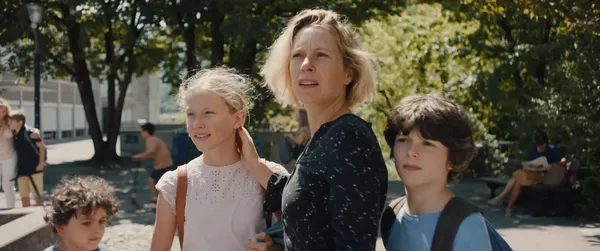
Director Jasmin Gordon's The Courageous (Les Courageux) follows single mother Jule (Ophélia Kolb), who is overwhelmed by financial struggles, yet does her best for her three children, Claire (Jasmine Kalisz Saurer), Loïc (Paul Besnier) and Sami (Arthur Devaux). When she finds a house for sale, it becomes a source of hope. However, her financial situation makes the dream of turning it into a family home an impossibility. Meanwhile, living on the fringes of a society that has given up on her, she bears the weight of needing to prove she is a good person and a good mother.
The Courageous is Gordon's feature début. She has previously directed the narrative short films Bonne Poire and Empreintes (Framework), and is well known for her short documentaries that have played at festivals across the world.
In conversation with Eye For Film, Gordon discussed seeing fiction through a documentary lens and how her feature début is a collage, partly rooted in the personal. She also reflected on telling a story that is a call to arms and the need to find humour in life's difficult moments.
Paul Risker: How would you describe your relationship to cinema?
Jasmin Gordon: I'm Swiss and American, and I grew up partially in Los Angeles with parents who have nothing to do with film. They were huge cinephiles, and they were trying to revive old classic Hollywood films at a time in the Eighties when no one was interested in that. So, they were sort of involved, and they understood the importance of film, and us kids, we really lived that. Film was central in all our lives, but it wasn't a direct path for me. I did many other things before I came to filmmaking, and especially fiction. I maybe wasn't sure if I had the right to make fiction films or if I was capable of it. And so, it came later in life, at a point when I had already lived through many other things.
PR: The American film critic Roger Ebert advocated for the importance of looking beyond cinema, and embracing the value of other sources of knowledge, like English literature. I wonder whether, as human beings, we're prone to developing tunnel vision that restricts our potential.
JG: Definitely, and life experience is worth so much. I'm 46 years old, making my first feature at 45, and I feel like that's something positive. Some people might feel that's too late, but everything that I've lived before this informs the stories that I tell and the way that I make films. And that's really important to me, so I don't regret that lost time leading up to this moment.
PR: We're brought up with a list of goals or ways to measure our success. With this comes a pressure to have achieved certain things by a certain point in time, that gives way to the idea of 'lost time.'
JG: Absolutely, and it's quite frustrating. You see young people putting themselves under so much stress because they don't feel like they've arrived fast enough to where they need to be, when, in fact, I don't feel that's how it should be at all. Often people come to or find their calling quite late, even much later than me. And that doesn't mean that what you do has less value. Maybe you'll make fewer films, but hopefully you'll make the right ones.
PR: A director's first narrative feature is a milestone moment. How do you look back on the experience of making The Courageous?
JG: I put myself under so much stress during the process of making this film, before shooting and also in postproduction, because you have all the pressure on you as of whether it will be good enough? Will it find the right festivals? Will it find an audience? And there's so much competition.
So, I guess it's such a joy when you are lucky enough to find that place for your film and it arrives somewhere. I say this very humbly because I know I did the best I could, and many people do the best they can, and they don't necessarily have the luck that I've had so far. Of course, there are also stories that are much more successful and luckier than mine. But it's a big relief now. Of course, the pressure hasn't gone — I still want to make a good film and there's always the next film. So, none of that goes away, but there's at least a moment where you can possibly rest.
PR: Coming from a documentary background, how do you see the way The Courageous fits into your filmography?
JG: In a way, it feels like it's a natural progression or result of the things that happened before. I made a lot of short documentaries, and then I made two fiction shorts. There are a lot of themes that I see in the shorts that are somehow in this feature and have been transformed. It's a very organic process and the way that I make fiction films or the way that I made this film, incorporates a lot of documentary elements. It's not a hybrid, obviously, but it's infused with the way that I made documentaries or how I learned to make documentaries. I never learned how to make a fiction film, and so, I approach fiction with this other perspective. Somehow, you can feel that in this début feature — maybe in the style and the way that it's possibly made.
There are a lot of handheld camera shots and other movements that are natural and rough, but it's also in the way that I worked with people on set. The documentary way of doing things pervades the way that I make a film, and of course, the film follows the script, but there's a lot of improvisation, especially with the kids. So, I allowed space for documentary elements to enter into the fictional structure.
PR: What compelled you to believe in this film and decide to tell this story at this particular point in time?
JG: It has to do with my personal story. I come from a family where my mother, grandmother and great-grandmother were all women who raised children on their own, and at times when it was not acceptable to be a single mom. And there are also some elements from my own life as a mother. I'm not a single mom, but there are still things that come from my experience. Then there are things that come from being different in a society that is very focused on the norm and not wanting to accept that and rebelling against those structures.
There are a lot of personal things that made me want to tell this story, but it's built up over time. It's a film that's written in many layers over years, with things that come from my own life as well as completely fictional things that I see around me — it's sort of a collage.
PR: Speaking with documentary filmmaker Suzanne Raes, she told me, "I always take a long time when I’m making a film, which is another thing I love, because you become acquainted with the world you film. The people really accept you, forget you, and you’re able to follow a process in the making of the film…”
JG: I totally agree with that, but, of course, it's always a bit of a battle, because on the other hand, you have all of these other pressures: financial pressure to survive, the need to finish things to advance and just the pressure of time passing.
We really allowed this film to ripen. We allowed it to become what it is today, which is not something perfect, but something that has its own qualities and is authentic. And I don't think that would have been possible without the time we invested.
PR: One of the striking things about The Courageous are those subtle moments the characters share. It's not necessarily a verbal exchange, but the way they communicate through gestures and occupy the frame together. This gives the film an effortless energy.
JG: It's the magical result of many different things. The script just needs to say exactly what needs to be said and nothing more. I had amazing actors that brought their own soulfulness to those moments. For example, Ophélia and Jasmine create moments that, for me, were so unexpectedly beautiful. It has nothing to do with the filmmakers. It really is just these two actresses and the writing in those moments connected to things that are deep inside of them, that they brought to the surface. Jasmine has no experience; she has a natural talent. And Ophelia is a natural talent but has been working for many years. I'm very grateful for those moments.
PR: The Courageous transcends Jule's single parent status and will universally resonate with the audience because this desire to be true to ourselves and not conform is a common and shared experience.
JG: That's true, and I'm glad about that because I feel like that also allowed us to connect with audiences around the world. For me, it's about the individual against society, or it's about being different when no one wants you to be different. It's about being courageous, and it's about breaking the rules. It's more about that for me than about being a single parent, because these are all qualities that, as you say, we share in different ways. And I'm very happy to see that it resonates beyond borders.
PR: Despite dealing with a serious and bleak reality, The Courageous' humour fills the story with warmth and softens the harsh lives of its characters. This doesn't undermine but complements the film's heavier themes.
JG: It was important to not make it too harsh. I understand that life is tough, and I don't want to necessarily spend all my free time watching films that then make me feel even worse — occasionally I do. So, I feel we were trying to also show the beautiful, the lighter side, and to talk about the love between these people, as well as the resilience and humour. In those difficult times, it's important to have humour.
I'm very lucky to work with my co-writer, Julien Bouissoux, who is naturally funny. And even when things are dark, he finds lightness, and the film really benefits from that.
PR: We all desperately need hope given the state of the world, and seeing stories that take your approach encourages us to try and find humour, warmth and hope, instead of becoming trapped in that spiral of despair. This might suggest that The Courageous is a political film.
JG: It's interesting because the title came quite late in the process when we were editing. It is the perfect title, because I feel it's also a call to arms, in that people should be more courageous in their lives, especially in times like these. And it doesn't necessarily mean that you have to go and become a politician, but be courageous in small ways. Jule is a role model in the way she is prepared to do those things that no one else does, and she does the best that she can for her family. I feel being courageous when times are difficult is essential.
The Courageous is in UK and Irish cinemas from Friday 5 September.