





Eye For Film >> Movies >> Earth Song (2026) Film Review


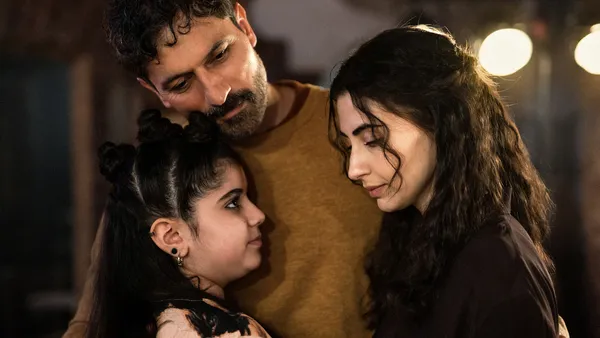

At its International Film Festival Rotterdam world premiere, Earth Song opens with an epigraph of verses from Langston Hughes’s eponymous poem, which calls the earth song a spring song and a body song, something waited for with the force of new bursts and first births. It is a generous promise of renewal, but the story that follows is more interested in the conditions under which renewal becomes difficult to hear, difficult to trust, or postponed indefinitely.
Erol Mintaş has long worked in a register where longing is carried through family structures rather than speeches. In his Mother and Son trilogy, deprivation becomes a refrain. Butîmar turns thirst into parable. Snow frames grief through a mother’s final wish. Song Of My Mother follows a dreamlike search for a song as if it were shelter. After the Finnish dystopian detour of Memory Of Water, Earth Song feels like an attempt to relocate that grammar of longing into the Nordic present, where exile shows up as routine and secrecy as a daily habit.

Rojîn (Dilan Gwyn), a Kurdish-born anaesthesiologist, lives in Helsinki with her husband Ferhat (Feyyaz Duman) and their teenage daughter Azad (Zenan Tünc). Their household is drawn through familiar points of friction, but with one crucial intensifier. Rojîn is frequently away, working as a doctor in conflict zones, and that absence becomes a steady pressure on the family. Ferhat struggles with a life organiaed around departures and returns, while Azad’s adolescent withdrawal reads as the reaction of a child who experiences care as intermittent. Another fault line sits quietly beneath these scenes. Azad is adopted and does not know it, making origin itself part of what the household withholds.
The most suggestive work is done through sensory motifs. The Helsinki exteriors are persistently wind-lashed, as if the city carries a constant abrasive chorus. It is hard not to connect that to the title, to the idea of an earth song that exists as pressure and noise rather than comfort. That pressure gains sharper meaning when Rojîn begins losing her hearing early on, given a vague hereditary diagnosis that makes the body feel like an unreliable receiver. If there is a song here, the story also stages the conditions under which song becomes inaccessible.
The most overt formal gesture is a recurring visual narrowing tied to geography and memory. Finland is allowed to breathe, but any move into Kurdish painful terrain, whether the opening violence, later work in warzones, or the closing return to ancestral home, is boxed in and made more distant. The intention is clear, as if these spaces are sealed off from the present, placed behind glass. The problem is that the move is so literal and so repeated that it risks turning lived history into a visual toggle.
The narrative hinge comes with the arrival of Rojîn’s father (Ali Seçkiner Alıcı), who carries a secret that reframes the nature of family and exposes a buried history of coerced complicity and inherited guilt. The material is potent and Kurdish lives remain far too rarely centered on European screens, which gives the premise its own weight. Yet the path to this recontextualisation leans heavily on domestic melodrama and repetition. By the time the truth surfaces, the viewer has been worn down by accumulated conflict, and what should land as a shock can register as late information.
The motifs, especially wind as chorus and hearing loss as cruel irony, hint at a richer and more elemental work than the one that unfolds. As it stands, the melodramatic accumulation blunts the impact of what should be its sharpest reframe.
Reviewed on: 31 Jan 2026


