 |
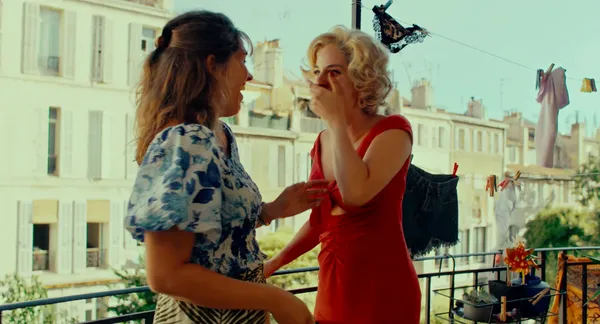
| Sanda Codreanu and Noémie Merlant in The Balconettes |
It won the Queer Palm at Cannes last year, it has entertained audiences around the world, and now The Balconettes has opened in the US, where is brash humour and confident, female-centred approach to presenting sexuality and bodies is bound to raise temperatures. Appropriately enough, it’s set during a heatwave, in Marseille, where best friends Nicole (Sanda Codreanu), Ruby (Souheila Yacoub) and Elise (director Noémie Merlant) spend time on their balcony talking and lusting over an unknown neighbour (Lucas Bravo) who keeps wandering around without a shirt – until life takes an abrupt turn, shifting from romcom to horror, and they find themselves doing things they never imagined. Readers should be aware that there are some spoilers in this interview, though they are unlikely to prevent you from enjoying the film.
It’s Merlant’s second film as a director, and the César and Lumière Award-winning star, best know internationally for her performance in Portrait Of A Lady On Fire, has not lost her enthusiasm for talking about it. Joined at a late stage by Sanda, with whom she has an easy rapport honed by years of friendship, she discussed a wide range of subjects, but we start by discussing an opening shot which pays clear homage to Alfred Hitchcock’s Rear Window.
“I’m a big fan of that movie,” she says. "In this shot that was all detailed in the script already, I wanted to open from the photographer’s gaze, looking at these mysterious people, these ladies on their balconies. But this time I decided, okay, so we start from here and we enter, we go inside those mysterious ladies’ apartments. But this time they don't disappear. It's the guy who disappears. And we turn the camera and we are in their point of view, in the female gaze. These women who are having a lot of troubles, but also looking at this guy. This time he is the one who is looked at and topless and sexy, you know? I wanted to have fun with this concept, with this idea.”
It’s refreshing to see more realistic women on camera, I tell her.
“Yeah. It's my goal. I think cinema and stories are so important in our lives because we humans are people who imitate what we see. If we always see stories of women who are mysterious or objectified, it will not help us. So I needed a movie where you see us. When I say us, it’s the women I know, my friends and I, the real way we are. With our trauma, with our desires, with our jokes, with everything. It's a good feeling for us as women, but it's also, I think, important to share it to the world.
“You know, men don't ask themselves what is scary in life,” adds Sanda. “They do a lot of scary movies, and it's very funny because a lot of people say that to us that oh, it's a different movie. It is scary because they are a little bit violent. Because the women are reacting. They are not violent. This is the reaction.
“I think it is not the scariest thing in the movie. I think men are sometimes shocked by just women having real bodies, you know, or women being vulgar. This is scary for men because they don't see that in movies.”
“The vulgarity of women,” Noémie agrees. “I think, also, women who defend themselves. The women were also far from perfect. And this is a cathartic movie where it's not realistic. It's like a science fiction movie. It will never happen. Women topless in the street walking. It will never happen. It never happened, and it will never happen. And also, most of the time, women don't and can't defend themselves. And so in this movie it's too much, but it's for me a good too much. It's just a cathartic way to breathe.”
We discuss the way that the film sets out to demystify female bodies.
“Why a breast of a woman is problematic?” asks Noémie. “They say it's because it's sexual for them in their heads. We don't call it a sex. The sex is down, you know?” She points towards her crotch, then shrugs and touches her chest. “So this is a breast, and we use it to feed babies. It's an erogenous zone because of course you can get pleasure from your breast, but men can get pleasure with their breasts too.
“So why women can't be topless when it's very hot, and men can be topless when it’s very hot? They say ‘Because it's too sexy, we can't control ourselves.’ That's the problem. The problem is not the body of the woman. It's the fact that we say to men that they can't control themselves, so we have to do it, we have to hide. But we sometimes – that's why I want to show it in the movie – are excited by a topless man. Sometime when I see one that I like I'm like, ‘Oh!’ – but I control myself. I will not jump on him or tell him that he's a problem. It's not the body, it's the mind. The construction of this patriarchal society that puts the desire of men in the middle of everything.”
A lot of French cinema – and cinema in general – is built around men obsessing over women, but when Nicole obsesses over her neighbour, somehow that feels very different, I venture.
Sanda shrugs. “I think it's very usual. I mean, I know a lot of women who have in their brains a lot of fantasies and stories that they leave in their heads because they imagine something like ‘I can be like that. I can fall in love and imagine I'm with this man and we have a lot of kids.’ So it was very easy for me to imagine that because it's...”
“You're a little bit like that,” Noémie tells her.
“I think she falls in love,” says Sanda. “Her imagination is her real love story.”
“It's not him,” says Noémie.
“It's not. It's what she can live in. Her imagination. Imagination is a real power, I think, in life.”
Noémie cautiously agrees. “But it can also be disappointing because she imagined...”
“Yes, that, you know, the perfect guy. A lot of actors get this question from journalists: ‘What do you prefer, the real life or movies?’ And a lot of actors say ‘movies’ because it's more intense, you know? And it is for me to be an artist. Nicole in this movie is the character who represents the artistic part of women, because she is a writer, she's an artist. And women always create in our society.”
“She's very nice,” Noémie observes. “And she lives only in her balcony, at the beginning of the movie. We understand that it's a woman who never goes outside, because outside is the public space. It belongs to men.”
“And she's afraid,” says Sanda. Noémie concurs.
“She's afraid because I think she knows that if she will try to live in the real world, like Ruby or like Elise, she will suffer and she will be disappointed by men, by society,” Sanda continues. “So it's more easy for her to create, to write and to just to watch. Because she's very happy with this imagination. She finds herself like that.”
“And the book she writes, it's the story of the movie,” Noémie adds. “At one point, we don't if it's the reality or it's the book she is writing. And in the book she is writing, it's her imagination trying to get free, to become free from her apartment, to help her friends to be free. Also to liberate themselves from their trauma. So all the movie is built through Nicole's games.”
“Noémie wanted to play with the genre,” says Sanda. “You know, the movie starts like a romantic comedy and finish like a horror movie. And Nicole said that to the Lucas Bravo character, to the neighbour, ‘I will write our stories.’ He said to her ‘But nobody cares. I mean, you can write, nobody will read you.’ And this is true. I mean, we can live that Nowadays, in women’s history, it is hard to create this movie, to produce this movie, because it is the beginning, I think, of women creation only. You know, when we are talking about ourselves. So yes, this is the point of the movie.
“She started like a Disneyland party. Like, I am in love in the neighbour, and he will save me because he's in love with me.” She compares it to Sleeping Beauty, but points out that the heroine of that film doesn’t participate in most of the story, just appearing at the beginning and the end. “So yes, that is the start for Nicole and at the end, Disney is finished and it's over.”
I suggest that Nicole is also interesting because, being able to see things that her friends can’t, she has a whole separate storyline which they barely participate in.
“Yeah, because she is complex,” says Noémie. “She is not one thing. It was hard to say goodbye to the man she fell in love with. She was disappointed. And a lot of women, we have that thing to be stuck in this patriarchal way, you know? Almost like Stockholm syndrome, in a way. We try to protect men. It's not so much their fault. You know, she is in this thing, like she tried to be like, not a mother, a lover, we don't know. But she cared about people and she cared about the man. He could be, in her head, someone extraordinary. But in fact, he did something terrible.
“She trusts her friend. She doesn't trust him, but she needs to understand why. She needs to say goodbye to him. She needs to not repair him, because it's not for her to do it. He has to do it by himself. She just needs to hear what you have at the end. She needs to hear him say it. Even if she knows. She believes her friend, but she needs to hear from him. ‘I raped your friend. Yes, I did it.’ We never have that in the real life or in movies. Never do we see a man who says ‘Yes, I did rape.’ It's always ‘No, it was her fault,’ or ‘No, she lied.’ We never have this sentence, and the whole movie, for me, was a way to go to this sentence.”
I mention that the other thing that struck me about Nicole's character is that in most traditional narratives, when she’s jealous of Ruby, that would turn into her and Ruby being set against each other in the story. Instead, she's much more concerned with her friendship than anything else.
“Yeah, friendship for her is everything,” says Noémie. “Sorority is the base of the movie. I wanted to do a movie about women, friendship, a group of women. There is a lot of movies with groups of men going to adventure, and here I wanted to talk about what I know, what I live every day. It's being with my friends, my friend Sanda and other women. It's like Céline [Sciamma], or it's thanks to her that I'm what I am now, that I can fight my trauma. You know, it's because we support each other. And I wanted to show that in the movies because we too much show women against each other, and it's not what I know in my life. What I know is that the woman around me, they help each other. So they're not jealous. They're amazing.”
Did she always intend to be in the film herself when developing it?
“Yes, because Elise is...” She hesitates briefly. “It's a little bit my story. And Nicole and I are like, Sanda is really my best friend. I started to write the movie with her at her place when I was living with her, and I wanted to have something really real. It made me more confident to know that, okay, this will be on the screen, this relationship. And so that's why I knew I wanted to play with Sanda. And also because my character does things that it’s hard to ask another actress to do, like the scene at the gynecologist. I don't if it’s cut in the United States because I know some countries cut some scenes.”
It wouldn’t surprise me, I say – and at the same time, I’m sure the US will have no problem with the blood and gore in the film. What was it like filming those latter scenes?
“It was funny to do and cathartic,” Noémie recalls. “Because me, I love horror movies, bloody movies. It was kind of my dream to do it because in life I'm not at all violent, but I received a lot of violence in my life and what did I do with all this violence that I received? I never, you know.” She looks momentarily glum, then snaps out of it. “And so I was, ‘Oh, a movie can help me express all this violence that I received.’ And Sanda the same, and Souheila the same. And so we were with all this blood and the fake body of this man, and it was very cathartic. Hard because it's painful, but at the same time joyful because it's fake blood and it's just disgusting like tomato sauce. And it's very funny to do, like we are kids again.”
“Yeah, I agree,” Sanda says, grinning.
The film has been getting a lot of positive attention everywhere that it's played. Did they expect that? How do they feel about the success that it's had?
Noémie suddenly reveals a shy side. “Thank you. I don't know if it is a success, but I'm happy that a lot of countries bought it because I love when the world shares things together, and to see how people react differently, from where they're from. I received message from women in Turkey and women who saw the film in the Philippines. It's very warming and, I don't know, just to have people telling me they feel less alone and then they feel good when they see this movie, or even men who tell me, ‘Oh, thank you. I understand things.’ You know?
“It's why I did this movie. To have a dialogue and discussion between people, between women, between women and men. It's my point. So for me, the success is there. It's the dialogues that exist after the movie. And we talk about serious experiences, important things. In the festival of Cannes, it was fantastic for us to be there. It was like a dream to feel all these people screaming and laughing at the same time. It was a lot of emotion.”
“It was very strange too,” Sanda remembers.
“It was,” Noémie agrees.
“It is a part of intimacy, you know, to talk about ourselves and to create something,” says Sanda.
Noémie nods. “And at the beginning, it wasn't easy.”
“No. And it is so strange to share it with people that you don't know, with different ages, with different genders and different countries, different cultures. For artists I think it's hard and strange because it's a very lonely work. I mean, this is the reason why we have psychotherapy, because talking about ourselves, it's very, very hard. So to share it with people and talk about that is another thing. You discover things about the movie, so you discover things about you, because it's a part of you in the movie. I mean, I think actors who are playing in movies, just interpretation, they give something about themselves in the movie.”
“And also what happened is that at the beginning, we were not sure that we will find at all money to do it,” says Noémie. “All the people who had got the money were very scared. So at the beginning, I thought we would never do it. And step by step, after a lot of discussion and questions with these people who have the money, you know, we convinced them we don't need a lot of money to make this movie, but enough to do it and to make it be here, existing. And that is a success also to be able to do it, to get the money to do it. This is successful.”
“To fight, yes,” says Sanda. “Because there is something like that in the creation of this movie. We had to fight a lot to make it possible, and the movie is talking about that.
“I wanted to take risks. I didn't want to be tepid,” says Noémie. “I didn't want to be in the middle. I didn't know if it would work or what people would say. I needed to do it and take a risk. Not take a risk for the sake of risk, but just share all the monsters and traumas that are in me and, I think, in a lot of people who are victims of sexual trauma.”
“This is a success of the movie,” says Sanda, “because I travel in different countries to present the movie and people are not in the middle. People love it or hate it. They don't tell me, but I feel that. And this is success for me because to be in the middle, we don't want that in life. We want to love something or to provoke. And if we change one person’s mind or life, it's amazing.”
The Balconettes has just been released in cinemas in the US and is available to watch on BFIplayer in the UK.