




 |
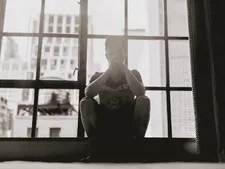
| Sam Slater: 'I think things do need to get broken but the idea of vandalism is so lacking in creativity somehow' |
Mstyslav Chernov follows up his Oscar-winning 20 Days In Mariupol with 2000 Meters To Andriivka, another visceral reportage film from the heart of the conflict in Ukraine, this time transporting us to the frontline. Here, troops are attempting to free the Russian-occupied Andriivka, in the east of the country, where the village is strategically important. Chernov doesn’t pull his punches, showing that life can be cut short at any moment, taking time to memorialise those we meet who have subsequently been lost. The sense of both the brutality of war and the melancholic lament to the fallen is also present in the score from British composer Sam Slater, who wraps his music around the documentary sounds of war. A Grammy-award winner for his work on Joker and Chernobyl, the Berlin-based composer also recently scored Divia, another Ukrainian documentary, which premiered at Karlovy Vary Film Festival and which considers the Russian invasion’s impact on nature. We caught up with him over Zoom to talk about his approach to documentary work.
Tell us about how you became involved with the project.
Sam Slater: It was kind of out the blue to be honest. Due to the way sound design is allowed to work within strict documentary structures, Mstyslav was looking for a composer who was comfortable and had the language to straddle conventional score but also bring the idea of sound design into the scoring language, which would allow him more dramatic flexibility. That’s outside of the very sensible restrictions that places like Frontline and PBS or AP have about where sound can be used within documentary structures. So that was how the conversation started and it went from there.
You started your career working more on fiction features, with the likes of Mother, Mandy and Joker. Does how you approach the work differ when it is a documentary?
SS: It depends on the documentary. It requires sensitivity in both different styles, but I think the thing that’s interesting about working within documentary structures, especially one where the subject matters are sensitive as this film, is that you’re trying to help tell a story without fabricating drama. When you're confronted with the lives and deaths of real people you've really got to be very careful and stringent about how you support the narrative being told without creating a sort of pseudo-fiction or a false emotional state out of someone's actual existence. It's a very tricky balance. Mstyslav is trying to tell a story and honour the contributions and lives of real people and I think it’s of the utmost importance that every person on the team operates from the same headspace.
Talking about the ambient sound we hear of the men on the battlefield and there’s sound design and score as well, how tricky is it to balance all those elements?
SS: I like the idea that you can blur ideas… Basically, sound design and music aren’t distinct practices. I’m not sitting there fabricating footsteps but there are some nice examples. For instance, I noticed throughout Mystyslav’s recording you have the sort of constant chatter of walkie-talkies, the voices of Ukrainian soldiers, who are communicating with each other in many different ways. I wanted to take the sort of walkie-talkie chat of men and we processed it and threaded this strange, semi-human kind of ambience.When the camera takes itself out of that first-person perspective and you're kind of hovering in these long drone shots over the forest, it's these sounds that are woven into the perspective. Whenever you're not actually in the eyes of a person, you come out and there’s this sort of strange semi-human ambience there.
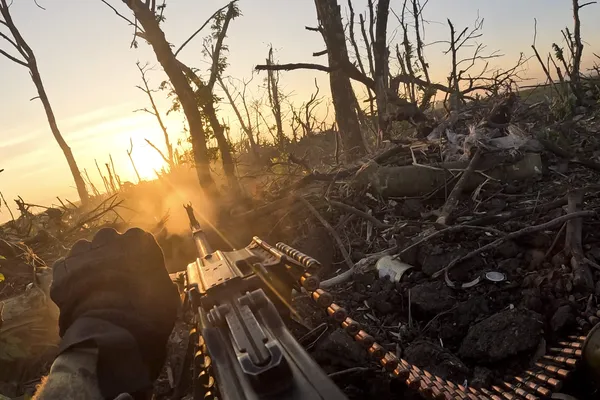 |
| Sam Slater: 'We settled on this idea that we would take the exact rhythm of the percussion of the bullets hitting the outside of the armoured vehicle, and we would transcribe it and perform it in percussion' Photo: AP Photo |
I have this feeling that the least sincere you could do with a film like this would be to write four chords and play on some strings and be like,’That'll do’. These are the lives and deaths of men. At this very moment, they’re still fighting, if they’re still alive and it doesn’t seem fair to arbitrarily dramatise that. The real is already so real, you want to allow that to speak for itself.
The use of vocals is very striking, there’s the feel of a lament about that element. I feel that there’s a trend lately, in general, for using more vocalisations in scores, rather than specifically singing. Have you noticed that? And why did you choose to use them for this project?
SS: That’s an interesting question. I think there's examples of most instrumentation at most times. I The Temptation to. There's more like single voices. I think people are kind of drilling down on the idea of single voices a little bit more. Whether that’s to do with film budgets or not I'm not totally sure. With this film, the reason for landing on the idea of a single voice was just that the film moves between two worlds, which is either first person, locked in fighting – at which point the only sort of musical language is drums and a strange sort of growling feedback we made from various instruments. Then the idea of the voice and the strings is that when you're in the spaces that are not pure fighting, they are often moments of reflection, their funerals, their grief and I wanted to make sure that the humanity of those moments is reflected in the score but not at any point allow the audience to settle.
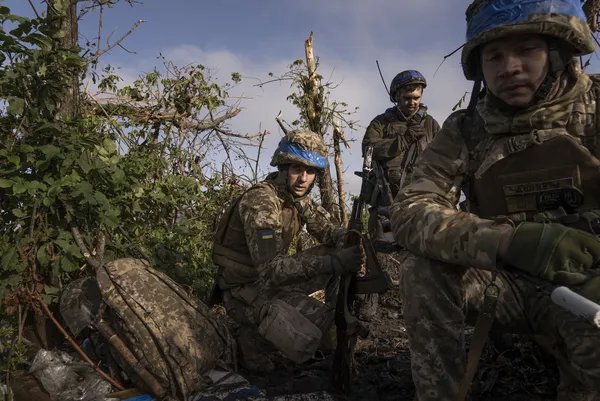 |
| Sam Slater: 'Instead of trying to make a world, it's about taking reality and enhancing it in a way' Photo: AP Photo/Mstyslav Chernov |
You also scored Divia recently, which is another film about the Ukraine conflict. Did your approach to that differ because it’s more about the impact on the natural world than specifically soldiers?
SS: That's interesting because it couldn't be a more different perspective. The director Dmytro Hreshko’s perspective that he has of that landscape is more mournful and very romantic, but in a kind of traditional sense of the word romantic. It's a lament and the music, therefore, has a bit more space to be harmonic. It's still pretty fucked up in places honestly, but there's much more space for it to breathe. There's no narration, so it's just music and visuals. In many ways I feel like it's kind of an installation that you see in a cinema, more than a film in a classic sense. It was very interesting to work on the two of them quite close together.
One of your albums is titled I Do Not Wish To Be Known As A Vandal – what would you like to be known as?
SS: I don't really know. I do think it's worth breaking things. I think things do need to get broken but the idea of vandalism is so lacking in creativity somehow. Definitely break stuff for sure but – I’m trying to think of a good analogy – like break the pottery, and then make a good mosaic out of that. That's kind of the sentiment that I have. When I’m scoring, I’m always trying to use sounds I haven't heard or methodologies I haven't heard. I do think it's important not to get lazy, especially in media composition, where sometimes you don't have a chance to be exploratory, but I think it's really important to do so. And there is a kind of destructive quality in saying, ‘No, I don't want to do it that way, I’m going to do it this way’. But it has to ultimately lead in a great direction.
It’s become quite sexy in the world these days to become quite nihilistic and smash it and be like, ‘that’s it’ – I think you’re only half way through the process, so it’s celebrating too early.
Can you tell us about any other projects you have coming up?
SS: The one really exciting thing I can't speak about just yet but there is um there's some really fun stuff up in the pipeline and the main thing I'm excited to do is take a little break. I've been building a new studio, so the end of the year is cabling stuff in.I have a solo record coming out, which is exciting – it’s very loud.
2000 Meters To Andriivka is on release in the UK and the US now. You can read more about Sam Slater’s work at Ssslater.eu.