 |
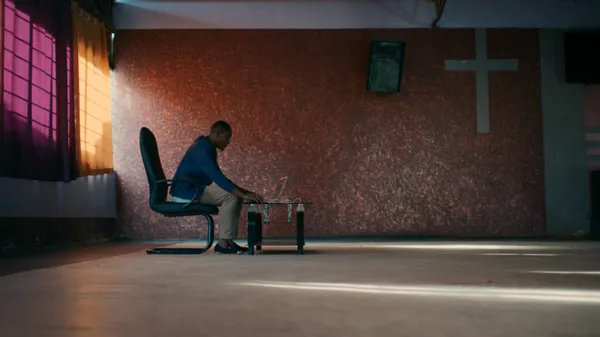
| Shadow Scholars Photo: Tribeca Festival |
One of the best films screening at this year’s Docs Ireland, Eloïse King’s Shadow Scholars lifts the lid on an industry that many now see as a precursor to AI-based academic cheating, but which continues to make a significant impact in itself. It then does a whole lot more. Presented by Professor Patricia Kingori of the University of Oxford, it takes in the experiences of the students who commission others to do work for them, and the brilliant scholars who take it on but who can’t afford a formally recognised education of their own. It looks into the global inequities driving the system, the impact of unqualified people moving into employment, the desperate legislative efforts to control it, and much, much more. When I met Eloïse, I asked her if she had had any idea that it would be that complicated when she began.
She didn’t, she confesses. “The first thing that grabbed me was that I just couldn't believe that there were so many people writing essays for other people that we didn't know about, and that they were then being called fake essays. That was the first thing that really latched me onto it, and then I started thinking about inequity. That's what made it such a rich project to work on with Professor Patricia Kingori. We just kept being surprised. And I think that's a real gift of a project, where you don't hedge your bets on what will happen. It just keeps evolving and presenting new problems, new questions, new challenges to try and respond to.
“When we began filming and even researching in 2019, it was definitely a clandestine industry. The information that was presented by the Oxford Internet Institute was just statistical. It just said ‘We presume there are 40,000 people doing writing and transcription work.’ And then what we saw as we learned more, and then went to Kenya, really that lifted the lid on everything, speaking to the writers. Then the pandemic happened and suddenly there was this real awareness that this industry existed.
“The New York Times did a piece, the Financial Times did a piece as well, and Forbes, and they were talking about this explosion of online cheating because, of course, universities were no longer open and people were working from home. And so at each point, I think we were kind of able to see how the industry was growing and changing and shifting and reacting to that. Our end point for me, as a storyteller, really came when there was this full circle moment. We were already in the edit, but Patricia having this dual aspect of feeling her own work was appropriated seemed for me to be a sad, satisfactory end for us, to open the floor to audiences.”
Underlying all of it is the question of why educated Kenyans are not able to use their degrees directly when rich white people can get degrees without doing the work, I observe, but Eloïse is disinclined to blame anybody.
“I think one of the things that really complicated it for us was there is, of course, this top tier, which you see in people buying entry into universities. It's logical to assume that when those young people get into universities, they're going to struggle to do the work. But I think when we started to realise that the scale of the industry was so big...” She trails off for a moment; it’s still a lot to countenance. “We're talking about 37 million students having already used it, and this is based on conservative estimates, people who had been honest about being dishonest. We were like, ‘This is much more widespread.’
“Anecdotally we were able to find out about students like the one who appears – or doesn't appear in the film, but we hear her voice – whose parents have saved for years to send her to university. It's their life savings, and she can't afford it herself. And then in this kind of twist of technology, she finds herself selling nudes in order to pay for that work. And so I think one of the things that I had always been quite open minded about to was not to vilify anyone's side, but if we went in with an open mind as to how this system works, what creates the demands, what the pressures are, but also who the actors are from all sides, it might just give us a more interesting and nuanced picture.
“One of the desires was to look at the film and the people within it and the systems that they were working within, as a potential lens for how we might reimagine what the existing world is that we're operating in. The fact that we can see that there is this incredibly unregulated but sophisticated industry, the fact that we know that there's this source of knowledge there, that it's being undervalued and actually often not even being acknowledged at all, what possibilities does that open up?
“I definitely think we've all been in situations in our professional lives where you wonder if people know what's going on or if they're qualified to do the job they've been asked to do. And I think one of the outcomes of working on this was maybe I was justified in feeling that sense of unease about people's expertise, you know? Just because there's the qualification or the position in an organisation to say that they can do it. Sometimes we understand, just through our experience of what's being exchanged, that the knowledge isn't really there.”
The film feels very timely, because we are seeing AI start to write people's essays for them and more and more people using that. The work that's being produced by actual scholars seems to be of a much higher quality than that and much harder to detect, but what does it mean for those scholars if AI starts to cut into that space?
“AI has had a negative impact on the economics of this industry,” she concurs. “Notwithstanding the fact that AI as we know it is already reliant on essays and doctrines and theses and published work that already exists. I think there's a real potential to understand that their work is almost being exploited twice, or at least extracted from twice, and dispossessed from them as a community. And then also we can see that students are using them to humanise work. So there's all of these complicated ways in which AI is disrupting the system that they've been operating within and also making them more invisible. It seems that all of these power structures that come in each and every time are really intent somehow on denying the presence of the writers in all of our everyday lives.”
People talk about going into that kind of work not really wanting to, because there's nothing else.
“Yeah, it definitely seemed to be that way. And at the beginning of the film, there was a statistic that said that one million students are graduating each year and finding themselves unemployed. Unemployment is a real factor in the attraction of this industry. And I think if you spend a lot of years writing anonymously online for other people – sometimes I feel quite precious when it's referred to as ghost writing because there's an acknowledgment with ghostwriters of who they are. There's a complete disconnection in the case of the academic writers working in Kenya because lots of their clients may not know that they're Kenyan at all and believe that they're getting the work from someone else entirely.
“To your point about AI, we used AI in the film to protect the identities of the writers. And in so doing, online, they're often presenting themselves as white students. So there is this kind of double mask that appears, or at least is discussed or explored, within the film. The fact that they can't go online as themselves in any case.
“Once the crackdowns began to happen legally, it became illegal in the UK to provide this work. It became illegal in Australia to provide this work. We're not talking about to receive and to hand it in, but to be someone actually supplying the demand for it. They're being criminalised. We then, for their own safety, had to create AI-generated digital, synthetic masks. And so in the film, they appear like there's just a slight blur, but actually those are completely AI-generated faces that are distinct from who they are.”
I mention that, when freelancing, I've been asked to write all kinds of things that are supposedly going to appear on websites somewhere. They could be turned into essays. Any number of things could be turned into essays, and one can't really know, so it makes it very difficult to legislate.
She nods. “Yeah, I think it is a difficult industry to legislate because there's a vested interest in saying it doesn't exist. The legislation was brought in in Australia. The letter that you see appearing in the film is written to the Kenyan education ministries, and what it outlines is that if this isn't curbed at the Kenyan side, or they don't discourage young people from doing this work, Australia will assume that the degrees that are coming out of Kenya are also fake. There's a real passing of the political hot potato, isn't it? It's like, rather than curbing at the side of the demand, where people are passing this work off, it's the communities who are already disenfranchised, with a lack of access to global institutions legitimately, who then face a double penalty.
“As you see in the film, many of them are interested in going to higher education, but specifically in countries in the global north, because the value of the degrees here is higher. And so within that economy, they can't come in legitimately because what they earn won't allow them to pay the fees. Or with various visa changes that are happening and hostile immigration policies, they can't access those spaces, but they're already in there and propping them up to begin with.”
There’s a moment in the film when we’re told about people writing medical papers who got their degrees in this way, and the fact that there are unqualified people in areas like that that is quite terrifying.
“Yeah. So what the research showed was that most subjects are involved in this industry. Writers are able to cater to humanities and STEM subjects alike. There is no discrepancy. However, STEM subjects we chose to focus on, particularly for the reason that you've mentioned, because when you think about engineering or medicine, these are subjects that require a lot of technical knowledge, very specific know-how, to implement in the real world. They also carry a far bigger public health risk if there are people who are working in those industries who don't have the knowledge or have cheated on the qualification.
“These are our doctors, our nurses, and as Patricia says in the film, our pilots. And beyond that, I think a point that's well made by Tricia Bertram Gallant is that you don't just want people who are qualified, you want them to be ethical, you want them to fit. You want to feel like these are people that you trust. And in a space where we're increasingly questioning truth and post-truth, it's incredibly important that not only the institutions, but the people who uphold the values of those institutions are people that members of the public feel that they can trust, are qualified, and have done the work that they say they have, when they're acting as representatives and taking care of us.”
We've got one generation that's going through it now, but it won't be that long before that generation is running the universities and judging the work of other people who are potentially using similar approaches. Then there will be a much more complex and embedded problem.
“Yeah, absolutely. It's really interesting to see how the relationship to cheating and getting ahead and faking it till you make it is different as generations change. In the film, we heard the voice of an influencer who'd been the recipient of work mockingly joking about having attended 100 million classes and worked really hard. And it's not just about the dishonesty of what she's saying. Other people and other students who are working alongside her are so dishonest, disadvantaged by someone who might be cheating. You know, you're working your absolute hardest to be somewhere without knowing that the person next to you is really paying an army of other people to carry them through academia, or you are aware of it, and then what students are inclined to do is probably feel that they have no choice but to cheat in order to keep in line with the curve.
With all of these different sensitivities around it, how did she and Patricia go about finding people to participate?
“It was really interesting because prior to going to Kenya, Patricia and I had a conversation about it, and we were talking to other people trying to research. There wasn't much that had been published online, and we were told that it was really unlikely that anyone was going to speak to us. And then through an interlocutor who was based in Kenya, who worked in the gig economy sector, we said ‘Can we just come over and then maybe we can set up some focus groups? If there are 40,000, if 1% speak to us, there's bound to be some inroads that we can make.’
“When we got there, we went to our first focus group. We'd shared our information ahead, and so they had checked myself and Patricia out, and they were trying to seek verification that we were who we said we were as well. And that was a really, I think, important basis on which to begin the negotiation of may we film with them. Because we knew that there was an agency. They wanted to know who we were, just as we wanted to know who they were. And going on from that, we held town halls where we brought the writers together a number of times over the four years of filming.
“As the situation changed, we were really transparent about what we did know and what we could protect against. We were also really looking to hear from them about what their concerns were, what their fears were around sharing. I think that process of transparency and collaboration really facilitated not just an ethical means for them to be involved, but one that meant that they were able to trust us, even as things became riskier...I think they were really happy and really proud to be part of the film.
“One of the big concerns that they had was that other members of their community would think that they were selling them out, that they would criminalise themselves and that this would hinder any opportunity to potentially gain legitimate work in the future. And I think another one was really ‘Are we going to cause a collapse in the industry? This could be biting the hand that feeds us.’
“What drove them to speak to us, I think, was that they did want recognition for their work. And they also wanted to present themselves not as the passive recipients of aid who were waiting for a handout, but young people who were intelligent and really capable of seizing opportunities. If the film could act as a vehicle for that, it was a a chance that they were willing to take.”
We discuss the other side of it – how she found students who had been buying their work and were willing to talk.
“When I was reaching out and making contact with people during the pandemic, it was really clear that there were a lot of young people who were quite disillusioned with the education process because they weren't having this access to institutions, or as many teaching hours,” she says. “But also they were under a huge amount of pressure. That was directly a part of why I didn't want to criminalise or vilify anyone in the film. It was very much about trying to understand the conditions that create it.
“I think a lot of the same truths existed for all of the students on both sides. You know, their parents want them to do well. They're the hope of the family. They want to have good jobs. And there are various other economic, mental health and structural pressures. But it's really difficult to get a job. For the first time in history, we have a surplus of educated people. It's not just young people in Kenya who are graduating and finding it difficult to get a job that they are qualified to do. This was also part of the experience of what was happening in America. I think they were willing to speak because they felt like they weren't being heard.”
Did the experience of making the film change the way that she felt personally about the industry?
“Yeah, I think it did. At the very beginning there was a sense of awe around the capacity of this group of people to output so much work. One of the writers that we saw in the film, Moses, we're looking at his computer and there are possibly hundreds to thousands of essays that have been completed over the years of him doing this. And Patricia makes the point in the film, most of us don't even want to do the essays that we’re required do in order to qualify or pass our exams. So it's really fascinating to me that that skill was there.
“I think one of the other things I couldn't help but think about were all of the ways in which, within the British education system – my mum is a Jamaican immigrant. She was born in Jamaica, but moved here when she was nine years old. And like many young people who came to this country at that point, they found themselves immediately streamed into being ‘educationally subnormal’. It really made me think about all of the ways in which education has often, for communities of colour and women and disenfranchised people, been positioned as an access to opportunity. If you get educated, then this will really make all of the difference. And myself growing up as a young person from a single parent family, I really innately connected with the writers and this idea that education is an opportunity for mobility – something that you grab onto with both hands if it's there. And when it fails to provide or there's a deferral in what it promises, it can be incredibly disappointing.
“Over the course of making the film, whilst keeping in tune with that really intimate and personal sense of it, I became more interested in the way that the larger systems around it, here and in America and Australia and in Kenya itself, were enabling this to happen. So there was a sense of progress that was brilliant. Technology has come to Kenya in 2010, they're using high speed Internet. And then what was actually, what is it being used for, and who is it really benefitting? Asking those questions. So I think my entry point was in some ways quite small and quite personal, as these things often are to compel us. And then by the end I really learned so much more about a broader system and how it implicates us all. There are never just clear, singular victims in these situations. It's a system that requires everyone to think about it in order to change and shift it.”
We talk about the film’s festival success.
“We've been so lucky,” she smiles. “We premièred at London Film Festival where we got a special jury mention. We then went to IDFA. We were at CPH:Dox where we also got a special jury mention, and Johannesburg Film Festival. We have recently been to Millennium Docs Against Gravity. We went to Docville in Belgium and then Tribeca for our North American première, and then Sydney. So we're really happy.
“I do really look forward to us landing in Nairobi towards the end of the year, to make it to Nairobi Film Festival. But I think what's been most encouraging about the festivals is that not only is there a really big geographical spread, which tells us that it's a subject that's affecting lots of different communities and there's kind of an urgency to see that. But whether it's been industry-focused festivals or very much audience-facing festivals, it's not just a story that's about people from the global South. I think it has different appeals in different spaces.
“I guess what I wanted to say was that it's been really encouraging that people come to it on an intellectual level, who are interested in power systems of education, as much as they come to it to see the kind of intergenerational mother-daughter relationship threads that run throughout it. For me, that's a really rewarding thing, to think that artistically it goes beyond being an investigative documentary. At its heart, really, it's a sort of character-driven narrative about people who find themselves inextricably linked through the systems that govern all of our lives. And one of those happens to be education.
“I think often we really understand things much more clearly through the experiences of others. You can put a hundred statistics up about what's going on somewhere else. But when you have a single mother who is working more than one job, including one that's providing work for other students, and yet struggling to keep her young daughter in school, I think that's an experience that many, many more people can identify with. Not just the injustice of it, but her aspiration and her desire for the next generation to be even better than she was.”