 |
| Leviticus |
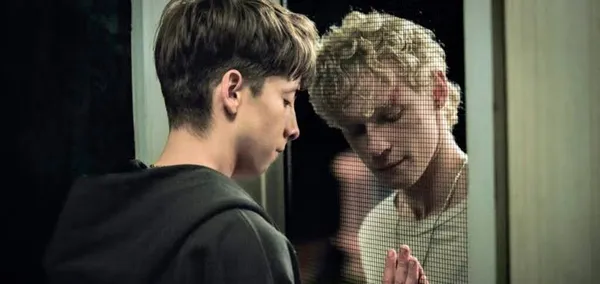
Australian director Adrian Chiarella's queer supernatural horror Leviticus, revolves around Naim (Joe Bird), who relocates with his mother Arlene (Mia Wasikowska) to a new town after the death of his father. He develops feelings for Ryan (Stacy Clausen), a teenager at his new school. When he witnesses Ryan in a secret romantic embrace with the preacher’s son, his jealousy drives him to expose their secret. The leaders of the homophobic community call upon a deliverance healer to expel homosexuality from the two boys. Instead of driving it out, however, he awakens a terrifying entity that takes the form of the person each boy most desires. Soon Naim’s secret is exposed, and with his mother’s blessing, he too is condemned to suffer the same fate.
Leviticus is Chiarella’s feature début. He has directed the short films Touch, about a man with a rare skin condition which makes connecting with his mother difficult; Black Lips, which sees a Chinese immigrant discover something about himself when he breaks his routine; and Dwarf Planet, an adaptation of Andy Boreham’s short story about an encounter between a teenage boy and a male sex worker.
In conversation with Eye For Film, Chiarella discussed confronting re-emerging homophobic attitudes, putting a queer spin on exorcism horror, and concealing transgression. He also reflected on creative stamina, the desire to not only rely on terrifying audiences, and the unique skill of his lead actor.
The following has been edited for clarity.
Paul Risker: Why filmmaking as a means of creative expression? Was there an inspirational or defining moment for you personally?
Adrian Chiarella: Wow, I can't really pinpoint it to one moment in my life, but I just know that I've always loved watching movies. It'll probably give away my age, but I still remember when I was a kid, my cousin was the first person in our family to have a VHS player. We watched all kinds of old movies: old musicals and, obviously, kid's films. But her dad had a few horror films, and in particular sci-fi horrors like Aliens and The Thing, which we watched. We probably shouldn't have watched them, but in those days, I don't think people were quite as strict with kids. So, I've loved this genre ever since I was too young to engage with it.
PR: Watching horror films when we’re young is what some might call a rite of passage. It introduces us to our primal fears at an impressionable age.
AC: Yes, and showing you the potential of what this format can really do. It’s so visceral even when you're a little kid, and you're too young to understand this world properly. There’s just something about this medium that's so powerful. It can really get to you and hit you in a way that almost feels like you've had a dream that won't go away. And sometimes that dream can feel like a nightmare or a different kind of experience.
PR; It's interesting how we shield people from stories, when real life can be more frightening, whose horrors are broadcast throughout the day.
AC: Yes, it's interesting how we have so many opinions about what we can and can't depict on our screens, and yet it seems to just be the Wild West when it comes to real life.
PR: A director’s first narrative feature is a milestone moment. You spend so much time looking ahead towards it, to now find yourself on the other side of it must be a surreal experience?
AC: I spent a lot of time making shorts and doing a bit of work in television, but what I was really interested in was this format of feature films, particularly theatrically. There’s something about the experience of an audience coming into a space and watching a story in one sitting where it begins and ends in front of them. And also having the audience walk in and not know anything about the characters and then get to the end and suddenly know more about them than perhaps they know about each other. That has always been magical whenever I watch a movie, and I want to play with that in this format.
Horror movies are a genre that audiences love to see in cinemas because they're so visceral and the experience can be shared. It's a bit like watching a comedy with a crowd, where feeling the rest of the audience's reaction is special, compared to making television and short films.
I knew that this would be a much bigger scale and undertaking and just the creative stamina required was so demanding that nothing could have prepared me. You really do lean on the creative collaborators around you: the heads of department, the actors, and the producing team. They were the ones that got me across the line. And in terms of the reality of releasing a film into the world, I guess what I wasn't expecting was that a film like this, perhaps because of the love story and the performances of Joe and Stacy, would inspire the young audience to really connect with those two characters and in their own creative ways. They're writing fan fiction, fan edits, and fan art online. That’s not something you ever think about when you're writing a screenplay. So, that has been exciting.
PR: What was the genesis of the idea for Leviticus?
AC: Australia legalised same-sex marriage in 2017, but we did it via what they called a postal ballot. They basically took a poll of every person in the country over this one issue and what that led to was a lot of debate in public spaces and online about how you were supposed to vote and whether or not people would vote for or against this. And it led to the unleashing of a lot of quite hurtful and, frankly, quite homophobic language. And even though we won that one and marriage equality passed in late 2017, early 2018, that language never seems to go away. There was this return of homophobia entering society, and I wanted to make a film that addressed that, and I wanted to do it in a personal way.
I thought back to the kinds of films that I turned to when I was a teenager going through the same experiences as the characters in my film, which was this genre of horror. I started thinking about the fact that horror movies at their core are about a type of fear and I asked myself, ‘Can we make a horror movie out of the fear that is known as homophobia?’
That’s when I started exploring the idea as a writer and at the same time, I was looking at exorcisms performed on queer teenagers. I asked myself if I could make a film that was a bit like an exorcist horror, but with these gay themes to it? But I didn't want to do a story that just perpetuated the myth that there was some sort of gay demon inside these teenagers. So, I started thinking about what they are really doing with these practices, and how they’re not taking something out, they're putting something in. And what is that fear that they're instilling in people? That’s where I came up with this idea of a horror movie monster that can mimic your desires and take on the form of the person you're most attracted to.
PR: Leviticus explores that relationship between humans and a mysterious other world, and poses the question: which is more terrifying? Should we be more scared of the mysteries of what lurk in the shadows, or should we be more wary of other people?
AC: Yes, it's literally in the mythology of the monster that we created. And the sad truth of this film is that these characters, when they have this curse put on them, they can't even be alone with their own truth and their own feelings. So, yes, there is something in that, but ultimately, they learn to find sanctuary with each other and offer their support.
It's interesting what you're saying about the horror coming from another world. In our film, we have this deliverance healer who opens the door to another world to unleash this curse. But for me, what I've always found great about horror movies with a supernatural or even a sci-fi element is that ultimately, it's the horror of humanity that is explored. And so, in Leviticus, I was interested in exploring what some people in this community do when there's a force like this that they can manipulate against each other and against their children.
When I came up with the concept, I knew it would be a film about identity and this one character at the centre of the film who is on a journey to understanding whether or not he can trust the people around him. Not just Ryan but also his own mother, as well as the people in the community and its leaders. And so that became a huge part of the writing and the plotting of the film.
PR: I remember being told “if” is a small word that means an awful lot. In Leviticus, big dramatic arcs come out of moments where we could ask, “what if?” For example, what if Naim had not revealed Ryan’s secret? How would that have changed the trajectory of their lives? And how did the representation of queerness play into the way the dramatic arcs played out?
AC: Horror movies are usually about a transgression being committed, and so, the mythology of a horror movie is always 'Don't feed this thing after midnight' or 'Don't cross this piece of land'. I always love horror movies where you can't quite pinpoint whose transgression it is. That's what started all of this, and that's what I was going for with the first act of Leviticus: what is it that unleashed all of this? Is it the way the boys treated each other? Is it the fact that Naim went to the church leaders and told them what was happening? Is it the deliverance healer turning up and unleashing this spirit and dabbling in this dark art of unleashing a curse? It could be all of those things, and it's up to the audience to decide that. But yes, those are the types of horror movies that have always interested me.
What was important to me with this film, in terms of representation, is that I wanted to show these two young men who are attracted to each other. And I wanted that attraction to feel genuine. I wanted anyone in the LGBTQ community, and in fact anyone who has ever felt an attraction to someone else at that age and has had to struggle with that and come to terms with their true feelings to identify with it. And so, it was important when we were casting and when I was rehearsing with Joe and Stacy, and when we were shooting those scenes between the two of them, that the connection felt as authentic as possible. This means anyone who has ever had feelings for someone else at that age will be able to identify and connect with these characters. Above all the technical horror set pieces, that was the priority.
PR: When you’re telling a story in the cinematic medium, you’re trying to convince the audience that what is contrived is real. That’s the biggest challenge, because when it feels fabricated or performed, it can break the suspension of disbelief.
AC: I have a background in editing, and what that taught me is sometimes it's about what you don't show. What we're really doing when we make a film is all of these images and sounds that we're gathering, they're just to prompt the audience. If you're doing it well, then you're firing your audience's imagination. So, they're joining the dots, and all the magic is actually happening in their head. That was an important lesson for me to learn early on as a filmmaker.
But it has to start with the characters and the audience needed to connect with our main character. So, it started with casting Joe and knowing not only that Joe was someone I thought the audience could relate to, but also that he has a rare gift amongst young actors, where he can act scared and you believe he's scared.
The key to this film was if the audience could be right there with him through this emotional experience, then I knew we'd have a film that would work in that genre space.
PR: Picking up on your point about the emotional, is Leviticus driven more by an emotional type of horror than the visceral jumpy and terrifying side of the supernatural?
AC: I was definitely always going for an unsettling feeling throughout the film rather than just jolting people with the jump scare. Although we certainly do have a few that some people have told me worked on them. But I was definitely going for much more of an unsettling feeling with this one, which I hope people get a sense of when they see the film.