 |
| Mārama |
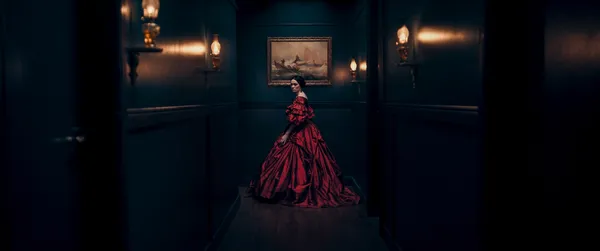
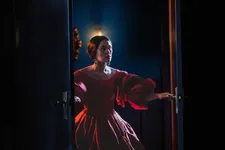
A début feature which has wowed the festival circuit and stands out as one of the best works of 2026, Mārama, recently screened at Overlook and Fantaspoa, sees two worlds collide as a young Māori woman steps off a boat in Whitby and straight into the English Gothic. Persuaded to serve as a governess in a spacious yet sinister country home, she gradually uncovers the brutal history interwoven with her own past. Themes of ancestry, inheritance and the legacy of colonialism lend the film additional weight, and the powerful central performance by Ariana Osborne will keep viewers gripped throughot.
“I felt that I'd seen a lot of beautiful films, Māori stories, in the historic period that I was interested in telling my story in,”says director Taratoa Stappard when we meet to discuss it. “But they were all set in Aotearoa – New Zealand. I've never seen a film that took a Māori lead character, especially a female lead, and positioned her outside of colonised Aotearoa. And perhaps because most of my life I've lived in England, it seemed obvious to me to try and find a way to tell a story that brought a Māori character to England.
“Initially I was so ignorant about the history. You know, a young Māori woman travels for 73 days to get to England. Is that credible? And yes, the answer is absolutely yes. It doesn't take long to find out through research that Māori were getting straight back on those boats that were the initial whaling boats, the missionaries that came to preach the word. They would get back on those boats and go all around the world. And we're talking early 1800s. So it felt credible that, you know, a strong, independent young woman, whenoffered information about who she is, would take that ticket and run with it and go.
“For me, I suppose it was a way of trying to find a way into a story that I felt I could speak to. I have lived most of my life in England and my father is English, but I had my taha Māori, my Māori side, that was, certainly until about six or seven years ago, almost entirely mysterious and foreign to me. All I had was a few stories that my mum would tell me and my sister when she was alive, of our ancestors, but no real lived experience. But now I do. Now I've been able to spend nearly four years making Taumanu, the short film that preceded Mārama with the same producer, and that acted as a proof of concept, I suppose.
“When we were looking for funding for Mārama, it was great to be able to show that was funded by TVNZ. It was a commercial half hour, so it was 23 minutes long. Taumanu is a Māori word, like many Māori words, that has two completely different meanings. It means both to take or colonise and also to take back and reclaim. That was the essence of Taumanu and kind of is the essence actually of Mārama as well.”
It fits perfectly into the tradition of the English Gothic with its strong willed young heroine, I observe. I was interested in the way that he wove together that traditions and the Māori supernatural.
 |
| Mārama |
“Honestly, it just kind of evolved. I'll hold my hand up. I haven't read many of the books that I've been asked about in Q&As. I get asked, you know, ‘Was The Wide Sargasso Sea in your mind when you wrote the script?’ And I'm like, ‘Okay, I'm going to be honest, I haven't read it.’ I've read Jane Eyre. I've read the basics, but I'm not a scholar of Gothic literature. But it feels like it's in the same lane, I think. I'm hoping that's what people who do know more about Gothic culture and Gothic literature are responding positively to. It seems to strike a chord.
“When did I first start calling it Gothic? There's quite a few drafts. I figured out, ‘Okay, it's got to be 1859 because she's this age then and that means he was – you know, it was all plotty backstory stuff that needed to make sense with Nathaniel Cole having made the fortune that he has made at the right time.”
He describes Nathaniel and his former comrade as “the tech bros of their era,” then changes his mind on the basis that they were not educated.
“They were these often horrific men – and it always was men – who made absolute fortunes from, as Cole brags, ‘harvesting’ the seas. Literally what they were doing on an industrial scale was slaughtering whales. Sorry, I'm digressing, but it was about getting the timing straight so that the birth dates and the death dates would all work and make sense. And I found myself telling a story in 1859. Well, that's prime Gothic. And yes, absolutely, a strong female character was always intentional. I look back just recently at my first short film and it's a film called Eight For Eight Thirty. It has a strong female character.
“There's something about the influence that my mother has had on my life and my sister had on my life when she was still alive and my wife now has on my life. I'm drawn to telling those stories. My next projects are all centered around strong female characters, so I like that idea. That was the one intention that I always had. When I finally found the self confidence to think about trying to write my first screenplay, the one thing I knew was that it was going to be about a woman, and then it became, well, I think I can make it about a Māori woman.
“I'm not trying to tell a contemporary story about a Māori woman in Aotearoa because I'm not qualified to do that. I definitely don't have that knowledge. Plenty of other people can do that properly. But I think I can research and look, in a fictionalised manner, at what it might have been like to be a 24 year old Māori who washes up, as it were, in England.
“It wasn't even intentionally a horror, to be honest. That came with the writing of subsequent drafts. Actually there was one particular moment I remember when I was in research, there was a horrific image. I remember coming across an infamous image of a man called HR Robley. He was a notorious collector, a self appointed expert in Māori moko tattooing. He wrote a book called Moko. Anyway, he also collected preserved Māori heads. And there's a picture of him sitting proudly in front of his wall with 29 Māori heads mounted behind him.
“When I saw that, I was like, ‘Oh my God, this is turning into a horror. This story, which I think I started out conceiving as a heavy drama set in the Victorian age. But that's no way to pitch a project. Oh, I've got a heavy drama that's Victorian. People are falling asleep already during the pitch. Once I refined the pitch I was able to talk about the project as a Māori gothic horror. When we went to the Berlinale, we got into the production market to pitch the project. We were looking for investors and the one thing no one ever said to me was ‘Oh, a Māori Gothic horror – we've already got one of them.’
We both laugh, but there’s serious subject matter at the heart of the film, and it goes to some very uncomfortable places. It tell him I admired the way that the racism we see itself functions as horror; I think it's something that a lot of people will come to it not knowing which of those tropes are racist in an immediate way because they're not familiar with Māori culture.
“We've screened at a couple of really interesting festivals, two of which are full on genre festivals,” he says. “Sitges in Spain and, more recently, Brussels BIFFF. It's called Brussels International Fantastic Film Festival. Have you ever been to Brussels?”
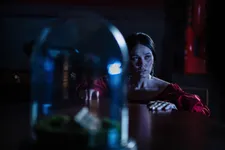 |
| Mārama |
I haven't, I tell him.
“They have this kind of call and response thing, with the crowd shouting out during the film, all kinds of different things. When someone in a film smokes, everyone coughs, the whole crowd. And it was a huge cinema. It's like a thousand [seat] cinema. On opening night we went and saw Ready Or Not 2. It was fun and it was a perfect opening night film because it's kind of commercial and easy, but oh my God, the audience interaction was incredible. People were shouting at the screen, people were howling. Everyone howls when a shot of a moon appears, which happens a lot in horror films. It was crazy.
“I was thinking, ‘Oh fuck, this is going to be a disaster for my film,’ which was playing the next day, because it's got lots of these tropes. And actually what happened is everyone was very quiet. Afterwards the organisers said ‘Oh, take it as a compliment. They were into your film, actually emotionally involved.’ And I was like, ‘Great.’ But the one thing that happened both in Sitges and in Brussels was after the pivotal haka, before we cut around to see what she's been looking at – this horrific tableau of cosplaying – the whole audience erupted in applause, cheering, clapping. And then what happens in the film happened and it suddenly went quiet again.
“Afterwards people came up to me and they were like, ‘I'm sorry. I felt bad. I feel like I want to have a shower. I felt bad for cheering her haka.’ And I was like, ‘No, I feel like you were cheering in the right way.’ But what way were they cheering? I don't know. The same happened in Spain. There were cheers after the haka, which just went to silence when what happens in the film happens.”
Another aspect of the gothic that it touches on is the long tradition of twinning and the sense of the split self.
“The twinning element of the story is a direct inspiration from one of the stories my mother would tell me about,” he says. “I never met my great grandmother, but mum’s kuia - kuia is the Māori word for old woman, old grandmother – my mother's kuia or my great kuia was a woman called Rangiriri Strew and she had an identical twin sister called Te Pura Strew. They were born in 1880. And by the time they were 16, so 1896, the twins, Rangiriri and Ter Pura, whose English names, because they had English names in those days as well, at the boarding schools that they went to – Eileen was my great grandmother and Georgina was her twin sister.
“Eileen and Georgina, or Rangiriri and Te Pura, were expelled from their third school when they were 16. Their English father – they had a Maori mother and an English father, like my situation – disowned them when they were expelled from their third school. All they wanted to do was speak te reo Māori and practice their culture, but they kept being told not to. They went off and got themselves matching moko koa, the facial tattoos for Māori women, and they became very popular in New Zealand as guides in the newly evolving tourist industry.
“With the steamships at the turn the century, loads more tourists were coming and wanting to see the genuine Māori authentic experience in an area called Rotorua. They became very popular with tourists and they were well known guides, beautiful women and also great English speakers. And they had great te reo Māori – their Māori was beautiful as well. Anyway, my great grandmother went on to lead a concert party of young Māori women, including my grandmother, called Princess Rangiriri and her nine Māori maidens.
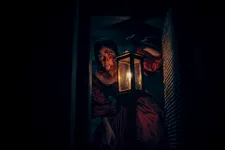 |
| Mārama |
“She took them on a tour from New Zealand through Australia, through America. They performed in San Francisco, all the way to England. I don't know the exact date, but it would have been in the 1910s, before the First World War. It struck me what must it have been like for my great grandmother, a staunch Māori woman, to lead a troop of beautiful young Maori women and basically sing and dance and perform and entertain those people who not only had colonised, but were still colonising people?
“That was partly an inspiration, as well, for the story. This idea of journeying. Sorry, I'm rambling, but to bring it back to your original point about the classical Gothic tropes, it all started to make sense and I could see how I could own the story a bit more. Perhaps because I was able. I could do a bit of ka mua ka muri myself – you know, I could look back into my past to understand my future.”
Coming up in part two: Taratoa Stappard on the women who helped tell the tale, the other colonial subject in the house, and finding his star.