 |
| Polly Maberly in Odyssey Photo: courtesy of Icon Film Distribution |
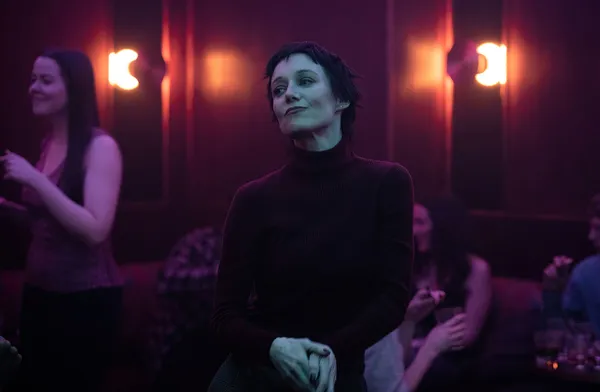
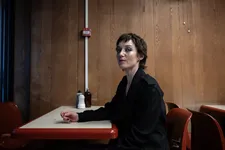
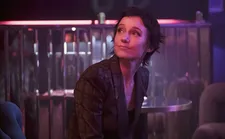
Gerard Johnson's Odyssey is a gritty tale that follows Natasha Lynn (Polly Maberly), a cutthroat real estate agent who is dragged through London's dark underbelly after she's drawn into a devious scheme involving a corrupt money lender.
Johnson made his feature début with the London-set serial killer thriller Tony, which was adapted from his short film of the same name. He also directed the neo-noir crime film Hyena, about a policeman's moral struggles amid the Turkish and Albanian ascendancy in London's criminal underworld, and the thriller Muscle, set in the world of bodybuilding and telesales.
 |
| Odyssey Photo: courtesy of Icon Film Distribution |
Speaking with Eye For Film, Johnson and Maberly discussed their appreciation for the movie theatre, drawing on her experiences of working as a letting agent, and using genre to counterbalance the film's politics.
Paul Risker: How would you describe your relationship to cinema?
Gerard Johnson: As soon as I could walk and talk, I was obsessed with films. It was the thing that I was passionate about from such an early age, and I come from a family that was quite obsessed with film. It was always talked about and there were lots of films in the house. We had an old beaten up Halliwell's Film Guide, and we used to go through that and test each other on which film and who was in what.
I had movie posters in my room. There was a James Cagney period, a Harold Lloyd period, and a Universal horror period. And then it went on to Scorsese and De Niro and Alan Clarke as I got a bit older.
So, I had an encyclopaedic knowledge of film before I even attempted to make anything.
Polly Maberly: I grew up with an older brother who was obsessed with film. Somebody asked me the other day what my first VHS was? We grew up on things like Breakfast Club, Weird Science, and all those movies — that started the love of it.
When I was 16, I went to drama school and my best friend there was obsessed with film. We had lots of theatre training, but she was like, "No, film's where it's at." She introduced me to so many brilliant films. I worked in Screen in Reigate, where I grew up and was perpetually wrestling with being a jobbing actress. And working in cinemas, I would always see new films when they were first out.
Even though I'm now witnessing the death of cinema, one of my favourite things is to go and sit in the morning in an empty screen and just switch everything off. I don't understand people who don't want to do that. It's a gift to be able to sit on your own in front of this huge screen and switch everything off. And I hate knowing anything about a film beforehand. I don't want any spoilers — I want to be completely surprised by what's coming.
PR: Speaking with Duwayne Dunham, he said, "The movie-going experience is unique. What other experience do we have where you pay money to go into a room full of strangers, where the lights are then turned out and the curtains open, and you're swept away? Or hopefully you are. You're transported into the story and then the lights come on, and you leave, but you will have shared this emotional experience with a bunch of strangers. Cinema is the only thing I know that can do that.”
GJ: Any cinema is fantastic, but the newer screening rooms are a little bit more sterile than the older cinemas like the Curzon Mayfair. If you go into the main screen at the Mayfair, it's not just the history of all the people that have sat there and all the films that have played there, but there's something about that big auditorium and, as you say, sharing it with so many people — it's unique. And the trouble is, when you watch stuff at home, which you have to do a lot of the time, there are interruptions, and you're distracted. Just turning your phone off and being in that space for an hour and a half to two hours, and then coming out in a different mood to when you went in, whether you've been inspired or you're left feeling depressed is the power of cinema. And I like it if films change my mood, even if it means they leave me feeling depressed because it's something different.
 |
| Odyssey Photo: courtesy of Icon Film Distribution |
Cinema at its best is the most powerful art form because you've got the visuals, the music, and the writing — everything comes together in one package for that hour and a half. And it's the perfect length as well rather than a TV series.
PM: With a background training in theatre, what's nice about the theatre is that you get to play your story out from beginning to end, which is a gift. I'm a jobbing telly actress where you seldom play out a story. You usually come in for a small part, try to make an impact and then leave — it's all a bit weird.
This film was different because we did do it chronologically, which was lovely.
PR: So, is it your intention to provoke the audience and make them active participants in the drama?
GJ: I like cinema that gets under your skin and is incredibly visceral and powerful. I try and make films that I know if I was a fan or if I was a viewer, they would resonate with me. And that's all you can do. The strength is not trying to make something that's successful or something that's not you. You have to be true to what you're doing, what you want to see and what affects you. And the stuff that I tend to do is the stuff that I would be going to see if I wasn't directing.
PR: What was the seed of the idea for Odyssey, and would you describe the film as a journey of discovery?
GJ: I started to become, not exactly obsessed, but interested in how many different estate agents there are in London. And I knew that Polly had done that job herself years ago, so she could use her knowledge.
Then I went off, and I worked with a writer for the first time. I normally write on my own, but I needed someone to bounce ideas off, and say, "Why don't we do this?" If it was just me, I felt it would have been a bit indulgent. So, that was it really — the seed of an idea, and we just built it from there. But I always wanted to make it a very stressful situation for this London estate agent, who we push into these shady and dark worlds.
PM: Years before I met Gerard, I bumped into a friend who came stumbling out of a pub and asked, "Do you want to work over the road?" And that's when I started working at a little boutique lettings agency. It was the sort of place that if you wrote down what happened, you'd think it was a bit far-fetched. I was there, on and off, for three years. But straight away, I was thrown in at the deep end. The boss was kind of awol and the guy on front of house had anger management issues and was quite bullish with potential tenants. I was drawing up contracts, and I was moving money around that certainly didn't always add up.
I also met a brilliant girl there who was just turning 40 at the time. I haven't consistently laughed so much with anybody in a job before or since. She was brilliant, but weeks into the job I discovered she was drinking herself to death because she was going through a traumatic divorce. Sorry, it turned bleak, but it was an incredibly eventful experience. From those stories, we didn't once talk about it being a film, but it loosely inspired the notion of it being set around that world, with I hope, some laughs.
PR: Odyssey is trying to sink itself into our cynical and depressing, angry and narcissistic present-day zeitgeist. I'd argue this brands it as grim and hard-hitting filmmaking.
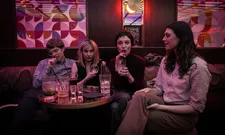 |
| Charley Palmer Rothwell, Kellie Shirley, Polly Maberly and Jasmine Blackborrow in Odyssey Photo: courtesy of Icon Film Distribution |
PM: There's a definite palpable anger to it. There's a definite sort of little man trying to compete against the rest, and there's this feeling now that the big corporations are just going to buy out, and the feeling of how unfair that is. I hope that's how people can relate to Natasha, because even though she's unrelentingly nasty and angry, there's something to tap into there if you're talking about the zeitgeist.
GJ: I don't want things to be overly political or to be too obvious, but there's enough in there, as there is in all my films, that it's pretty obvious what the politics of the piece are. But because it's not social realism, and it's wrapped in that genre space, it's almost giving you more of a release than hitting too much of a point.
PR: Are you drawn to any specific influences that inform or guide your approaches to writing, directing and performance? I ask because some filmmakers will have a small library of films they'll watch while working on a film, not necessarily to imitate, but to tap into their energy.
GJ: Being as cineliterate as I am and knowing so much about film, I'll use a lot of films as reference points. But there won't be an obsession with certain ones. There are a lot of filmmakers that become so obsessed that they're "Oh, this is from this scene." I don't like the approach of, "I'm going to make this a homage to that", to the point that Tarantino uses soundtracks from other films, which I can't get my head around. That is the opposite of what I'd want to do. I love Tarantino, don't get me wrong, but the score should be created for the film itself. I just can't get my head around using an old Ennio Morricone score from the Sixties.
So, there were a lot of reference points for this, such as Driver's Seat, which is an old Elizabeth Taylor film. There was Full Circle with Mia Farrow and The Moustache, which is a French film. There are references to about 50 films, but in those 50 films there could be one camera shot, one little movement, or one location. It's not like we're going to do our our version of this or that. It's good to have reference points, but it's also good to create something that's new.
The Seventies was probably my favourite period of filmmaking, but we have lost our way slightly. The Seventies was such an angry period and the best films came out then because of what was going on in America and in the UK. So, the best cinema came out of the angriest periods in American history.
PM: Hopefully we should be in good stead for some time.
GJ: I do believe that now, if I could get to make Phantom in America, if I'm even allowed in America again, it would be a great film to do because it's all about the anger of what's going on in the 'States right now.
PM: Talking about inspiration for me, I was consuming lots of one-woman performances as a female lead. So, I watched Cate Blanchett in Tár and everything this French actress called Laure Calamy is doing at the moment — I love her. And Isabelle Huppert and Laura Linney, and people like that. I was just reading their approaches to those films where they've just had to take a role and run with it.
Odyssey played at London FrightFest 2025 and is released theatrically in the UK on 7 November.