 |
| The Turin Horse |
Bela Tarr, giant of Hungarian cinema and icon of artistic integrity within modern cinema, has popped out for a fag. Except it seems more like the Man of Earth is taking the air and indulging in the peasant pleasure. A basic, almost symbolic, human enjoyment. His worn face is that of a worker. His eyes those of an intellectual. His kindly expression that of a friend. We have never met, but he seeks me out so I am not left waiting unacknowledged.
The idea for his new film, his final film, The Turin Horse, began in 1985. Tarr heard László Krasznahorkai, the award-winning Hungarian writer, retell the story of Nietzsche's breakdown after trying to save a horse. Nietzsche went mad. But what happened to the horse?
Krasznahorkai and Tarr became friends, and soon collaborators. “For the next few years, every time we met, I'd say, ’What happened to the horse?!’”
I wanted to draw him out on this, so I said, “To catch your attention in such a way, you must either be a fan of Nietzsche or a lover of animals...” Tarr refuses the bait to go into philosophical territory (even though I know he admires Nietzsche). He tells me of his love of animals, his dog, his cat and, after developing an interest in the theme, his horse. The horse is now pregnant and pastured in a nearby forest.
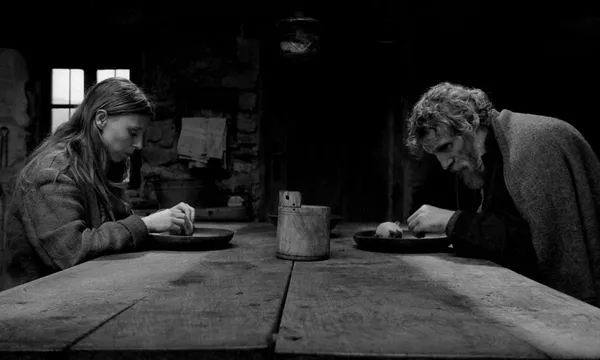
Is the theme of humanity important in the movie I wonder? We see little kindness towards the horse of the title. But again, Tarr brings the discussion back to basics. “It’s about essentials. Man needs fire, needs to eat, needs certain basic things to survive. It is not about money.” Many grand themes have already been attributed to the film, but he rejects them. “It is not apocalyptic, it is more basic than that. We each live, and we each die.”
Each turn of our conversation comes back to the fundamental realities of our existence on the planet. Why environment and landscape are so important to his work. “We don’t exist,” he says, “except in relation to a place.” Music is also used as a central ‘character’ in his films, and one he plans carefully in advance. “I have the whole thing in my head before we start – everything.” This is quite remarkable considering there is no prior script. (Some of Krasznahorkai’s prose was used to raise the funds needed to make the film.) With such long takes there is obviously much preparation to capture such perfect camera angles, impressive composition, and striking detail that holds our attention in slow-moving scenes. He explains - “I am shouting to my cameraman as we go along – up a bit, left a bit – we cannot edit the scene afterwards so we do all the editing in the camera.”
What about sound? “We record the sound for our own memories, but it [the actual sound on the film] is all added afterwards. Even the monologue is dubbed. There is too much going on to record the [finished] sound at the same time as filming.”
We talk about Tarkovsky, who also used very long shots. “But you know the difference between Tarkovsky and me?” he asks quizzically. I am reluctant to guess, as there may be something more central I have missed, but I take a stab. “Tarkovsky is religious and you are not?” I ask. He beams, rather like a kindly uncle. “Yes. I do not believe in the ‘God.’"
For me, this makes his long takes entirely different to Tarkovsky’s. Tarr is rooted in tangible reality. Even when he is studying a face (he recalls a long shot in close-up from his first film, Family Nest) there is more to see when we really have to look for a long time. Readers who have seen Warhol’s series of Screen Tests may have experienced a similar phenomenon - when Warhol posed everyone, from hangers-on to great poets and artists, in front of a movie camera, for silent, black-and-white portraits, shot mostly in close-up. As minutes tick by, we start to see deeper. We see the emotions beneath the surface. Coming back to the sense of actors as co-stars of their environment, Tarr comments, “Each person is a prisoner of their situation. I could be looking at you; I could be looking at that wall.” (He indicates the wall behind me and to the side.)
This is a natural opener for questions about freedom, but my time is up. I throw in a last couple of quick questions that have been on my mind. The first scene of The Turin Horse is an incredibly long one. Wordlessly, man and horse fight their way across uneven territory and against an unforgiving wind that rages and bites. How was it filmed? “A crane and a truck.” Then there’s the weird trailer!
He laughs. “Yes, but it’s everything. The light goes out. It is what the film’s about!” I recall a comment by Shane Danielson, former director of the Edinburgh International Film Festival, after seeing The Turin Horse. “By the end, the lights had gone out, the world was done, and the thought of seeing another movie, then or ever, seemed faintly absurd." Whether or not it moves you to that extent depends on your own experience. My own experience of this year’s film festival easily centres on The Turin Horse. Speaking to its creator reminds me that there is still a light that makes films worthwhile.