 |
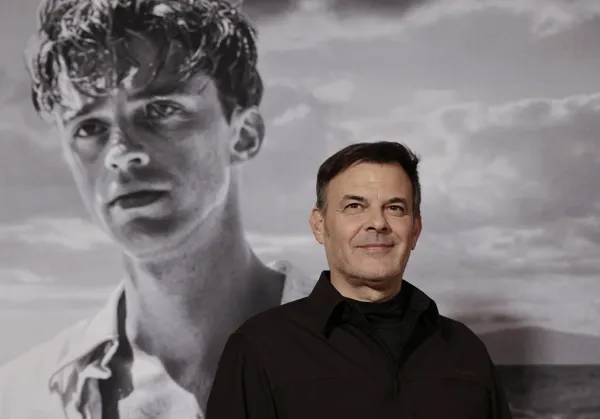
| François Ozon, in front of a still of Meursault in The Stranger: I had this character in my head of a young man who is at odds with the world'' Photo: UniFrance |
In hindsight he has no regrets with the film attracting a positive critical and audience reaction including a Best Film award at the 31st Lumière Awards earlier in the year. Ozon, 58, explained: “If someone had asked me a few years ago whether I would take on a classic from French literature that is almost sacred, I would have said, 'Never. Previously I have worked on adaptations of books or plays but they have always been minor works.
“The Stranger came on the scene because I had another contemporary project which I was planning to do about a young man with Benjamin Voisin [named best actor at the Lumières and at the Venice Film Festival] as the main character who was despairing of the way of the world today and was contemplating suicide. I didn’t manage to get the project off the ground and could not get it financed.
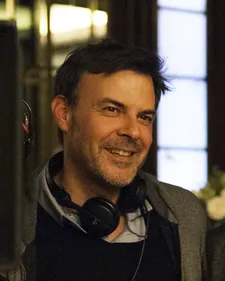 |
| François Ozon: Actually I like my work - and unlike some other directors who suffer when they are shooting I suffer more when I am not working'' Photo: UniFrance |
Ozon discovered that the revered Italian director Luchino Visconti had adapted it previously in 1967, although that version had not been widely seen in France.
“I was scared that if Visconti had done it how could I possibly do it any better? I wasn’t sure … and there was the fact everyone in France has read the book and they all have their own idea about how it should be; everyone would have their own idea of how Meursault would look and their own thoughts about Algeria and relationship with the French.
“I needed to immerse myself in the history of the period and the French-Algerian conflict and why Camus at the time in 1938 had decided to write the story. It became clear that I had to make a film for our times but put into context a story that happened in the Thirties and Forties. So that’s how it started but still I approached it with some trepidation. Then, of course, the fear came back when it was about to be released but it seems to have worked.”
His star Voisin kept asking him questions about why Meursault did this or that or reacted in a certain way. “I told him that the reason we were doing the film was to reach an understanding,” said Ozon. “In some ways this character reminded me a bit of the young girl in one of my earlier films Young and Beautiful (Jeune eEt Jolie) who is very distant from the world. She had always seemed very passive. I am fascinated by characters who have mystery and I have to try to find the key to them.”
Voisin in real life, suggested Ozon, is the opposite in temperament to Meursault. “He is joyful and funny but I had to ask him not to act. It was a real challenge for him and complicated too. It’s strange but adolescents can see themselves in Meursault. It touches them emotionally and I think the book had that effect on Benjamin when he was that age.” The pair had previously worked together on Summer of 85.
Ozon understands why the book has proved problematic for Algerians. The way Camus dealt with colonialism was controversial. “The French and Algerians were living side by side but there was no real mixing except perhaps in very poor communities. It was a kind of apartheid. Camus did not speak Arabic and had no Algerian friends. From today’s perspective the situation seems shocking with France being attacked as very colonialist. Camus was conscious of all that,” explained Ozon.
He had to convince Camus’s daughter Catherine that he was the right person for the task. Camus, during his lifetime, was reluctant for the book to be adapted for the cinema. He declared that he would make an exception when actor Gérard Philippe wanted to do it on the proviso that Jean Renoir would assume the directorial reins. “Unfortunately Renoir had gone off to the States and Philippe died in 1959 around the same time as Camus so the project never happened,” said Ozon.
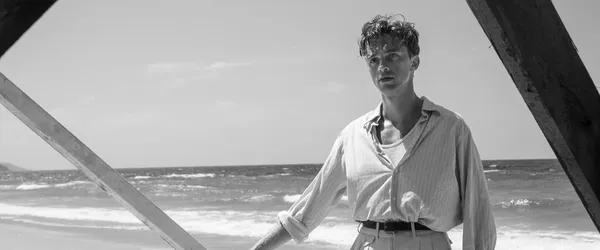 |
| Ozon: 'We wanted to work with the light and monochrome allowed you to push the strength of the light' Photo: Curzon |
Ozon knew that Catherine Camus had refused the rights to several other directors. Ozon explained that he wanted to make a film with a contemporary spin and also to develop the female characters. Finally she agreed and declared her confidence in the Ozon vision. “She has seen the film and liked it even if she would have preferred that it was closer to the book towards the end. And she wasn’t at all present during the shoot.”
The director chose to shoot in monochrome because it seemed to be “the natural choice.” All the archives he had studied for research were in black and white. “It was an aesthetic as well as a historical choice. We wanted to work with the light and monochrome allowed you to push the strength of the light. I also thought that it would help to distance the character from the world. And from a budget point of view it is easier and cheaper to do a period film in black and white,” Ozon explained. His cinematographer took home best cinematography award from Venice.
When we meet earlier in the year at the UniFrance Rendezvous with French Cinema in Paris, Ozon had no other projects in prospect. Unusually for the workaholic director who makes on average a film a year, he was looking forward to a holiday and a period of contemplation. Finding the budget for The Stranger had proved unexpectedly difficult despite his directorial reputation from a grand total of 23 features in 26 years.
“I thought it would be easy with such a well-known novel. The financiers all seemed a bit scared which I can understand: it is a very philosophical novel in which nothing much happens, at least for the first part. We managed to shoot very quickly and came in on budget,” said Ozon, breathlessly. “Actually I like my work - and unlike some other directors who suffer when they are shooting I suffer more when I am not working. I prefer to write and to work. It is not easy. It is also a long process but first and foremost for me it is a pleasure.”
The Stranger on UK and Ireland release through Curzon from 3 April. Also on release through Music Box in the US in April
- Read what Benjamin Voisin told us about his journey from extrovert to introvert for The Stranger
- Read what Denis Lavant told us about his role in The Stranger