





Eye For Film >> Movies >> Marama (2025) Film Review


It’s 1859, and a strong willed young woman called Mary arrives in the port town of Whitby. She will travel through the countryside to an imposing stately home, and there become governess to a lonely nine-year-old girl, whilst developing a complex relationship with a wealthy older man who admires her spirit. You might be forgiven for thinking that you’ve been here before. This particular young woman, however, has travelled 11,500 miles to be there. She’s Māori, her true name is Mārama, and the last thing she’s looking for is romance.
One of the most impressive films of the year to date, Taratoa Stappard’s sidelong take on the Gothic explores themes of ancestry, inheritance and the legacy of colonialism. The weight of truth it carries makes it hit harder than most, while Ariana Osborne’s riveting central performance guarantees that it will stay with you. it also stands out as a rare example of a film about colonialism taking place outside the colonised space, emphasising its psychological dimensions and the poisonous effect it also has on the world of the coloniser.

That she is a colonial subject is not something Mārama can escape. Having undertaken the journey in search of information about her background – she was adopted as a baby by well-meaning white people who told her very little – she is coerced into taking the governess job because finding other work in England, as an educated woman of colour, will be downright impossible. The situation is made more uncomfortable by patriarch Nathaniel Cole (Toby Stephens) and his obsession with her culture. His explanation for his ability to speak her language makes sense, and it’s possible that he simply doesn’t understand how inappropriate it is for him to have sacred objects in his possession, but the more she learns, and the more he enthuses at her, the more she comes to feel that she too is at risk of becoming an object in his collection – and perhaps not the first woman to find herself in that situation.
Fetishisation and the treatment of human beings as exotic curiosities is one of those phenomena that white people don’t always recognise as racism. After watching this film, no-one will make that mistake again. Stappard doesn’t need to spell it out; it’s all there in the performances. The more familiar you are with Māori culture, the more particular things will get to you, but the tone of the whole can hardly be missed, and nor can its impact on the relationships between the characters.
Particularly interesting in this regard is the initial hostility Mārama experiences from Nathaniel’s West Indian maid, Peggy (Umi Myers), who has legitimate reasons to resent her. There’s an immediate sense here of the tricks that colonisers frequently used to set people of different races and ethnicities against one another, yet there’s a different kind of tension between the women too, and they’re both too smart to be easily manipulated.
Peggy isn’t the only female influence on our heroine in a film which makes ample use of the Gothic motif of twinning. Mārama peers into reflective surfaces whenever she can, sometimes catching glimpses of the past or future – it can be hard to tell which is which. Though these can be disturbing in themselves, she’s at ease with the supernatural. it’s in much more mundane spaces that the real horror lurks. The insidious, destructive nature of racism builds through the first half until more corporeal colonial horrors start to become apparent.
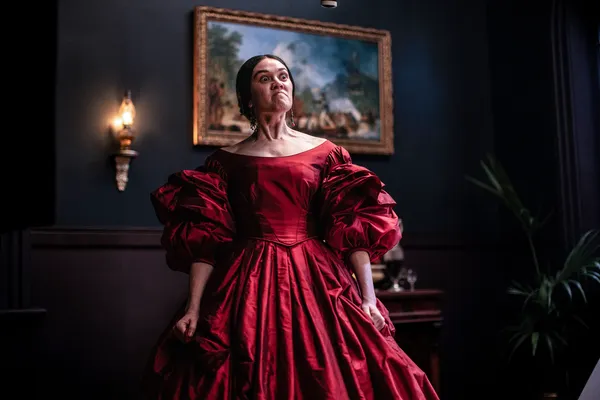
It’s rare to see a film comnmunicate so effectively to very different audiences; rare, too, to see storytelling traditions from opposite sides of the world mesh so beautifully. Gothic tropes take new forms when seen through a Maori lens – though it’s worth remembering that Stappard himself has mixed Māori and English parentage, and the idea of the split self is also important here. Dressed in a blood red ballgown which would make a typical Gothic heroine feel elevated, Mārama looks weighed down, inconvenienced for others’ pleasure, but even then she has a few surprises to deliver. She may be in unfamiliar territory, but she, too, is an unknown quantity to those who wish her harm. This in itself constitutes powerful opposition to the idea that people or their traditions can be neatly categorised, comprehended and brought under another’s control.
Densely packed with ideas though it is, this is a film whose narrative flows easily and grips throughout, delivering all the elements of mystery and intrigue that fans of the genre could hope for. It looks gorgeous, with magnificent (though often disturbing) costuming and cleverly lit, atmospheric locations. Steeped in bloody history, it nevertheless succeeds in finding a path of its own, and a reckoning.
Reviewed on: 15 Apr 2026


