 |
| Rebuilding Photo: Jesse Hope |
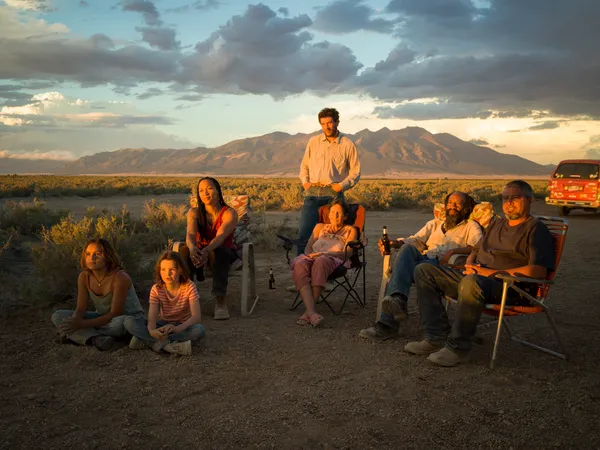
American director Max Walker-Silverman's Rebuilding follows ranch owner and cowboy Dusty (Josh O’Connor), who is forced to live in a trailer on a government-run campsite after wildfire devastates farms in Southern Colorado. At first, Dusty is reluctant to embrace the small and intimate campsite community, but acts of kindness compel a change of heart. Meanwhile, he begins to rebuild his relationship with his daughter Callie-Rose (Lily LaTorre), and ex-wife Ruby (Meghann Fahy).
Silverman’s directorial feature début, A Love Song, told the story of a woman waiting for the return of a lover from her past. Rebuilding is the filmmaker’s sophomore feature. He has also directed the shorts Lefty/Righty, whose story about a father connecting with his daughter shares similarities with Rebuilding, as does Chuj Boys Of Summer, which follows a Guatemalan teenager beginning a new chapter of his life in an unfamiliar place.
In conversation with Eye For Film, Silverman discussed the social realist tradition, how his own upbringing fostered Rebuilding’s sensitivity, and cinema’s purpose in our turbulent present-day life.
The following has been edited for clarity.
Paul Risker: Including Hot Water, which you produced, what has motivated your interest in telling sensitive stories focused on recognisably human characters?
Max Walker-Silverman: It starts with a clear sense of place. The stories I've loved and found the most enchanting have always been deeply connected to a specific world that's not necessarily real. That could be the world of Shrek or JRR Tolkien. These are worlds that we never visit, but we feel someone deeply cares about them. And for me, that just wound up being Colorado, where I grew up. If I'd grown up in Indiana, it would have been Indiana, and if I'd grown up in Sheffield, it would have been Sheffield. But I'm lucky that it happened to be in a place with big mountains and cowboy hats, where people see the movies as westerns and that makes them easier to get made. While that has been convenient, it is entirely accidental.
Beyond the sense of place, a TV show like Succession is popular, but rich people are already glamorous. So, the idea of using cinema to glamorise that seemed kind of pointless to me. This big, bright screen that makes the world more beautiful is so much more profound when it's about us regular people.
There are sunsets and sunrises and so much beauty every single day and suffering too. We all know that we suffer, but I want to pay tribute to the beauty.
PR: While your films can be compared to the western film, are they connected to the ethos of the realist cinematic tradition?
MWS: I hope so, because I feel more morally and ethically inspired by those traditions, which I have learned about later in life. Maybe it's because of the way our films are funded in the United States that this tradition feels less prevalent. But yes, I feel deeply connected to something like The Old Oak, which is not the harsher type of social realism. The Old Oak is tough and honest, but there's an optimism to it. And I think that's the difference between art and journalism.
You need journalism to explain and illuminate the world as it is, but only through art is there some version of imagining the way it could be. And sometimes the way that it could be is very modest. It might be two different groups of people in a pub together, but there's a great profundity to that. And to be able to see that and more importantly feel that through these types of films is powerful, even if it’s only for a couple of people.
So, I very much admire that tradition and just the affection in a Ken Loach film is its own political statement. The actual tenet of the work, to have affection for all people and all places, is radical.
PR: It’s increasingly difficult to separate the personal from the political. Audiences are unlikely to come to Rebuilding and see it first and foremost in a political context. Instead, it is more identifiable as a human drama but herein lies its core politics.
MWS: Everything is political, and nothing is more political than trying to not be political. My politics have always been very clear to me. I'm a man of the left and of the world, but I'm also a pragmatist. I come from a conservative region, and I've tried to make films without losing the room, so to speak.
A great hero of mine is Willie Nelson, who has campaigned for every Democratic presidential candidate. And yet when he puts on a show, there are hippies and rednecks in that room. And it's not because he's shied away from his beliefs. It's because he believes there's room for more. It's because he wants to win, and like I want to win and have a new congressperson, the way to do that is not by ignoring the people whose votes I hope can change.
There are plenty of people in the world, and certainly in my country, who would not want to engage anymore with the right. But from my perspective, that's simply not a choice we have. And in my own little world, which is made up of only art and independent film, I want people to be able to watch the film from beginning to end. I want them to feel invited with the hope that the film can say something about the world that we all share, whether we want to or not.
PR: What do we need most from cinema at this moment in time? What purpose does cinema serve?
MWS: Our eyes and minds are most open when perceiving beauty. And for all the new technologies in the world, there's an actual tenet in a great film. When the right song is playing at the right moment, that is still the most distilled experience of beauty we can reliably find in art. And at that moment when, for some reason, you start to cry, and you don't know why, the whole world and your heart are open, and you feel everything from these people you don't know. Is that something we need now more than at other times? Sure, I guess so. But then, I don't know. Maybe today is like growing up with George Bush and Iraq — just look where we are now. And the idea of now more than ever seems infinite.
I want the world to be open, shared, and woven together. And when a movie is good, there is something in that experience of beauty and radically vulnerable moments of empathy that can hit us. I can watch Left-Handed Girl and truly feel for these people in a market in Taiwan that I've never been to. And if war comes to that place, there will be a tragedy to it that is so much more profound than if I had not watched this child and her mom cooking food there.
PR: There are scenes in Rebuilding when you just sit with the characters and allow the actors to silently use their bodies to express themselves. How attentive were you to striking this balance with the dialogue?
MWS: It starts with the fact that, ironically, given that this is an interview, I so often don't have the words to explain my thoughts and feelings. And I think that's true of most people. Maybe we can talk about grand concepts of art, but when you’re actually sitting next to someone, and you have to apologise to them, for example, it's hard to find the words.
So much of the human experience is the quest to find out how we explain ourselves. As a writer, it starts with that — people don’t know how to explain themselves. The idea of silence and quiet is not because words are important — it’s because words are so important that they can be profound. When we finally get to the point where we can explain, we can’t find the words that will mean everything. And our story hasn't been deluded by banter and chit-chat. Instead, we've protected the meaning of the words and the language. Or that’s the theory, but, of course, that theory only has a chance with an excellent actor, because acting without dialogue is a huge challenge, and that's why Josh O’Connor winds up playing an American cowboy.
There are so few people that can give a character soul and pathos without being able to tell you why. It's something intangible; it's something in the eyes; it's something in the way someone sits, stands, and moves, and it’s a hard skill to have. And I've been fortunate to work with very good actors, which is the only chance you have at telling a story like that.
PR: When Dusty first shows up at Ruby's front door, we might expect there to be a tension between the pair. However, Rebuilding subverts the expectations of an inherent conflict between the characters and chooses a different path. Do the characters communicating with one another open up the possibilities available to you?
MWS: That's the provocative and interesting challenge. There’s a reason why, traditionally, most movies have a villain/bad guy. It is fun, and it is exciting, but ultimately, like many of the great challenges in our lives, they do not have a singular villain. So, movies can oversimplify life and there could be a version of this movie where Josh O’Connor plays the part like he's a recovering alcoholic who relapses and gets beat up by his ex-wife's new boyfriend. Also, there could be a lot more bar fights and smashed bottles. Maybe that would have made more money, but my hope is that by taking this softer approach, there's the chance to touch on something deeper that’s harder to explain, and is an interesting challenge.
PR: Could we say it’s the merging of the masculine and the feminine? And rather than juxtaposing one another, does the film explore the feminine qualities of the masculine and vice versa?
MWS: When I look back at my childhood, I see this pattern of being raised by a lot of very strong women and a lot of very gentle men. I feel extremely fortunate to have grown up with those aunts, uncles and friends. And maybe that's why the relationship between a cowboy and his daughter is so profound to me. I've also known a lot of tough dudes who just turned into jello by having daughters. So, it’s that ability of people to soften with age, which is something I find very beautiful. And sentimentality is something I find very beautiful too. I always hope to pay tribute to that in my films.
PR: It’s important to consider vulnerability when making and talking about films, because to make or be a part of a film is to be vulnerable. The audience too must allow themselves to be vulnerable, and yet the subject of vulnerability is something we don't discuss enough.
MWS: I wonder about that too. I've had some interesting conversations with people who come up to me and say, “It must take a lot of bravery to expose yourself to the critics.” The truth is, if I were truly brave and vulnerable, these would be documentaries. It's fiction for a reason and this is the meta of the films themselves.
There are things I'd like to say to people that I don't know how to, or I don't have the courage. And that's why we dress up our thoughts and feelings, hopes and fears in costumes, and put hats on and build sets in which our thoughts can interact with each other. There are stories behind my movies — the deepest ones that I haven't shared because they still feel too personal, and it feels too weird to explain. And you want the movies to stand for themselves, but of course, they're standing for something else.
Ideally, the power of fiction is that it becomes not only yours. I don't want it to be my own narcissistic and myopic therapy. The power of that character that gets dressed up in a costume and has conversations is that it might truly wind up meaning something to someone else as well, and perhaps something different or the same.
That's just our crazy human relationship to story, right? That’s religion, that's myth, that's folklore. The fabric that we all share is how we can relate to characters and narrative together.
Rebuilding is released theatrically in the UK on the 17th April.