 |
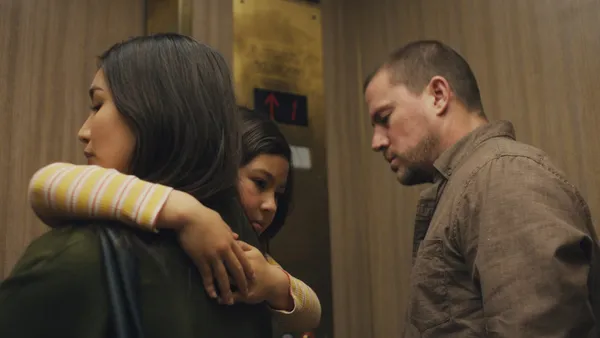
| Gemma Chan, Mason Reeves and Channing Tatum in Josephine. Beth de Araújo says she wanted to explore 'the intersection of unreasonable, hyper vigilance and reasonable fear that we have walking through the world' Photo: © Josephine Film Holdings LLC |
Jospehine had its premiere at Sundance Film Festival, where it won the Grand Jury Prize in the US competition and went on to make its international bow in competition at the Berlin Film Festival.
Speaking about the origins of the project at a Berlin press conference, also attended by Tatum, Chan, Philip Ettinger – who plays the perpetrator Josephine witnesses – and others, de Araújo said she drew on her own experience. “It’s based on a memory that I have. When I was 8 years old my father and I interrupted a sexual assault in Golden Gate Park in San Francisco and I just wanted to take the hyper vigilance I was left with after that day and explore it through the eyes of an eight-year-old girl the whole time – kind of exploring the intersection of unreasonable, hyper vigilance and reasonable fear that we have walking through the world. So that was the birth of Josephine.”
 |
| Beth de Araújo answers questions from the press Photo: Courtesy of Berlinale |
She said: “I felt very committed to depicting the legal and justice system as it is.”
For Josephine, she reteamed with Soft & Quiet cinematographer Greta Zozula, who has had a busy few years, with films also including Call Jane and Materna.
“She’s a woman of very few words and her images are very powerful. We have a deep mutual respect for each other's commitment to the work and I think she's brilliant.”
Josephine’s father Damien’s reactions to his daughter’s trauma are crucial to a film that shows how when words fail, other things can take their place.
De Araújo observed Damian’s reactions always come “from a place of deep love and deep understanding”.
Tatum said: “Damien was like a mix between myself and my own dad.”
 |
| Channing on his character: 'Damien was like a mix between myself and my own dad' Photo: Courtesy of Berlinale |
Speaking about the way that Ettinger’s character has a physical presence in Josephine’s life, courtesy of her imagination as a result of her trauma, she said: “I felt like the looming visualisation of him [would mean] the threat would feel more visceral for the audience.”
Asked about what needs to happen in society so that empathy stays more with the survivors of sexual violence, de Araújo said: “I think there needs to be accountability. It creates more silence, more shame and leaving survivors to have to heal completely on their own, the less accountability that there is towards the perpetrators, the paedophiles and the rapists and the shame needs to be on them. We have to find a way to make holding [people] accountable more possible.”