





Eye For Film >> Movies >> The Education Of Jane Cumming (2026) Film Review



Sophie Heldman’s period drama about two teachers dragged into a libel fight ends up manufacturing what the establishment cannot bear, a public record. The compromise is delay, the case sealed for a century as if time could launder facts. The statute of limitations may be a lifetime’s worth of censure and concealment, but inevitability laughs through it.
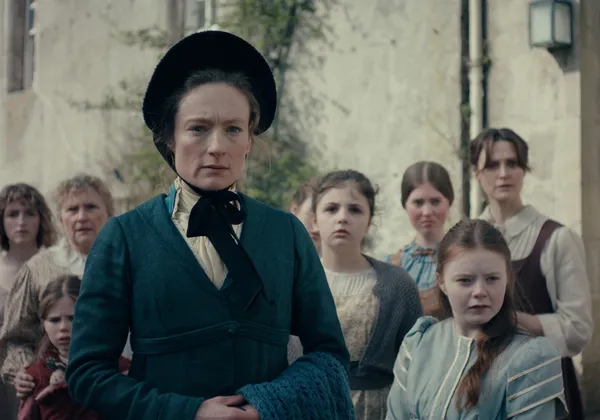
The Education O Jane Cumming begins in Edinburgh in 1810 with a modest revolution. Jane Pirie (Flora Nicholson) and Marianne Woods (Clare Dunne) open a boarding school as a means of independence, a livelihood that also functions as shelter in a world that grants women few legitimate arrangements outside marriage. Their carefully built space is tested when Lady Cumming Gordon (Fiona Shaw) enrolls three granddaughters, including Jane Cumming (Mia Tharia), her 15-year-old “illegitimate” grandchild from India. Jane arrives already pre-judged. The other girls make her foreignness actionable, not through grand declarations but through petty refusals, small humiliations, the daily work of keeping someone at the edge.

Heldman’s sharpest instinct is to show how a society polices intimacy by pretending it cannot see it. Pirie and Woods’ closeness is real, and the story neither sanctifies it nor turns it into tease. When the inevitable question arises about what they are to each other, the answer offered is the one history has always found most convenient, simple enough to pass, vague enough to survive. That evasion is not only a personal strategy, it is a structural trap. It trains everyone around them to treat ambiguity as guilt waiting to be named.
The summer interlude makes that trap feel almost tender before it turns punitive. Lady Cumming Gordon insists the teachers look after Jane during the break, a gesture that presents as care while functioning as containment. At the seaside cabin, private and professional lines blur, affection grows, and an unlikely family begins to form. It is the kind of fragile arrangement that feels miraculous precisely because it is unsanctioned, held together by discretion, routine, and the hope that no one will look too closely.
When the term resumes, the story tightens around need and perception rather than incident. Jane’s desire for closeness becomes a pressure the adults cannot satisfy without risking themselves, and the teachers’ own shifting dynamic is strained by the simple fact of being watched. Jane’s eventual rupture does not read as pure malice so much as the volatility of a child trying to regain control of a situation she never chose. What follows is an allegation engineered to sound too specific to be invented, borrowing its credibility from overheard knowledge. It is the kind of detail that passes for “proof” in polite society. Heldman and Nicholson, who co-wrote the script, refuse the easy version of this story, where a child is simply wicked and adults are simply wronged.
The devastation arrives socially before it arrives legally. Respectability does not wait for evidence. Rumour travels faster than any verdict, meanwhile, the legal system takes its time, and time itself becomes part of the violence. Even when judgment comes, it arrives late, and in the shadow of what has already been done.
The German-born director also catches a particular cruelty in how women’s desire is policed here. Not always with the overt brutality gay men faced, but with a meaner dismissal, a smirk that turns intimacy into a joke, something too unserious to name until it becomes useful to weaponise.
We are largely in on the truth, yet the presence of a child almost hardwires an inkling of doubt in the viewer. That involuntary hesitation is the film’s most uncomfortable achievement. It speaks to how impossible these situations are to navigate without wrecking lives, and to how readily “protection” becomes a pretext for policing what cannot be spoken.
The period texture is handsome without being museum-stiff, and Shaw is formidable as Lady Cumming Gordon, making control read as a form of love that never stops keeping score. Heldman’s direction is impressive, even if the drama sometimes feels more carefully assembled than inevitable. Suppression leaves records. Censure creates archives. Eventually, what was meant to be sealed returns, not cleanly, not justly, but unavoidably.
Reviewed on: 18 Feb 2026


