 |
| Walud |
It began, Daood Alabdulaa tells me, with a visit to his sister. He had fled Syria as a refugee when he was a child, and ended up in Germany. They didn’t see each other for many years – until three years ago, in fact, when she was working in Qatar. She told him then about her marriage, the fact that she and her husband didn’t manage to conceive a child, and the way that people in their village had blamed it all on her, pressuring her husband to solve the problem by taking a second wife. He found himself thinking about that for a long time afterwards, and out of that process, Walud emerged. Now it has qualified for Oscar consideration, which is very exciting for him and his co-writer/director, Louise Zenker.
They both laugh at the fact that a man being potentially infertile would never have crossed the minds of those villagers. For Louise, it opened up wider questions about what it’s like to be a woman in a deeply patriarchal society.
“ISIS is just like an even extreme version of a patriarchal logic that is apparent everywhere in the world,” she says. “It's just another version of it, and it's very extreme. Daood’s sister is not married to an ISIS soldier. That part [of the film] is all fiction, but it all came from her sharing how she suffered from the pressure and what society made her think of herself.”
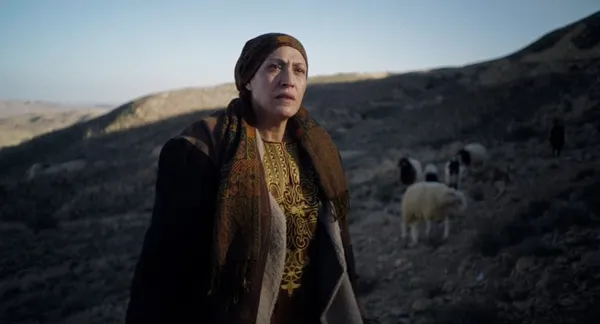
Their film follows a woman in a similar position, who lives with her husband in a small house far out in the rocky desert, where she tends sheep. I tell Louise that the first thing I noticed about that woman was her beautiful headscarf, which has a traditional pattern of browns and golds, not the black that outsiders associate with the region and not what her husband would like her to wear.
“Yeah,” says Louise. “She does not want to wear the veil and everything. She's very actively not doing it. And her husband's power to control her is somewhat limited because they have this longstanding relationship. She's going to choose what she's wearing.”
Daood says that it was important for him to show that ISIS doesn’t really have any business out there. Syria is a vast country and they were never able to control it all directly.
“People in the desert, even like wearing a scarf or a burka, they don't need it because no one is there. So she's really free with what she's wearing.”
“If you go to the argument that you can't wear certain clothes as a female because there is someone looking at you, if you think about the logic of like ‘Why do I control how a woman looks like?’ – the argument is not any more valid when someone is looking at her or not looking at her,” says Louise. “Because it is simply about controlling the person.”
Daood agrees. “It actually started with ISIS,” he says. “That's before the war. It was everyone, every women, even a child, she should wear a burka.”
I suggest that by wearing her own clothes in that way, the film’s protagonist is highlighting a different tradition and a different way of being . Not only do ISIS not own the present any more, but they don't really own the past either, the way that they claim to.
“Yeah, that's true,” says Louise. “Extremists use religion as something. They will always claim that they use some sort of tradition that goes back to the past and has always been the real way or something. But the way she's dressing herself makes a statement that it's not necessarily the truth or the reality. There is a different past and a different present.”
We talk about the phenomenon of young women and girls from the UK travelling to Syria in pursuit of romanticised ideas about marrying heroes. There’s a character like that in the film, though she has learned a few things since.
“I think we put the character in there because we were, in the first place, trying to understand,” says Louise. “To understand the character, we had to understand the people who went. It is sort of a warning or like a dismantling of a narrative that this is like a romantic marriage and then you're in this sort of safe golden cage where you as a female are worshiped and are very precious. The reality of it is very different. But also, part of the concept of the film was to connect the western world to the east, like the Middle east, and say ‘It's not an over there problem.’ It is connected and we as a world are connected. If we go back to the past, there's colonialism, there's different sorts of politics and geopolitical areas and things that do connect us, so we decided to put a European character in there to sort of open up the gate, to connect the two continents.”
“And one another reason,” says Daood. “In northeastern Syria, there's still these camps for the women who were married to ISIS fighters, and their children. And in this camp there's people from all over the world. We wanted to bring this topic to the screen again because some countries, especially France or Germany, there's German or French people who are still in these camps and their countries, they don't want them back.”
“Germany is really having a hard time taking these people back because they were part of an alien terrorist organisation, which is one of the very few reasons you can lose your citizenship, I think,” says Louise. “And these people are just stuck there.”
“They don't have schools,” Daood observes. I watched a documentary about that and there were some interviews with these children. It's like a time bomb. Children need schools and not just being in this camp. It's a kind of prison. This is one of the reasons why we wanted to tell another ISIS story and bring a European person, especially a woman, into the spotlight.”
Daood can remember being in Syria when ISIS was in power, but Louise had to rely on books for her research. She explains that the actor playing Alina, the European woman, had a more immersive approach.
“She signed on to TikTok for a couple of days and liked content that would be the entry door into this whole thing, which still exists, to understand the logic of the character. But I feel like the combination of literature research and just reading a lot, even the propaganda sort of narratives that exist, that also helps. I read a book that was like a version of the Quran for women in ISIS. It was a thin little book and it was written to persuade women to join ISIS. And it was very interesting trying to get into the logic of those sort of things. How would you be responsive to this sort of logic? I don’t know.”
Bashir Assad was still in power in Syria when they shot, she explains. As a result, Daood could not return there, so they searched for similar landscapes in Tunisia – somewhere that would remind him of his childhood.
“This place was important for us in the solidarity between these women,” he explains. “The war is more in the cities. If people are living in the desert, they hear this bombarding, but they don't see it. And we have this scene in the film when Alina and Amuna go up this hill and they walk to [where they can see] the war. We wanted to travel in these locations because the place where I grew up, it's really similar to the locations in the film.”
“I feel like if you put in, like, war visuals a lot, it overpowers a lot because it is very drastic and very extreme,” says Louise. “I get why that is interesting visually, but in this scenario, with these characters that talk so little and the resistance is so subtle and still so strong, I feel like if we would have put in extreme visuals of war, it would have been the main focus point within the film, and it would have taken away from the characters that carry this whole thing.”
I suggest that if there had been war imagery, it would have suggested that the first wife was held there by violence and threat, and it's a little bit more complex than that.
“Yeah, absolutely,” says Louise. “Because she has been in this marriage for so long. It's not in the film, but in the backstory that we build in our heads, she's married to her cousin, so she can't leave because both of the families are related, which is very common. So it's a far more complex sort of thing. And also, she's at a point in her life where she had had a job and ISIS took over when she was beginning of her forties. It's not like a capture the princess sort of hostile thing. It's a grown situation where she's trying to manage her everyday life and sustain a life that is sort of okay-ish, for her, while this situation lasts.”
It also seems like her husband is a little bit intimidated by her and has to listen to her, because they know each other so well.
“Yeah, yeah, exactly. We thought that before the films, before the ISIS occupation, she would have been an English teacher and he would have been the person who took care of the sheep. And then the ISIS came and took over the village, so she couldn't work as a teacher anymore, and he stepped up in status, joining ISIS. So their power dynamics would have shifted quite extremely. Before that, she was the one having the upper hand, being the person who would call the shots within the relationship, and he would have endured it, and his mates would be like, ‘Oh, well, your wife is always telling you what to do,’ but no one really could change the situation. And then with ISIS and this very clear definition of being a man is the better thing, that enabled him to be the person he is now. But his old self is still there and he knows his wife is very intelligent, very witty, very strong.”
Daood says that he feels overwhelmed by the Oscar interest.
“I am really, really happy about that. For me, you know, studying film was a dream. When I was a child in Eastern Syria – I'm a son of Bedouin family – when I told my family the first time that I want to be a director, I want to make films, they were laughing about that. Like, ‘The child from the desert, he wants to go to Hollywood!’ And I was like, ‘Yes, I do. Why not?’ And now, to be qualified for the Academy run, it's... I can't say it in words, but, yeah, we are a bit proud of ourselves.”
“I'm very proud of the team as well,” says Louise. “We had so many rough patches along the way when producing and shooting the film, and everyone just stuck together. I feel like we forced this film into existence. This film should not exist, whatsoever. Because our film school was not amused when we were like, ‘We're going to shoot outside of Europe and we're going to go into the desert and we're going to carry a fake ISIS flag.’ Everyone was like, ‘Are you sure, guys? It's not ideal.’ So I feel like everyone really believing in the film is what forced it into existence. And the fact is that it feels like the film should not exist, but yet here it is, and is now part of this whole Oscar shenanigans. We're both from villages and not really film families. We just stumbled into this because we really always wanted to make films and it's just so cool.”
Now that they’re here, they plan to keep going.
“For the next three months we're trying to plan our final films from the film school because we do have one more that we need to do,” Louise says. “Then we're going to do our first features after that, and we now have to sort out what we're going to do. Is it going to be co-directed again? Are we going to do separate films? We're trying to find the best possible way to go forward.”