





Eye For Film >> Movies >> Hamnet (2025) Film Review



It is a deeply human impulse to seek meaning, especially in death and in the lives of artists we have turned into secular saints. Few figures have absorbed as much projected meaning as William Shakespeare – a man who transformed the English language and yet remains stubbornly out of reach. In her 2020 novel Hamnet, Maggie O’Farrell takes a handful of surviving documents and spins an intricate fiction around the death of his son, using conjecture to give emotional shape to a biography that will never be fully known. The book is more an act of imaginative possession than a historical account, constantly flirting with the question of how far creative license can go when the subject is this monumental and so culturally overdetermined.
Chloé Zhao’s adaptation, co-written with O’Farrell, keeps closely to this outline. We first see young Shakespeare (Paul Mescal) in Stratford, where he meets and marries Agnes (Jessie Buckley). History tends to remember her as Anne Hathaway, but her father’s will names her Agnes, and the co-writers follow that choice. They build a family, and the story tightens around their son Hamnet, who dies as a child of pestilence, even though the historical record never specifies a cause. Zhao stages his final hours in convulsions and gasps, and that choice is not neutral. Depicting children dying on screen is always a difficult proposition. In a year that has given us, among other things, Kaouther Ben Hania’s The Voice Of Hind Rajab, which uses the real emergency-call audio of a Palestinian girl dying while Red Crescent paramedics remain on the line, watching this fictionalised, carefully choreographed death feels oddly contained. No period drama should try to measure itself against real-time horror, but the juxtaposition throws into relief how decorous and managed the grief in Hamnet is. At the same time, the narrative tracks Shakespeare’s early artistic stirrings and his gradual move to London, away from his wife and children, and it culminates in him writing Hamlet as an attempt to wrestle with, or at least stage, his grief.
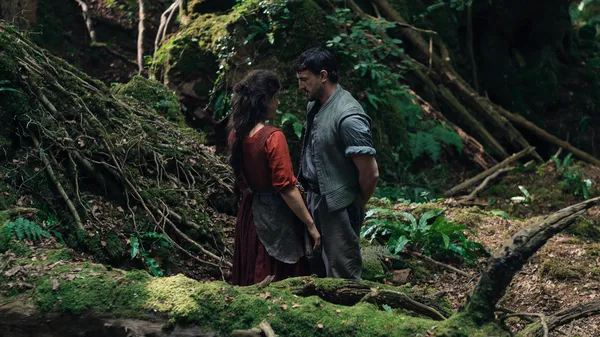
Having read the novel before seeing the film, I had hoped Zhao might sharpen or interrogate this act of meaning-making. I was wrong. While Buckley is spectacular as Agnes, grounding the drama in something raw and lived-in, there is almost no chemistry between her and Mescal’s Shakespeare, who is flattened into a shallow iteration of the tortured artist. The forest and the susurrus of the natural world serve as mild portents and give a little respite from otherwise inelegant transitions that often feel abrupt, perhaps inevitably, given a timeline spanning roughly a decade. Every now and then Zhao’s craft as a visual poet bleeds through, in the way she frames bodies in space or lets light grace their faces, but it appears in brief glimmers rather than as a sustained vision.
The adaptation feels oddly timid and selective. Zhao omits several of the novel’s most obviously cinematic set-pieces, moments that might have given the work its own pulse instead of tracing the book’s outline and hollowing it out. At the same time, she breaks some of O’Farrell’s more interesting constraints. The novel famously never uses Shakespeare’s name; the film not only says it out loud but leans heavily on quotations from the plays, including a clumsy staging of how the “to be or not to be” monologue came to be, underlining its own cleverness instead of deepening anything.
The climax hinges on Agnes discovering that her husband has written a play named after their dead son (Hamnet and Hamlet being interchangeable at the time) and travelling to London to confront the man who has already been drifting away from her. Instead, she stands in the theatre, packed into the pit among the groundlings, and watches Hamlet. This becomes the emotional high point: Agnes seeing her son resurrected through art, and Shakespeare supposedly transmuting his guilt and grief into genius. On paper, that is fertile material. On screen, it plays like a cheaply manufactured grief machine, a sequence of reactions and stage business that wants to be devastating without having fully earned it.
The music choice in that sequence does a lot of the heavy lifting, and not in a good way. Hamnet is being sold on the prestige of a new Max Richter original score, but at the most emotionally charged moment Zhao abandons that in favor of Richter’s already ubiquitous “On the Nature of Daylight,” most famously used in Denis Villeneuve’s Arrival, where it all but swallowed Jóhann Jóhannsson’s score. The piece arrives preloaded with an entire history of cinematic usage; it is, at this point, almost impossible not to cry when it swells. Here it feels less like an organic extension of Hamnet’s world and more like a button you press when you want instant profundity. Zhao’s drama reaches for classical gravitas and ends up with something closer to cheap thrills and cheaper grief, borrowing the ready-made sorrow of that cue rather than generating its own. It also quietly undermines the idea of this being an original score in anything but awards-category terms, since Richter’s new compositions sit in the shadow of his own greatest hit.
Hamnet is ostensibly about how we turn loss into meaning, how we fictionalise and aestheticise the dead to make our own living bearable. O’Farrell’s novel already walks a fine line there: it is a beautiful piece of imaginative projection, but also a closed system with its own limits. With O’Farrell co-writing the script, it is hard not to wonder how much room Zhao had to push back against that framework or to question the project itself. There is a version of this story that could have interrogated that urge to make grief “useful,” or at least sat longer with its discomfort. This version mostly accepts it at face value, smoothing pain into a tasteful literary “biopic” and then supercharging the finale with a piece of music that has already done too much emotional labor for other works. By the time the credits roll, what lingers is not a new insight into Shakespeare, Agnes or Hamnet, but the nagging sense of having been gently, beautifully manipulated.
Reviewed on: 09 Dec 2025


Director: Chloé Zhao
Writer: Chloé Zhao, Maggie O’Farrell
Starring: Jessie Buckley, Paul Mescal, Emily Watson, Joe Alwyn, Jacobi Jupe
Year: 2025
Runtime: 126 minutes
Country: UK
Search database:
