 |
| Palestine 36 |
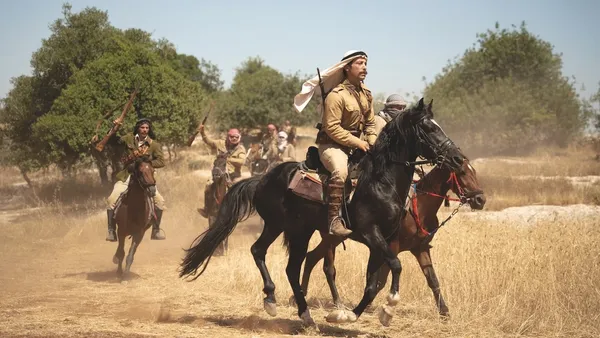
Palestinian director Annemarie Jacir's Palestine 36, explores the events leading up to the Arab Revolt against British colonial rule. She focuses on an ensemble cast of characters from different walks of life, who are impacted by this life-changing event.
Her previous films include her feature début, Salt Of This Sea (Milh Hadha al-Bahr), which tells the story of a Palestinian woman, born in Brooklyn, who returns home and confronts the realities of life there. She has also directed When I Saw You (Lamma Shoftak) about a son's search for his father and discovery of an unexpected journey, and Wajib, in which a father and son fulfil a Palestinian custom.
Speaking with Eye For Film, Jacir discussed her love of fiction and its poetic freedom, telling Palestinian stories from their point of view, and how her films are an act of resistance.
Casper Borges: How did you come to want to make films?
Annemarie Jacir: I grew up in Saudi Arabia, a place where there wasn't any cinema. I left when I was in my twenties and that's when I started to discover cinema. But it wasn't about escapism, because I don't like that word. It was just about being part of a community and getting lost in these other worlds.
From the beginning, I wanted to make films, but I started out as a writer because I didn't think I could make films. So, that was my entry point, but for me, it was just about getting lost in another world. And cinema is a beautiful thing because it combines all the art forms.
CB: Are you trying to create these opportunities for connection between the characters onscreen, as well as the audience?
AJ: Absolutely, connection is what I'm interested in. We're not making films for ourselves, and especially with Palestine 36, there's the whole historical context. But that's not what I'm interested in. Yes, it's epic and there are these big moments, but it's very personal and raw, with these smaller moments shared between the characters. That is what I thrive on and what I'm most interested in. It's that conversation between the father and the son or the little girl and her grandmother. It's those moments in somebody's life where you're just confronted with something so much bigger than what you are, and you have to decide what to do or what not to do. And everybody is flawed; nothing is clear. There's no black and white — we live in this grey.
I make fiction, which I love because it's poetic, and it gives you this freedom. But everything is rooted in reality, and that's what I'm interested in.
CB: On the subject of reality, fiction can explore truth in a way that documentaries cannot.
AJ: Sometimes fiction is much more truthful than documentary. That's why I don't work in documentary now. I didn't like it because I felt as the director or creator of the film, I was asking real people to tell me their life story, and then I decided what part of the story I wanted to use. I was cutting it up, and I wasn't comfortable with that. In fiction, we're all on the same page — we are creating something together that is real, or more real.
CB: Films such as Palestine 36 are an opportunity to revisit the past and to learn how the modern world has been shaped. You've focused on a specific moment in history that confronts British and European countries with the longstanding consequences of their choices. Of course, many British people are ignorant of the part Britain has played, but then, colonial powers have the privilege of ignorance.
AJ: Of course, history is always written by the victor. This film is our point of view on it, and all those stories are very much alive and real. But even I, who grew up hearing about the revolt of 1936, was surprised. I learned during the research that the massacre took place in Al-Bassa. I didn't even know about that. It was ten years before 1948, before the Nakba, that this happened. The soldiers that were involved in that incident talked about it later, so how have I not heard about that? I've heard about the revolt, but the brutality was something that I learned about in the research. And I learned it from mostly British historians and British accounts, which was interesting.
CB: Picking up on your earlier point about cutting up people's stories in documentaries, the same is true of fiction. Were there any challenges in pulling together the different character arcs to tell the broader story?
AJ: It's an ensemble and it was a challenge. I feel like the characters were literal threads of embroidery in my mind. When you step back, you see the whole thing, but when you're inside of it, you are following the thread. Only at the end do you understand the whole thing and how it's all connected.
CB: On this point of threads, it's important that Palestinian's have cinema as a means to communicate their story, among all the competing narratives.
AJ: There are so many films and stories and news things about us. Mahmoud Darwish, our national poet said, we're famous not because of us, but because of who our enemy is. Otherwise, nobody would hear about us; nobody would know anything about us. And I think that's interesting, but this is our challenge. It's about how we unapologetically tell our stories, our way.
CB: Are your films a form of resistance?
AJ: I think by nature it's resistance because they exist — that despite everything, we continue to make the films. There's a kind of stupidity about it, right? You have to be naïve and stupid and say you don't accept that everything is impossible and that we can't do this. We find ways to make things. If you block us here, we'll find this way to still make it, and if you put a block here, we'll go this way instead. So, even if it's nothing, or it's an experimental film about a flower growing, it becomes an act of resilience and resistance.
There's an archive in the film. When we were shooting in Jerusalem, at one moment, we were asking ourselves, "How are we doing this? We might not be able to be here in a year. We might all be gone; we don't know." There's always this feeling of what are we doing, because this might be the last time we can ever be somewhere. And that's a very intense feeling to have when you're in a place, or even in your home, and you feel that in a minute, it, and all of us could be gone. So, we are now creating an archive because in my first film, Salt of this Sea, there are neighbourhoods and places we filmed that don't exist today.
Palestine 36 played in the Journey strand of the 69th BFI London Film Festival. It is released theatrically in the UK on the 31st October.