 |
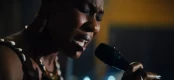
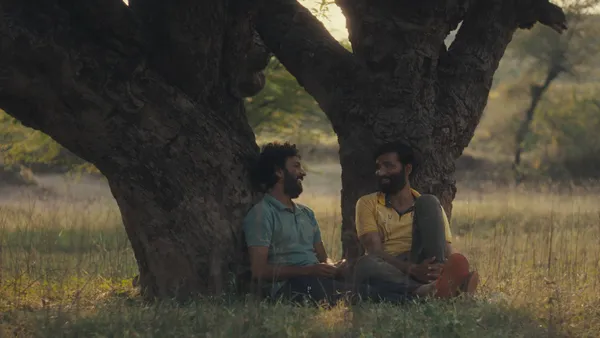
| Bhushaan Manoj and Suraaj Suman in Cactus Pears |
The slow-paced, intimate story of a gay man who returns to his ancestral village for his father’s funeral and is forced back into the closet during the ten day morning period, Cactus Pears is an extraordinary début work, announcing the arrival of a clear new voice in Indian cinema. Bhushaan Manoj plays the central protagonist, Anand, with Suraaj Suman as Balya, the local farmer, the only person he can really be open with, and someone with whom he forms a tender bond. The film wowed audiences as Sundance and Inside Out, and has since been named Best Feature Film at SXSW London. I was delighted to have the opportunity to speak with writer/director Rohan Kanawade, beginning by asking him about his experience with Venice Biennale College Cinema, which supported the film.
“We were part of the lab,” he says. “Although we didn't get the grant with that first workshop, which was for ten days, it was quite helpful. The other thing was they invited us again the next year for the Venice Gap-Financing Market because they said they really love the film and they still want to support us.”
He came into film through an unusual route, having begun his professional life as an interior designer.
“When, when I finished my schooling, I didn't know what I should be studying,” he says. “Even my father had no idea. And then his boss, where my dad was working as a private driver, suggested ‘Oh, your drawing is good. Why don't you do interior designing?’ To be honest, I had no idea what interior designing was at that moment. He explained me what it is and then I thought ‘Okay, I guess I can do this.’ That's how I ended up doing that. But even during my studies I was writing short stories.
“One of my classmates was also my colleague, and in 2007 she pushed me to make a short film for a competition. That's how I ended up doing a short film for the first time, using my other colleague’s mobile phone and my schoolfriend’s home PC. But we couldn't actually finish that film because that home PC was not equipped to handle editing, so it would crash every time we started editing. So we could not actually finish that film. But I was so excited with that whole process of creating something, I just wanted to make another film. And that film I made with another friend’s mobile, and I asked my parents to act in it.
“So that's how I actually started. I kept making films using my friends, and my dad then noticed it and he supported me, saying ‘I can see that you are spending more time in exploring filmmaking. It feels like you want to change your career. It's completely fine. Do it honestly and passionately.’
“Him saying that was very important because he was a driver, but at one point, when I was a kid in school, he quit his job, start working for himself, and with whatever savings that he had, he established a small company in Mumbai and he started running that for a few years. But after a few years he had to shut it down because of some losses and he went into a depression for a year. At that age I had no idea about depression or anything, but I used to think ‘Why is dad behaving like this? Why is he sleeping all day? ‘
“His thing was ‘I wanted to work for myself, so I started that company, and now how can I go back to driving again?’ So that was eating him up. But at the end of the day, he had a family and he had to earn money for them, so he had to go back to driving. So even after that experience, he supported me to change my career. He had invested all his savings in my interior designing course, but he still supported me. So that was very important. So many of my other friends, they don't have support from their families to explore filmmaking, even to be an actor.
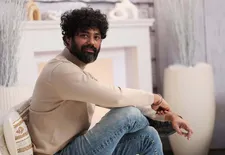 |
| Rohan Kanawade Photo: IMDB |
“That's how I just kept making films. And when I got access to internet, I started watching lots of interviews with writers and filmmakers. I already had a membership to one of the DVD libraries in Mumbai, so I was watching world cinema already. And some of those DVDs used to have this bonus feature where they used to include the making of the film. So I used to watch those first before watching the film, because I wanted to see what happens behind the camera, because I was never on a film set.
“All of this really helped me. And then after I started filming, I realised that screenplays are also available on internet. So if I wanted to watch a film, I would first download the screenplay of that film and read that. So I would have my own imagination while reading, and then I would watch the film to see how the filmmaker made it, what kind of decisions he or she took while making the film.
“So that's how my filmmaking journey started. In 2013, my films started getting into film festivals. With every short film after 2013, I used to write a feature film, but nothing worked out with those. But finally with this feature, which I started writing in 2020, things started working out, because we started submitting to the labs. And thankfully we started getting selected at Venice twice. We were at NFDC Film Bazaar twice. Then we were at Film London Production Finance market, which was our first film market in 2021. So all those things started happening with this film, and finally we opened at Sundance.”
I explain that this makes sense to me, because the film feels very mature for such an early stage in his career. It also has quite an international flavour about it. It's the first film in the Marathi language ever to screen at Sundance.
“You know, the person who started the Indian film industry more than 100 years ago was a Maharashtrian person and he made it in Marathi, although it was a silent film. The captions in the film, that was in Marathi. Even though we have such a huge industry and even a Marathi industry, none of the Marathi films ever went to Sundance – and with this film, it happened. That was my goal always, because I used to always think that whenever I make my first film feature, it will be in my own language, and I want to take that film to the biggest platforms of the world: Venice, Berlin or Sundance. And already at the script stage, we were part of Venice, but I wanted to be at one of those platforms with the finished film as well. That's what my goal is. I want to make film for a global audience, and not only for the Indian or Marathi speaking audience.”
Did this limit his casting options?
“The choices were limited, even because of the looks of the characters. I wanted those specific looks because usually we see very handsome looking, gym-toned men in this kind of film, and I was like, ‘Not every gay or lesbian person looks like this.’ I wanted to cast actors who look like normal human beings. I mean, they are good looking in their own ways, but not the kind of actors we see in usual films. So that was one thing.
“In some of the films in Marathi, when they have to cast a village character, they would cast an actor with dark skin, and the city person with a fair skin. But I said ‘That's not the reality.’ There's so many people in the villages who have fair skin. And so I wanted to even reverse that. So all of those things were quite difficult to find in one actor. And on top of that, there is sexuality involved, plus that one sequence where they had to be naked in each other's arms.
“I told my casting director, ‘Whenever you are approaching actors, just tell them everything, honestly. Tell them the backstory, why we are making the film, why that one shot in the film is important. Tell them everything. And only if they are okay with that, ask them to come for the audition.’ So that's what he started doing. And those who were completely fine with it, only those came for the audition. But, yeah, it took us three years to find these two men.”
I mention that I love Jaysri Jagtap’s performance as Anand’s mother, and that, to me, the mother and son relationship feels central to the film in many ways.
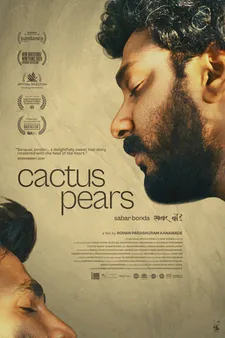 |
| Cactus Pears poster |
“Right, right. The mother was the first one to come on board. We found her in 2021, and since then she was like, ‘I am doing this film, I'm not going anywhere.’ She was a very big support.
“The kind of relationship that you see between mother and son, it's actually inspired from my partner's relationship with his mother. Me and my mother are actually the quiet ones. We don't really talk that much, but I use his relationship with his mother because they talk all the time. They show love to each other with touches, the way he keeps his head on his mother. I never did that with my mum, but my partner used to do that all the time. So I took the quietness that you see in the beginning from my relationship with my mother, and the later part from his relationship with his mother, and I just blended them. I tried to make something more honest and authentic.
“One of the important things was that we usually see the struggle for acceptance in the film. I didn't go through this kind of a struggle because my mum accepted me without any drama. My father accepted me without any drama. Although I Was scared when I came out to them because everyone is. The kind of coming out stories that I heard from other people and the kind of stories that films portray all the time, I was scared. But when this happened I was like, ‘Oh, it was this simple.’
“That simplicity was because my parents love me. It was that simple. That allowed them to accept the way I am. And I thought ‘Why don't we see this simplicity and positivity in films?’ That's why I use all those experiences to craft something simple. Because I think sometimes, just for the film’s sake and to tell the stories, people complicate things. And that's not the case all the time. I mean, I'm sure there is a struggle for some people, but there is also simplicity for some people and it's high time that we show that other side as well. Maybe that might give hope, encourage to some parents to accept their kids, or some kids to come out to their parents.
“Sometimes I feel we take our parents granted thinking that ‘Oh, they won't understand.’ Sometimes we have to take that step to just share. We might get surprised by our parents’ reaction and then also going beyond that traditional narrative of looking for acceptance.”
Setting that narrative aside gives him room to explore tensions with the extended family and wider community.
“I knew this one story where this guy was out to his parents and everything, but once his relatives came over to meet him and he asked his partner to go out for a while,” he recalls. “I know some other friends where parents are ‘It's okay, we understand you, but you know, don't tell it to the relative because you don't know how they will react.’ Even when I was there grieving my father, first of all, the situation was not right for me to come out because I was going through this pressure all the time for those ten days. So I decided not to stir the emotions anymore.
“I was also unsure how my relatives would react after that, even though I am not really emotionally bonded with my relatives. My mum is. Already she had lost her husband, and she needed the support of the relatives. I just didn't want to ruin that. So I had to be quiet. I think that's also a reality sometimes. For me,what was important was my parents. That said, I am not seeking any acceptance from the world or the society because I feel my sexuality is not my identity. My identity is my work, filmmaking, and sexuality is just a part of my personal life. So why I should seek acceptance from the whole world? So that's why I was not even interested in telling them.
“The triggering part was everyone was just continuously talking about marriage. You know, that's why sometimes you get so provoked and triggered. That's why you want to come out. But you also have to have a sense of the situation and surroundings. So it was just that. During one of the lab sessions, one of the mentors told me ‘I just think Anand and Balya go to Mumbai very quietly. They should stand up in front of the village and relate it.’ And I said ‘No, I'm not making that kind of a film. I know so many people who are living their life without standing up and going against the culture and the customs.’
People still fight, try to find how to live their life and navigate all this through this pressure. I want to show that reality rather than an imagined version of the queer life for the film's sake. So I'm not. But then I told her, ‘You know what? If I find my own way to incorporate that, I will do it’. So I just added a small thing.”
We discuss the film’s ending, and I remark that it feels more natural to me because there’s a bit of uncertainty about it.
“Exactly. And that was the whole point. I didn't want to make a film where it's a completely happy end. I just wanted to have some optimistic end where these two guys at least take a step to explore that relationship. Even that is important because I know so many people are so scared to explore the relationship because they're scared of break-ups and things not working out. But sometimes you have to also take that step.
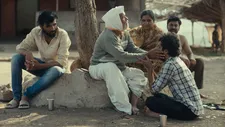 |
| Sabar Bonda Photo: Courtesy of Sundance Institute |
“Me and my partner took a step. My partner literally shifted from his city to live with me in Mumbai. Everyone in his circle was telling him ‘You should not do that. How can you give up everything and go to another city and stay with this person? You don't even know him that well.’ But you know what? He was like ‘It's okay if it doesn't work out. I just feel like this at this moment, and I want to do that and I want to explore that.’ So sometimes I think you have to take that step, and I just wanted to show that there might be hope.”
This works well with another aspect of the story, as people discuss what has happened to the father's soul now and how he has moved on. It also seems to be about moving on to a different kind of life.
“Yeah, yeah. I thought that father's story gives strength to Anand when he gets to know how his father and mother got married. That is actually the story of my parents’ marriage. When I heard it as a child, I was so excited about that whole thing, because there have been movies about this. You know, the man goes to see a girl, but he finds another girl, either beautiful or something else happens, and he gets married to another girl. When I heard, I was like, ‘This is like a film.’ And when I started making films, that story was always with me. I was like, ‘I'm going to use that sometime.’
“In this story, I thought that story might help him to take some decisions. I thought maybe seeing his father finally in a dream and knowing that he's finally gone, he's not there anymore, helps him to accept that reality. I thought all of this might help to create those emotions and that journey for the character.”
How does he feel about the way the film has been received?
“To be really, really honest, I wanted all of this to happen. You know, you want audience to feel something and what that feeling is was always in my head and while writing, I knew, ‘Okay, this scene is for this reason, so I want audience to feel these things.’ And those things are now happening. When people from the audience come and tell me that, I'm so happy that it's translating in a good way, and people are actually feeling those things, which is an amazing thing. I think all filmmakers want that to happen.
“With this, the vision was so specific. Not using background music at all. Just using the natural soundscape, static camera movement, long takes, but for a reason. Because when I was in my ancestor village grieving my father, there was no background music. Me and my mother were in the house all the time just listening to the sounds of the village. And I wanted to create that. We were in the village, it was the grieving period, so time felt so slow. I wanted to create that through static cameras and long takes. And still the audience were so engrossed. They said that they love the whole premise of the film and they were enchanted by it. So all of those things paid off, finally. I just feel happy about it.”
It feels a very personal film, I say. I think that often for new filmmakers the biggest challenge is finding their own style instead of just doing what they’ve seen other people do.
“Exactly. And I think I read somewhere that the more personal you become, the more universal that thing becomes. The other thing is, most of us have lost our loved ones, so people know that feeling. People know the feeling of heartbreak and connection with the parents. That's why, I think, people connect with this story, even though it's so specific and it happens in an Indian remote village with specific customs. The grieving part, and receiving the love from the lover and the parents, it's universal everywhere. I think that's what connected.”