 |
| Silent Friend |
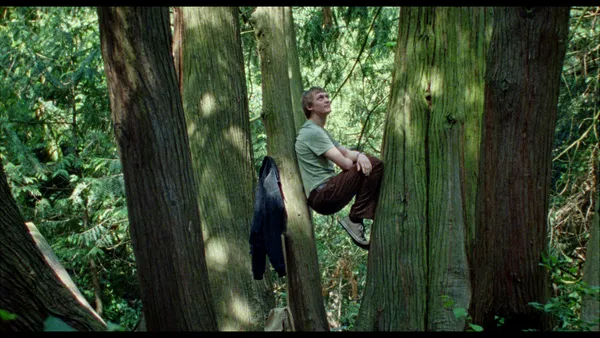
At the centre of Hungarian director Ildikó Enyedi’s Silent Friend is a ginkgo tree, which sits on the grounds of Germany’s University of Hamburg. Around this majestic marvel of nature unfolds a multi-generational story about three lonely people. The first is set in 1908, where Grete (Luna Wedler), the university’s first female student, navigates the inherent difficulties of the patriarchal institution and discovers botanical photography. Then in 1972, Hannes (Enzo Brumm) discovers a connection with nature when he’s entrusted to look after a fellow student’s geranium. And finally, in 2020, neuroscientist Tony (Tony Leung), sees his research shut down when the Coranavirus pandemic hits, but finds new meaning when he begins stufying botanical consciousness. Each of the three chapters, intercut together, are shot in a different format, from 35mm black and white to 16mm, and finally digital.
Enyedi’s previous films include On Body And Soul (Teströl és lélekröl), about an introverted man and woman working in a slaughterhouse who discover they share the same dreams. Discovering this surprising connection, they attempt to connect in their waking state. Enyedi has also directed The Story Of My Wife (A Feleségem Története), about a sea captain’s marriage based on a bet, and Simon The Magician (Simon mágus), in which the police call on an individual with unique gifts to solve a murder.
Speaking with Eye For Film Enyedi discussed defending science, the film’s visual language and sensory cinema.
The following has been edited for clarity.
Casper Borges: What was the seed of the idea for Silent Friend?
Ildikó Enyedi: In all my films, there are not only humans, but there are also animals and plants. Karl Baumgartner, a wonderful independent producer who this film is dedicated to, one day asked me a question. “Hey, Ildikó, why don't we make a film about plants?” Silent Friend was thanks to him, but he sadly died young, and he never got see the film. But he did get to read the first draft of the script.
CB: There’s a sadness rooted in the film’s origins then.
IE: It depends. At many of the screenings in North America, audiences laughed a lot. This pleases me because laughter creates a shortcut in your mind. What would, in an analytical way, be a painful and boring series of explanations, becomes something you can understand in a matter of seconds.
What is behind this is loneliness, separation, and the longing to break through these cultural barriers we build around ourselves. And even if we cannot step out of our human senses, which themselves are barriers, it’s just about evoking other ways of being and creating different realities. And there’s an excitement and adventure in evoking these other lives and realities. But it makes me curious why this film felt sad for you.
CB: Baumgartner’s passing and how he was unable to see the film he inspired being shared with audiences.
IE: Well, that's true, and that’s actually the whole history of Western philosophy. It’s about separation. One part is about being proud and the other is about being sorry for it.
CB: What were your broader intentions with Silent Friend?
IE: There hasn’t been an era when getting meaningful information was so easy. But there is a very strange resistance to accessing information, and it’s not by chance that the film is set on a university campus. The university experience is not just about getting a piece of paper or a good job, it’s about exploring, and so, one of my intentions was to show the beauty and the adventure in science and how precious it is for all of us in an era when it is widely attacked and questioned.
CB: We’ve been taught to see science through a clinical and intellectual lens, but as your film shows, there’s a creative side.
IE: It is something messy and bold and unpredictable, and it requires serious passion. So, it is perhaps the only space in our society where failure is part of the process, and it’s not something negative — you can eliminate and step forward. It's probably the only space where you immediately share your findings with your peers, instead of keeping it for yourself. I of course idolise it, and at its roots, it is about not being afraid of making a fool of yourself.
CB: On your point of knowledge, the security guard who is suspicious of one of the characters is representative of a deeper social and political paranoia, specifically the fear around information, whether it be the flow of information or the need to control the narrative.
IE: This small figure is important for me, especially the way his suspicion and animosity against the professor just dissolves through a very simple, human moment. He's eating and watching Tony in the distance. He only sees his back, but he sees that this guy, after being cut off from his experiments, is sad. He has lost the joy in life.
In many cases, the conflicts between people-to-people, not institutions, are based on fear and misunderstanding. These conflicts are about lacking the tools to articulate yourself and being able to understand and articulate what others say. It’s a sort of social clumsiness.
CB: What was your thought process behind the film’s cinematography?
IE: Well, I wanted it to be a sensual film that works through the audience’s senses. That's why the storylines are broken and not complete. It's there to facilitate the involvement of the audience. But in cinema, you have the sound and the image, and nothing else. So, you can just evoke a smile or a feeling. The texture of the film was really basic and really important. I didn’t focus on fitting the era exactly, rather, amplifying the way people at that time were watching the world or perceiving their environment. And in each case, there were these moments of discovery or a shifting perspective.
For Grete, the new discovery is nature’s structure. To show structure and cinema, the very beautifully dated 35mm black and white cinematography was the best choice. And of course, a certain way of lighting goes along with it. Then, the Seventies wasn't about the structure. It was about experimenting with the senses and enlarging them by walking bare foot in the grass or taking some hallucinogens — getting outside of your little nest. It was about the moment, the smells, the hormones, and the pheromones. So, this very grainy 16mm film could create an impressionistic-like painting, and the patches of colours create the main interest and not the silhouettes of the objects. And for 2020, these huge empty spaces were built for many people and now there is just one figure ambling around alone. The precision of the digital was the right choice, and we also tried to shoot everything under a covered sky.
CB: Will you continue to pursue sensory-driven cinema?
IE: I was a teenager in the Seventies and even if today there are so many wonderful films, the overall image is going step-by-step towards conservatism and narrowing and what you can imagine would be shown in a cinema. And it doesn't want to openly be an auteur film. I don’t want to push an agenda on the spectator. Instead, I try to offer an entertaining experience and let their curiosity, stimulated by a film’s layers, lead them wherever it might.
Silent Friend opens in New York on May 8th and Los Angeles on May 15th.