 |
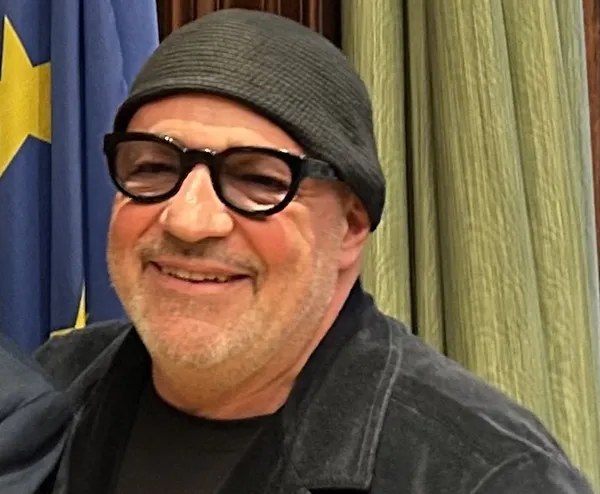
| Gianfranco Rosi, director of Below the Clouds (Sotto Le Nuvole), on Pietro Marcello: “He’s the one I told you who made me make this film. He’s a master of using archival footage in his work.” Photo: Anne Katrin Titze |
At the Italian Cultural Institute on Park Avenue in New York, during the event for Gianfranco Rosi and Francesco Sossai in conversation with Claudio Pagliara (director of ICI-NY), I asked the director of Below The Clouds (Sotto Le Nuvole, Venice Special Jury Prize winner and a highlight of the 63rd New York Film Festival) about his use of archival footage, plus George Sanders and Ingrid Bergman in Roberto Rossellini’s Voyage In Italy on his screen.
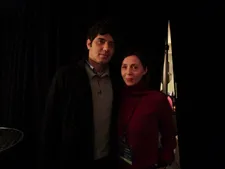 |
| Pietro Marcello with Anne-Katrin Titze in New York Photo: Anne Katrin Titze |
Below The Clouds begins with an epigraph by Jean Cocteau: “Vesuvius makes all the clouds of the world.” Legend is always told as truth and thus this is a fitting send-off into the enchanted and very real realm of Gianfranco Rosi’s marvelous new documentary. Mount Vesuvius and the region of Naples below is the setting, but the apprehensions of tremors that could foreshadow catastrophe, though heightened there, are universal. The cloud formations in black and white (as is the entire film) and the mystical fogs swallow up distinctions of time. The great disaster that destroyed Pompeii in 79 A.D. lives equally in the past as in the future. Set in the in-between, the now includes both and is limited to neither.
As he did in Sacro Gra and Fire At Sea, all the way back to Boatman, Rosi expertly paints a picture of a community with all its widely varied facets. In Below the Clouds, the local fire department, extraordinary in word and deed, is first shown in action in the tunnels aiding an inspector investigating grave robbers ransacking the treasures hidden underground and often under abominably dangerous conditions.
An old regional tram can encroach like a monster at night and resemble the calm orderliness of the trains and stations in the films of Yasujirō Ozu. A woman in a white lab-coat studies her friends, antique statues in a vault, like a Dr. Frankenstein inspecting a head and commenting on the wonderfully graceful coiffure set in stone. In an old cinema, long out of business, Rosi projects footage that tells of the region’s history.
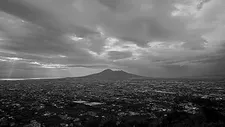 |
| Gianfranco Rosi: “For me, inside the lens, in filming, is where I discover storytelling.” |
Rosi had spoken about the death of audiences watching films on the big screen, and explained how it was Pietro Marcello, whose wonderful film Duse (starring Valeria Bruni Tedeschi as the legendary actress, also in this year’s Main Slate of the New York Film Festival), who initiated the idea to make a film in the shadow of Vesuvius. Cinema history, besides Cocteau and Rossellini, flickers in and out Below the Clouds, and although Alain Resnais’ Hiroshima, Mon Amour had not been on Rosi’s mind, he told me, when near the end, luminescent particles float and glisten, a similar air of threat envelops both.
Anne-Katrin Titze: Gianfranco, a question to you, apropos the death of cinema you were talking about: A dilapidated old cinema is a place that you return to several times in the film. Where we see on the screen George Sanders and Ingrid Bergman in Roberto Rossellini’s Voyage In Italy and documentary and archival footage. This cinema that is somehow there in the center - can you talk about finding it and having the idea of giving us the past of the region and, also in a way, the future in there?
Gianfranco Rosi: I wanted to use the archival footage. When I was writing the idea of the film, to find out where the film was going, I was rewatching a lot of archival and I love so much the Roberto Rossellini film, which was shot all in Naples. And I didn’t know how to use that film by Rossellini, that element. In Italy we have Pietro Marcello, who is a great director, who is another one who is still searching for new cinematic languages. He’s the one I told you who made me make this film. He’s a master of using archival footage in his work. He always did it. And he uses it in his own historical way.
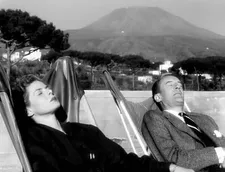 |
| George Sanders and Ingrid Bergman in Roberto Rossellini’s Voyage In Italy |
And I felt I cannot use archival the way Pietro is using it, because I was not able to reach that element of spontaneity that he has. Then I encountered that area where I was filming, where Titti [the man with his own after-school program for kids in his bookstore] is, where the boat is, the Syrian [grain] boat. I shot probably 60% of the film in that area, which is very different from what is known. That used to be the area of the old port of Pompeii. That was the area where I was filming. And when I was passing by the front of this cinema, which is a huge cinema from the Sixties, Fifties probably, it was so painful to see this incredible structure completely dilapidated and abandoned; there were three movie theatres down there.
Then one day I found a way to go inside the theatre to see. It feels like an archeological site and I had the idea to use it for the archival, as a space of narrative. Having the images coming from the memory from this existent screen that still is leading to the memory of the past. A past that doesn’t exist anymore. Unfortunately in Italy, I think, they closed down 60% of the theatres. The remaining only survive because there’s a huge subsidy from the state and from the European Union. Otherwise all these theatres would not be there because there is no audience. People don’t go to the cinema anymore. It’s an illusion.
What is the beauty of cinema for me is not so much to share the same experience with other people. Because I love to be in a theatre completely alone. It happens so often that I want to see a movie and there are no people and I’m alone there. Once I was able also to smoke a cigarette in the theatre, the way it used to be. No, but what I love about cinema is that we are smaller than what we watch. This is the beauty of cinema for me. We are watching there this beautiful film that’s wide-screen projected for us, and we have two hours immersed in that story. That’s what I love.
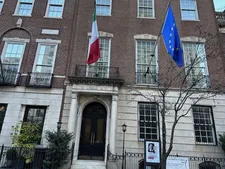 |
| The Italian Cultural Institute on Park Avenue in New York Photo: Anne Katrin Titze |
When we see things on our phones, our watch - there are so many areas of distraction that are always bigger than what we watch. Of course cinema will not die, there’ll be something else. But it’s a fact that theatres are dying. In Europe, in France, a film theatre may survive only because there’s an audience, but the rest only because of huge huge subsidies. Newspapers - it’s the same thing. It’s changing. We have to find and develop something else. It’s an illusion that theatres will survive. It will not.
For me, inside the lens, in filming, is where I discover storytelling. I discover a new reality there and I love to film. When people say, it looks like you’re invisible - you’re not invisible, there’s a huge camera there. The camera separates me and the subject. It changes you that are filmed and it changes me, that is filming.
DOC NYC screening of Below The Clouds is on Sunday, November 16, at 2:50pm - IFC Center