





Eye For Film >> Movies >> Duse (2025) Film Review


Pietro Marcello begins his jewel of a portrait of the legendary Eleonora Duse (Valeria Bruni Tedeschi in top form, giving one of the best performances of her career, a highlight of the 63rd New York Film Festival) with a prologue depicting toy soldiers, little clay figurines trapped in the horrors of the Great War, and produces an emotional impact more profound, than most CGI spectacles could ever dare to dream of.
Duse, the greatest Italian actress of her time, accompanied by her Austrian assistant, Désirée Von Wertheimstein (Fanni Wrochna) is on her way to address the troupes at a mountainous camp. The soldiers, many of them traumatised and severely injured, are in awe, despite the fact that she had given up performing ten years prior. This goes beyond entertaining the men. In a tent, she witnesses the wounded holding on, until a doctor tells them to allow themselves to pass out. She recognises one of the officers as Giacomo Rossetti Dubois (Edoardo Sorgente), a young writer she once knew and is happy to reunite with.
The world has changed with this war. From a small plane flying high above, a message drops down with a kerchief for Eleonora from her former paramour, the poet and political firebrand Gabriele D'Annunzio (Fausto Russo Alesi), whose presence is one of the threads that snaked through her life and the film. The other strand, braided into the visual narrative is the carefully colourised archival footage of a train that transported the body of the unknown soldier across Italy to be buried in Rome in 1921, stopping along the way for the population to pay their respects.
Marcello works with archival footage in such a masterful fashion (and did so in his previous movies Martin Eden and Scarlet) that both his fiction and the preexisting material illuminate each other in new ways. While wondering who this magnificent funeral could be for, we may come to the conclusion that the point of the journey lies elsewhere.
Duse’s health is deteriorating and in the post-war chaos her bank in Berlin went bankrupt and her entire savings are gone. The situation is dire and even her estranged daughter, Enrichetta (Noémie Merlant), arrives from London to maybe say farewell forever. But as nothing in her mother’s life is predictable, a dream about a grotto resurrects her, makes her feel “so free and alive”, that plans to perform Ibsen’s Lady from the Lake in Venice go full steam ahead. Duse will return to the stage and it will be a triumph. Doctors who want to send her off to the Schatzalp Hotel in Davos will have to hold their horses. Invigorated by showing young actors how to get to the truth in their performance, a precursor to method acting, she steps back into her element. No one could have shown this better than the actress playing her.
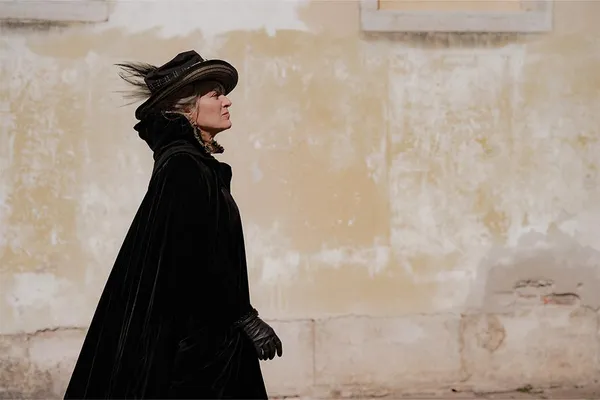
Valeria Bruni Tedeschi’s face is electric. Every nuance can be felt and yet her portrayal leaves intact all the mystery of this visionary in the art of acting. We see Duse in a Venetian palazzo, being fitted for a gown by Mariano Fortuny (Marcello Mazzarella), out on a gondola, and walking the old stone bridges in her famous hat and cape. She is “free and responsible,” like her character in the play and at the same time profoundly vulnerable and holding it together with all her might. Duse’s joy is her work, her life elixir, and her daughter, who is in Venice from London with her two children, is shunned once more when only the family is not allowed to celebrate the opening night success at La Fenice.
Sarah Bernhardt (Noémie Lvovsky, star of Marcello’s Scarlet) had come all the way (and with a wooden leg) from France to see her colleague and it is her criticism the next day that Duse takes to heart. How can she do the same plays after everything that happened? Also in the audience was Benito Mussolini. His time is coming, he is flexing his wings to take full flight. Duse is as much about the rise of fascism as it is about the decision making of an artist at a precarious time in her life.
Marcello and his costume designer (Ursula Patzak) outfit Bruni Tedeschi with a black velvet cape whose feathered collar unfolds like the gills of a pale mushroom and a sea green garment looks as though it were colorized by hand. The textures jump off the screen as we are touched by her ordeals and tribulations. Trying to adapt to the new times, she ventures into fresh theatrical territory with a rather unruly play, called Hecuba of the Trenches, by her protégé Giacomo, a kind of abstract, wailing, un-thought through Mother Courage that nobody wants to see.
“They cheer you, but they don’t listen to you” is an artist’s curse. The young playwright will resurface again in her life, in black shirt, when Duse is summoned by Mussolini and brings a model of her 'church', a temple for the theatre she wants to have built. It is a formidably disturbing scene as she realizes that nobody there takes her seriously. She is the crazy hag who shall receive a pension and have her debts paid off by the state power.
Her facial expression oscillates between gratitude and horror, and for seconds Bruni Tedeschi seems to want to push her Duse to stop ignoring what she knows is true. She is not only “an old lady and a little girl,” she has become Leni Riefenstahl and tied her legacy to another. “So you too are in their butterfly net?” D’Annunzio confronts her when she, once more, flees back to him. He knows they made a fool of her. “They bought you for pennies,” he says, ailing and still in awe of her.
There still is the family, of course, her daughter, forever in competition with her mother’s work, and more personified, with her assistant Désirée, also returns and returns, despite all the fights and disappointments.
The grandchildren and we, the audience, receive the extra treat of Bruni Tedeschi’s Duse reading to us from Pinocchio, which is as frightening and impressive as it gets. Now a new chapter can begin, the marionette is to become a real boy. But maybe the call of adventure is too strong and the theatre is really all there is.
Reviewed on: 04 Oct 2025


