 |
| Shadows Of Beirut |
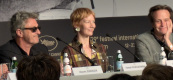
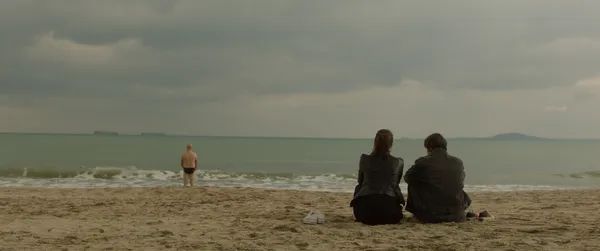
A woman’s journey to the city of her childhood to try to reconcile with her hospitalised father leads her to rediscover the place in Tina Gharavi’s new film Shadows Of Beirut, which opens in cinemas across the UK this Friday. It was written by Tala Calil, based partly on events in her own life, and Tina persuaded her to take the leading role of Lana, though she had little experience as an actor. Playing alongside her, in the role of her cousin, was popular actor Assaad Bouab, and the three of them joined me last week to discuss the film, which will open in UK cinemas on Friday.
For a film focused on quiet observations, conversations and interior experience, it opens spectacularly, with the blast that levelled a large part of the city when 2,750 tonnes of ammonium nitrate stored in a portside warehouse exploded on 4 August 2020. I note that a lot of people elsewhere in the world still don’t really understand how devastating that blast was. The distinctive landscapes it left behind, along with the legacy of past wars, are explored at intervals throughout the film, but Tina reveals that the script was developed before it took place – and that, of course, it redefined much of what followed.
“The blast happened while we were just starting preparation for the film the first time. We were supposed to be on a recce that weekend in Beirut, and due to a lot of things that were happening around Covid, we actually were doing it remotely. But we knew that when this happened, this tragic thing that happened for the city, something that is just unbearable to think about because so many people lost their homes, their lives, it showed another fracture in the city. We knew that we really wanted to address it rather than ignore that, like it never happened. So we worked on the further drafts of the script that Tala wrote, and we added that story into it, which also seemed very prescient, very relevant.
“This blast really showed the cracks and the fundamental problems that were underlying in Lebanon at that time. You know, Lebanon is constantly going through upheaval for more [reasons] than war. It's a city and a country that is always fighting to exist in its own right, with peace and with harmony. The film is a documentary of the moment when we were making this film, between the blast and the Covid lockdown, which was really at the end of our film production. The film traverses one of many difficult years for Beirut.”
I tell her that I’m also interested in the way that Covid came into it as well, because I have friends from the region who, like characters in the film, dismiss Covid as ‘just a flu’ and don't take it seriously. Here, it seems to suit the way that the lead character is distancing herself from everything.
“Yes,” Tina nods.
“And for a character who's already suffering from rather severe OCD, to have that layer of Covid added is just...” Tala trails off. “I mean, it added more trauma. It's horrible. That was a very difficult time. And on set, the production adapted quite miraculously by Covid testing every day. Everybody was wearing face masks. And we forget now, we forget that we went through that, but we did. And we managed. So to have that extra layer for that character was almost a natural. It was relevant because it's also a film about connection.”
“Yeah, and connections that somehow became very relevant again about how do we be with people, how do we connect,” says Tina. “Yeah. That also is another thing that was there. And then what was happening in the documentary of our lives was also being talked about.”
Tala agrees.
There's quite a lot in the film about breathing in there and not being able to get breath, and the distance that creates because of how other people perceive the heroine and the panic attacks that she has.
“Absolutely,” Tala says. “And for someone who had never acted before, having a mask on for a bit of time was quite convenient. But it did add to that character. The panic attacks were always there. So having the panic attacks be exacerbated by this face mask that Rami keeps trying to take off her face because he just believes it's the flu. But for her, it's almost that she's hiding behind that mask. I was, as a person, hiding behind the mask, but the character is always hiding behind this mask. Having that mask emphasises that internal feeling that she has anyway, of not being able to breathe. So the mask, that excuse, that extra reason – do you know what I mean? To not be able to breathe. And once Rami takes that mask off, she has to confront it.
“She can't breathe, but you have to find a way. We need to confront it and try to breathe without it. Try to confront those demons that you are going through.”
Without wanting to introduce too many spoilers, I say, Rami seems like a character who is conflicted in the other direction by making connections too easily and not knowing how to manage that side of his life.
Tina laughs, looking at Assaad. “You are full of connection. You are opposite.”
“Yeah, he's the opposite,” Tala concurs.
“Well, they grew up in the same family and they probably have the same background and trauma, but two ways,” says Assaad. “I think Rami holds this joy and just wants to be happy, but it hides a lot. He doesn't talk about some subjects. When we see him with his family, we can feel that there is something much more heavy for him, and probably a sort of anger too, because he didn't express some things. But with Lana, he's very himself. I love this complexity with Rami.”
“And, you know, it's very relatable, I think, in the Middle East,” says Tina. “Our cousins are such an important part of our landscape of our lives. They are brothers and sisters, really. It's part of your life. And I think that that relationship, the contrast between the two of you, like, Lana who's the most uptight and Rami, who seemingly is so open and free, but he's suppressing quite a lot. You know, he's not too similar, but very similar.”
That sense of extended family seems to extend to the city itself – something else with which Lana has to achieve reconciliation.
“Absolutely,” says Tina.
“She goes back to Beirut for the first time,” Tala observes, “so Rami is her pillar. He is her only connection of the family. She thinks she's coming to a place that no one really knows why she's there or what she’s really doing, but Rami, within a few hours of her being there, is already telling her ‘Are you here because of him?’ So he knows the reason, and she's kind of shocked because she's no longer used to this intrusiveness. There's this feeling of you have nowhere to hide because everybody knows everything about you, even though you haven't spoken to them in a long time, even though you have not been there for a long time. So Rami tells her that, and she feels sort of naked, just exposed.
“I think the paternal relationship evolves through these characters, through Rami, through Sirine, through all the people she meets, through the things she sees. I don't want to reveal too much, but she sees the scene of the blast, firstly with Rami, then goes to visit it. It's Beirut. Tina has always said that from the start, it's not just a city, it is the main character of the film. So the relationship towards Beirut is what makes her confront everything else. By confronting relationship with the city, she has to confront her relationship to her family.”
Were they also interested in contrasting the culture in Lebanon with that in Britain by having a British character go there and discover how everybody knows everybody, when Britain often seems like the opposite of that?
“Yes,” says Tala.
“That's the experience of a lot of second culture kids,” Tina adds. “Kids grow up in the West but they have another identity and another culture. Going back, you have to renegotiate your relationship. I had that with Iran. You might have had that with Morocco,” she says, nodding to Assaad. “There's still a dialogue between who we are, where we might have grown up, but also our ethnic background origins, which in some sense is part of ourselves, but we have to renegotiate a relationship with that as adults. Often there's something called Saturn's Return, where people, at 28, do great big return journeys. I don't know how old Lana is supposed to be, but roughly around that.”
“She was supposed to be 28. By the time we shot the film she was, like, 50,” says Tala, referring (in a slightly exaggerated manner) to the length of time it took to get the project off the ground.
“Well, yeah, so it's just that return journey to find who we are. It's like a pilgrimage, you know? Like going back and thinking about what it means to come from there. Sometimes, for people from the Middle East, sometimes that's a problematic place that we come from. And I know for me, it was very healing going back to Iran 23 years later, to be in my culture. I had a whole different viewpoint on it. I was like, ‘Oh, Iranians in Iran aren't so annoying here as they are in DC or Los Angeles.” She laughs. “They're very different, you know? I mean, I know you had a different relationship, I think, to Lana...”
“Yeah,” says Tala. “I mean, this is the whole point of this script, of this film: I never went back. So Lana does what I didn't have the courage to do in real life. I never went back to see my father. I did go back to Beirut, but I didn't go back with that objective. So I think living it through Lana was extremely cathartic for me.”
“It's almost like they've had the experience of writing about it and then playing it and then producing it for the last hundred years,” says Tina.
“Exactly. There you go.”
“It's free therapy or very expensive.”
“I think it was, eventually.”
“But it was worth it,” says Tina. “That's why – I teach screenwriting – I always say ‘Write about the thing that is in you that gives you the most trouble, because you need to work something out.’ And then the audience gets to also benefit from that. I think you were so generous to put that real experience that was troubling you into a story, and that's what makes this so great. There is something very authentic and genuine at the heart of this, which you brought with your biography and you shared. And that's why I had no choice but to ask you to play the role, because only that made sense in my head.” She turns to look at me. “And also because she’s gorgeous and such an amazing actor.”
Tala blushes. “Obviously working with someone who's so experienced like Assad means that you have support to have that way of constructing the story,” she says. “That wasn't entirely a gamble. And everything happened so serendipitously.”
“Yeah,” Tina nods.
“We look at it now and it is a miracle that we're even here today,” Talia says, leading Tina to speculate about writing a memoir.
“This is, I think, the only way that the story could have gone,” Tala concludes. “Had it come out two or three years ago, I don't think I was ready. I think we were all in a different place.” We have a little time left, so I ask about the music in the film, which is really interestingly arranged. I would really have to ask composer Yavor Zografski, Tala says, but she still has thoughts to share.
“There were a few songs that I know Tina wanted to capture that from the very start. She wanted to get as much Lebanese essence into this film as she could, and I know there was a moment were discussing Fairuz, who's one of the most iconic singers that I remember. Even though she's Lebanese, she was known all over the Middle East. She's an incredible figure in France as well. So we wanted to have as much Lebanese flavour in it as possible. That ended up being a little bit more expensive than we hoped for, but I think Yavor managed to capture as much as possible from the Middle Eastern music without making it overly cliché and overly, you know, drummed into people that this is a Middle Eastern film. I think he managed to weave those different threads.”
“Yeah,” Tina agrees.
“And then Tina had this beautiful song from an artist who's not Lebanese, Emma – I think she's Algerian, but has a French connection. And I think that song captures the film so beautifully.”