





Eye For Film >> Movies >> Itch! (2024) Film Review


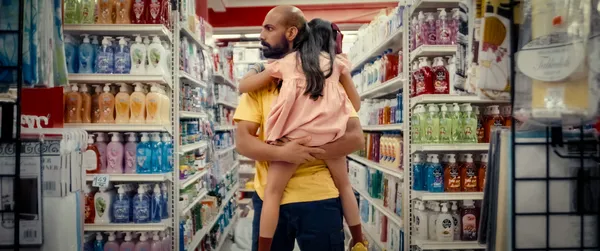

“I want to visit Mom,” writes Olivia. She only communicates in writing now, although Jay (writer/director Bari Kang) knows that she’s capable of speaking. It’s implied that her silence began with the death of her mother from cancer. Jay still blames himself, crushed by his inability to protect either one of them, and for the drunken oblivion which consumed a year of his life when his little one needed him most.
The radio plays in his car as he drives into work. Refugees are being blamed for an outbreak of scabies, we hear. As in George Romero’s classics, little snippets of media and things glimpsed in passing function as warning signs of the horror to come. An epidemic is spreading. Nobody really knows its origins, though theories abound. Overwhelmed by intense itching, the infected rend their own skin to the point of inflicting serious wounds, and easily tip over into taking out their aggression on others.

When he gets to work, Jay abruptly finds himself caught up in a dispute. Somebody has been stealing money from the supermarket his father owns, and Miguel (Patrick Michael Valley) has been sacked as a result. This doesn’t seem right. Later, Miguel will return seeking resolution. There is already a lot going on. At a pivotal moment, people start receiving worning messages on their phones. Close all doors. Don’t go outside. If you can’t resist scratching for the count of ten, the police will shoot you.
If the end of the world comes during your lifetime, the chances are that it will happen when you’re in the middle of something.
Though the remainder of the film takes a familiar form, with the various staff members and customers in the store banding together to ty to survive amid external crises and outbreaks of distrust, Itch! retains a solid core. Olivia is in the store too, and Jay finds himself caught between the desire to shield her from what’s happening and the need to prepare her to deal with it. As his own coping skills deteriorate, he begins to open up more and more, which may be what she needed all along.
Most of the characters here are immigrants or the children of immigrants, though with different backgrounds, with prejudice sometimes emerging between as well as around them. Racism hangs in the air like a skin irritant. Try as one might to ignore it, it is always present, perpetually exacerbating tension, demanding a reaction. The world outside the store may now be too dangerous to enter, but it has never been safe. Aided by Chris Liang’s evocative work in the sound department, the sense of vulnerability and fustration builds up throughout the film, threatening to lead to self destruction.
This is not the only metaphor present in the film, which also touches on the social impact of conspiracy theories. The social body feels as fragile as the corporeal one. Early scenes of contact with the infected change the frame rate to create a sense of the uncanny, of losing control. The gore in scenes of frantic scratching is kept light, putting the focus on the performances. It’s rare to see severe pain evoked this well; one suspects that the actors must have some personal familiarity with it.
The scenes of violent confrontation are relatively few, but mroe powerful for it. Again, Kang wants us to see not just the physical effects of this, but the psychological effect on those doing harm. There’s a suggestion that this is a positive form of distress. Each time violence is necessary, it’s a little easier. Eventually it will be filmed in the same way as everything else. Thus our perception of what constitutes normality changes.
You may or may not have the patience for another zombie film, but this one is well made, and Kang has something to say.
Reviewed on: 20 Apr 2026


Director: Bari Kang
Writer: Bari Kang
Starring: Bari Kang, Tim Andrews, Darrell Bowman, Gabriel Carter, Monica De Oliveira, Carl J Grasso, Phil Harris
Year: 2024
Runtime: 82 minutes
Country: US
Search database:
