 |
| Snipped |
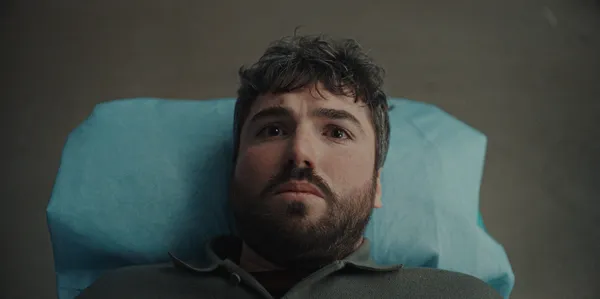
There’s some great stuff on the Best Live Action Short Film longlist for next year’s Oscars, but inevitably, out of the hundreds in competition, there are also great films that didn’t quite make the cut. Among them is Snipped, a Danish film about a man called Adam (Louis Bodnia Andersen) who is converting to Judaism and needs to be circumcised accordingly. To do so, he has to make use of the services of a Muslim doctor. Tensions are running high due to the situation in Gaza, so an already nerve-racking procedure makes him more anxious by the minute. In the event, nothing goes quite as he expects.
When I met producer Rebecca Pruzan to discuss the film, she reminded me that we had met previously, at a press conference about previous Oscar contender Ivalu. We were joined by director Alexander Saul, who also wrote the film – based, as it turns out, on personal experience.
“The last couple of years, I've been doing my conversion to Judaism,” he explains. “My mother is Christian and my father is Jewish, and I always felt closer to Judaism. Then, after October 7, I reached the point where I had to get my ritual circumcision. And in Denmark, the Jewish doctor retired, so my only option was a Muslim doctor to be circumcised.
“I wasn't nervous beforehand, but when I got into the room at the doctor's clinic, things were escalating in the Middle East. I got kind of paranoid that they would hurt me somehow, and just very nervous about the operation and the whole thing. And afterwards I was very embarrassed to be paranoid in that situation because everything went well. So I spoke with Rebecca about it, sharing my story, and we together decided that this was a film we could make that could preach coexistence somehow.”
“I haven't told the story to any man who doesn't immediately do like this,” says Rebecca, leaning forwards abruptly and putting her hands over her groin. “I think the whole situation is, for any man would be, no matter if there's any religion involved, just the fact of being an adult and getting that surgery is something different than most other surgeries. I think it's more fear provoking. But then the whole situation, I mean, the whole picture that stood up in my mind about a Jewish man and a Muslim doctor and everything you hear about in all news outlets is just conflict and intense, horrible situations. And then here comes Alexander, going with his Jewish penis to a Muslim doctor. It's just, you know, it's a crazy picture you get in your mind.” She looks at her colleague. “And then especially the fact that you felt ashamed of being more afraid because it was a Muslim doctor – that just put the whole situation in such a strong context of what's going on in the world right now.”
I tell them that it seemed to me that it's talking about the space between politics and the way we talk about things on a world scale, and actual human experiences.
“Yeah, yeah, yeah,” says Alexander. “I mean, as Rebecca said, the media and social media and the whole algorithm is only talking about hatred between the two cultures. There's so much hate at the moment. It's so polarizing. And when it's just normal human interaction, it's not what you feel. I mean, I wear my star of David, at all times, and I live in a – not a Muslim neighborhood in Copenhagen, but a neighborhood where a lot of Muslims live. And no one has ever said anything. So I think it's something different when it's on a human scale than on a larger political level.
“I tried to make it pretty much as I felt it, how I experienced it. A lot of the elements, some are fiction, but a lot of them are also what happened in real life. The most difficult part was writing the Muslim characters. We used a Muslim consultant to help me be very precise and respectful around Muslim culture.”
The circumcision procedure is pretty much the same for Jews and Muslims, he explains, though there’s a different prayer involved. The prayer can be offered later.
“His father is in the room, but I think the father also has his worries and his fear of what's going on in the world, and he doesn't support him doing it,” says Rebecca. “I think that's also hard for him, that his own father, who has gone through the same thing as a child, doesn't support him. I think that’s also making the whole situation worse.”
That gives them the chance to show generationally different viewpoints on it.
“That was a very important part for me,” says Alexander, “because my father's side of the family, like the older generations, are scared in a whole other way than I'm scared by this conflict, because they've been through others and they have another baggage, so to speak.”
We talk about the smallness of the consulting room, the operating theatre, and the car which Adam and his father inhabit at either end of the film.
“The claustrophobia feeling was very important in this film because you feel kind of trapped in this situation. There's no way back, really, when you're lying under the operation,” Alexander says.
Then there is the use of humour.
“Penises are generally quite funny,” he says. “Rebecca and I talked a lot about that. The humour is very natural in this setting – there's so much humour around this operation. So I didn't write any humour in it; it just developed itself somehow. When we were developing the script, Rebecca and I talked a lot about when that humor somehow breaks down barriers. So that's a way to make this whole theme of the film more easy to digest.”
“And it's also been a profound thing,” says Rebecca. “I mean, when you told me first about the surgery, my instant reaction was laughing. When I contacted many of the cast, I was nervous because it's hard to call a Muslim guy and ask him ‘Do you want to play a taxi driver?’ It’s so full of prejudice also. And his reaction was bursting out laughing. It's probably the funniest set I've ever had. At the same time, it's one of the most serious subject matters. I think we also need to be able to laugh about it because as I said before, everything is so extremely serious, intense and devastating, wherever you look.
“It's a very hard time we're living in, in many different ways. And I think that exactly what you said before, it comes down to that human interaction. It's just such a relief that you're able to laugh because everyone is so afraid. I'm afraid of saying, you know, will I say something to insult you? We are so cautious these days. We're so afraid of saying something wrong because everything Is so tense, so serving a subject matter so serious and being able to laugh about it, I think, is very important.
“When we screen the film, in the beginning, people are a little worried because, if they don't know what it's about and they hear about Jewish and Muslim and circumcision, that's a pretty hefty subject. And then the start is pretty fear provoking. And then one person starts laughing and it just spreads, you know, and the whole room is cracking up. And that's just, I think, marvelous. I think that's what we need right now, is being allowed to laugh, and laugh together, and not being afraid, and only being serious because there's still much joy and there's much to laugh about together.”
“We’re showing all the similarities instead of differences,” says Alexander. “I mean, in all countries around the world at this moment, it's all about the differences all the time. But we are much more similar than what is preached at the moment. I think that's very important. I think humour can help show that.
“We very much agreed with what was funny, but you never know,” says Rebecca. “Humour is a hard thing to share and it's also a cultural thing. But so far we haven't had anyone being offended. It's been a good experience, but all you can do is really trust what you find funny and good and hope that it resonates with other people. I think as long as you do it in a respectful way, it’s good. The whole essence of the film is that we all carry all these prejudices about each other, but what it comes down to is that we're not that different.”
They’re both very happy that the film got as far as it did in the Oscar race.
“Even having this conversation with you probably wouldn't have happened if we hadn't been this situation,” says Rebecca. “That's the wonderful part there. I mean, it's a great honour to reach that goal, but it's more the fact that you can really get to share your film and talk about your film with many more people than what is otherwise possible with a short film. And that's why you make your films, is because you want people to watch it and to start a conversation.”