 |
| The Truck |
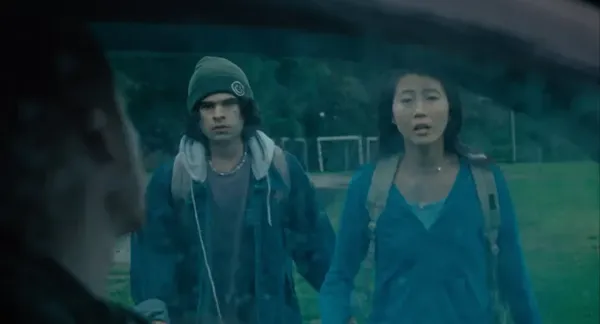
Liz Rao is a filmmaker who has already had a taste of success, as a editor and producer of 2018 indie hit Madeline’s Madeline, which was nominated for several Independent Spirit and Gotham Awards. She’s now attracted Oscar attention with her short film The Truck, which follows a young couple in small town Tennessee as they go looking for the morning after pill, eventually ending up in a truck with a man who might be able to help them but won’t do so without getting something for himself. When we met, she explained that it had roots in the places she knew as a child.
“I grew up in the American South and Midwest, just outside of Nashville in this very suburban but almost rural little neighborhood. It was outside of Nashville, but it gets so quickly into rolling hills and wild farms. As a Chinese American in that environment, I always had this kind of romantic love for the American dream and the American landscape – and also standing a bit outside of that and critiquing and questioning the rules and the dynamics between people at the same time.
“My parents were immigrants from Southern China, so there was this dual cultural experience. My parents never spoke with me about sex, and so I learned all of that in experience and also a little bit in school. But also in school, it was a very, very Christian and religious community, so there was just very little talk of any kind. And, of course, getting into teenagehood and dating for the first time, having sex for the first time, you know, all of those wonderful things as teenagers brought up all these questions in terms of power.
“It was just a shock to kind of grow up in this community that was more conservative and less conversational, and then meet the world and step outside of that bubble and realise that teen love is great. And there's also so many other forces at play, because becoming a teenager and coming of age is a way of stepping into society in a larger way.”
I mention a line that struck me early in the film when the young couple, Jo and Arash, go to the supermarket to try and get the pill, and they're asked for drivers’ licences. It not only tells us that they don't have the ID that they need for this, but also that they're trapped in this place and they could be 100 miles from the next town.
“Yeah, exactly,” she says. “Access is fine as an abstract idea, but what it really means for a teenager growing up now is that. And if you're stuck in a state with different rules than, let's say, New York and California, you're really at the mercy of the people in your community to decide what you get access to, what you don't.
“As soon as Roe v. Wade fell, I started imagining what it’s like to be a teenager growing up in a small town like this today. And it brought up all that duality, the romantic feelings that I have towards my childhood and the everyday horrors that can underlie adults’ choices. Also your own choices.”
Watching it as an older adult, I venture, what stands out is that Jo is being really responsible. She knows what she should be doing. She's trying to take the right action, she's trying to prevent a crisis from happening. And everything gets in her way. So there's this sense that things are skewed for entirely the wrong set of reasons there.
“Yeah, yeah, absolutely. In a lot of states, rules are also rules and laws are changing so quickly that it's very hard – even with access to information online – to really figure out what you can and can't do and what's legal, what's illegal. Sometimes it shifts from one week to another. And so I wanted to have us have the audience settle into this kind of slice of life, like a day in the life of Jo, and experience the moment by moment reality of what it really takes to overcome this.”
What comes across very much from the scenario is not just the unpleasantness of what happens to her, but the awareness that it could be much worse, that she's open to any kind of blackmail in that situation. Some people claim that this is making her safer, but it's putting her in a lot more danger.
She nods. “That's a great point. It's such a slippery slope. I think I wanted to tonally to bring the audience to the edge of their seats and open us up to this shared fear that anything could happen, that these two teenagers are suddenly being placed in a vulnerable position. What it's really like to face that vulnerability and leave it offscreen for the audience to imagine what other horrible things might happen and why that power dynamic is just wrong.”
Jo is also very much objectified in that situation because the conversation is going on between the guy who's allegedly going to help them and Arash. She seems very much pushed into a corner.
“Yeah, I guess we're all used to seeing films that objectify women, and also Asian women as sex objects. I wanted to call out that dynamic by putting the two guys in the front of the truck. They're somehow on the same level, and she's almost trying to interject her own presence into their boys will be boys camaraderie. I think the surprise for me, and what was fun to write about the ending, is the discovery that her boyfriend is also just as much a subject to the same rules and the same consequences of these more powerful adults in their lives.”
She wanted to avoid a classic victim narrative where there’s an assault, she says, because she was interested in exploring other aspects of the situation.
“I just found it to be much more unsettling to keep the audience in this state of suspension. What could happen? And so part of that was the separating them in the blocking and also finding a more creative way for Mason to violate the dynamics between them. For me, it's also just much more realistic that every adult in that position has more power than those two teenagers. And it's a slippery slope, but it's also the line between what is illegal and what is wrong. There's so much gray area in between. So the driver, Mason, is so good at walking that line, toying with them for his own amusement but never fully crossing the line into doing anything illegal.
“I think that a lot of people could relate to this feeling of encountering power in that way. They might not exert it, but they definitely know how to push that boundary and will do so if it makes sense. Every person can make choices and go down that road. I didn't want the audience to feel alienated from any of the characters, but to be able to step into the shoes of each of them.”
We talk about casting and the opening scene where Jo and Arash lie in bed together, finding an intimacy and charm that gets viewers onside.
“Actually, that scene is the first scene that we shot. And the actors, Shirley Chen and Daniel Zolghadri, they actually had been recommended to me by my casting directors. ‘They've each had their own independent feature films already, and we just think it'll be so great to see their worlds clash and mingle together.’ And they were totally right. But Shirley Chen and Daniel Zolghadri only met for the first time the day before we filmed that scene, so it was just such a great process to see them as professional as they are.
“They were able to have a few conversations, and we did some warm ups and improvs and of course worked with an intimacy coordinator. And they just jumped right in and found a comfort level with each other, really, through joking. And we were playing acting exercises during the scene as well, just to warm up. That really also opened them up to relating to each other as actors and having a good time.”
She’s very appreciative of her team as a whole.
“It was such a pleasure to work with Eliza [Soros], our producer, who had read a really early draft of the script and really been so crucial in saving that last beat with the boyfriend. You know, it's her story, but it's very important that he [does what he does] as a final emotional beat. So Eliza has really been with me for every part of the process, guarding the emotional core of the film, even as we changed locations and shifted other production elements.
“We only filmed for four and a half days and most of that time we actually spent in the truck. We were very surprised because it rained the first day that we found the truck. At first we were like, ‘Oh, that's great.’ And then we realised the rain was actually such an important element and so it stopped raining and we recreated the rain with spray bottles and gelatin. That gives us another reason to believe that – why would they stay in the truck?
“The production was very condensed and compact. Originally we had scouted to film in Tennessee near in my childhood neighborhoods, but because we were working with mostly friends and classmates from New York, from NYU, Eliza designed locations up in upstate New York, actually near her hometown, to match my childhood locations. That's how we managed to fit it all in the small budget that we had.”
Now the film is Oscar qualified. How does that feel?
“It feels great. It's such a nice process to get to know people that I've never met before, and also see new films. All the films in the running are so special in their own ways. It's also an honour to be considered and I think it's great practice for the long run.”