 |
| Santacon |
It must have been about 20 years ago that I first heard about Santacon, I tell Seth Porges when we’re chatting about his new film. Appropriately enough, it was Chuck Palahniuk who told me, back when he was still super excited about the whole thing; he appears in the film and seems distinctly more cynical about it now. That’s true of most people, Seth tells me. He previously directed the films Class Action Park and How To Rob A Bank, and early on in this one there’s a line that stood out to me: “This is about taking what people think they want and giving them way too much of it.” Is that the ethos of his films in general?
“Interesting,” he says. “I never really thought about it that way. You might be onto something. I think there's something about the tension between the fantasy and romance of things that sound so fun or so cool on paper, and then what happens when you actually do them, and what happens when you can't stop doing them? That's sort of a common thread, perhaps.”
While other people pick them up and run with them, or you lose control of your ideas? I suggest.
“Absolutely. I mean, this, to me, is largely a movie about this very 2025 idea. I keep thinking about what it means to live in and survive in and thrive in a world that you no longer understand and relate to, even if you yourself are sort of responsible for creating that world in the first place. I mean, it's a movie, to me, that feels like it's about living in the rubble in many ways. How do you still live a good life and a creative life when you don't recognise the world around you anymore?
“Like everybody who ever lived in New York, my relationship with Santacon was ‘Ew, gross. That's the worst thing in the world.’ When I saw it, I knew I was in the wrong place at the wrong time. Lock up my loved ones, cross the street, treat it like the zombie apocalypse. I never really thought much about its origins. And then one day I ran into a friend of mine named Scott Beale, and we just started talking about SantaCon. And he told me, basically, ‘You know, when my friends and I started it, it was so different, and I have such a strange relationship with it now.’
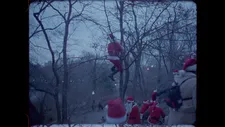
“I was like ‘Wait, hold on a second. Pause. When your friends and you started this..?’ And I'd known him for 15 years. I never heard this before. And he was just like, ‘Yeah, in the Nineties we started doing this in San Francisco.’ And he started talking about the relationship with Burning Man and how it was the same people who created Burning Man and how these folks had inspired Project Mayhem and Fight Club. And oh, yeah, just so you know, Seth, I personally filmed some of the early years, if you ever want to see the footage.’
 |
| Santacon |
“I was like, ‘Yes. Immediately!’ And he shows me these old tapes, and the movie just sort of comes alive in my head. I couldn't believe that this stuff had been captured on camera and how it played out as real scenes. It was like the cinematic language, the establishing shots, just the attention to detail – and how nobody had really ever seen this footage before. It felt like one of those gold mines that as an archival filmmaker, you just dream about stumbling onto.
“You know, whenever you begin making a documentary, you always have to have an open mind about where the story goes, because you're not writing it like you are script. You're trying to convey the truth, right? But for me, it's always about ‘What is this story on a surface level? And underneath that surface level, what is there? Why is the story worth telling? What ideas, what themes, what emotional journeys does a story serve as a window into?’
“I wasn't quite sure about that when we first started making the film. But after spending a lot of time with the people involved, not just looking at the footage, but actually getting to know the people, talking with them about it, I began to really see this film as a meditation on what it means to live a good life. And none of that was obvious to me when I started the project. The thing that was obvious to me was that there was this incredible dissonance between what I and everybody else thought about Santacon and the story behind how the event started. And to me, that dissonance allowed us to be surprising, if nothing else. You know, the difference between expectation and reality is always a fun place to live as a filmmaker, and as a starting point, that allowed me to go to so many other places.”
Early on in the film, people talk about the idea of capitalism and what it's doing to the world, and wanting to find something else and create a sense of wonder and get beyond that. Did they achieved that on some level, even if only for themselves, by way of Santacon?
“Yeah – I'm glad you used the word ‘wonder’,” he says. “That's the thing I kept thinking about, was the word ‘wonder’. And to me, it is also about wonder and possibility and creating joy out of nothing.
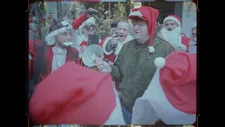
“It's a film that largely takes place in the Nineties, but we're very deliberate about how we establish a time and place so that it resonates and feels familiar to people in the present day. History always repeats itself, and humans haven't changed really, in our lifetime, on a biological level. The things that we struggle with as people and our responses to them 30 years ago should make sense to people today. And I think we. But I think the beauty of the early Santacons, looking at this old archival footage, the thing that really stood out to me wasn't so much that the Santas themselves were acting all that different. They were always kind of obnoxious, kind of drunk, kind of causing a little trouble. The thing that stood out to me was the faces of the people around them.
“Today we all know what Santacon is. We've been conditioned to understand that the fence is electric. Stay away. Do not touch. But back then, nobody ever experienced it before. And because they hadn't yet been told how to respond, they could respond in a very authentic way. And that authentic way – because it was something never seen before – was confusion, was awe, was joy. In some cases, it was terror and horror because it was something new. But it became this blank slate through which people's personalities could express themselves. They're seeing something they had never seen before.
 |
| Santacon |
“To me, there's something so beautiful and wondrous about that idea, about showing people something they've never seen before and then seeing their brain scramble a bit and in doing so, perhaps shake them out of something. Some routine, some sameness, something. And the realisation that there's just such real value in them – like, if you do nothing else but show somebody something new and cause them to have a response they didn't expect to have that day, you can create this ripple effect, I hope, that can just maybe, in the smallest little bit, change the way they see the world.”
There's one moment in there – just a brief shot between two longer sequences – where we see a small child in one quarter of the frame and his face lights up with wonder. Was that the kind of treasure being sought in the archives?
“Yeah,” he says. “Any time the camera drifts to some onlooker's face, you never know what you're going to get. I mean, it could be the same sort of horror and disgust that many people have today, but in so many cases, just like that, you'll see a child whose face lights up with joy and wonder because they are seeing something they never even imagined could be possible. And once you see something you never thought was possible, even something as stupid as a thousand Santas, that's a new thing. And when you see that new thing, you go, your imagination starts going ‘Wait, if this thing I didn't think was possible is possible, what else could be possible?’ I think that was a big part of the ethos of the Cacophony Society who started SantaCon: how can we scramble people's notions of reality in a way that leads to joy, to wonder, to creativity, to something other than the same treadmill of experience and feeling that people tend to go through on a day to day basis?
“The Cacophony Society just sort of fizzled and drifted away, but the people involved with it kept doing amazing creative things, just under different names. The Cacophony Society I view as this Rosetta stone of the modern underground. The people who were involved with it splintered off and they did so many things that still live with us today. Things like Burning Man, of course, but a lot of other things, many of which are public, many of which are not. A lot of people involved do things like urban exploring that may be a little bit less than legal. And in this era when kind of everything is plastered over social media, I think many of the things that they're involved with, they are very, very intense about keeping them still underground as much as possible.”
We talk about the way that the characters of different cities emerge through their encounters with Santacon.
“In Portland, the police and the community believed the Santas to be a group of terrorists hell bent on destroying their city,” he tells me. “They responded with riot cops and undercover police infiltrating the Santas and tapping their phone lines. In Los Angeles, though, nobody cared, because you walk down Hollywood Boulevard and there's ten people dressed like Spider-man already walking down the street, or people assume it's a film shoot. And so as they go from city to city, you see this incredible range of response from ‘Who cares?’ to ‘Oh my goodness, this is a threat to our way of life and it must be stopped!’”
The film also addresses people’s first experiences with realising that Santa wasn't real.
“I don't really recall having much of a relationship with Santa as a kid,” says Seth. “You know, I just recall at a very, very young age getting toys that somebody said came from Santa and going ‘Why does it say Made in China on the package when it was made in the North Pole? Why does it say Mattel made this when a bunch of elves made this?’ It was really hard for me to kind of square this idea that Santa was giving me these toys. So for me, Santa was like, ‘Come on,’ you know? But it was fascinating, I think, seeing some of our characters recount their own disillusion with learning about Santa Claus as a kid.
 |
| Santacon |
“To me, that gave the film the structure of a Christmas movie. So many Christmas movies are about people becoming disillusioned with Christmas and then finding a new way to experience and relate to the holiday. And that's what happened to these guys. They felt disillusioned as children because they felt like they've been lied to. So what do they do? They find a way to recreate Christmas and recreate Santa Claus in their own image, something that they can relate to. And to me, that makes it really feel like a true Christmas movie, in a way that I thought was a lot of fun.”
Towards the end of the film, we meet a younger generation of Santacon atendees.
“The most beautiful thing to me about the journey of the creators is how non-cynical they end up being,” he says. “How they're able to experience this thing that they might not relate to anymore, that they may not like anymore, but they can step back and say ‘You know what? This isn't for me. But who cares? The kids are having fun.’
“You know what might be more obnoxious than all the idiots dressed like Santa and getting into fights and throwing up everywhere? What might be more obnoxious than that are the people who are constantly complaining about that. Like, you know, as they get older, they don't want to be the person who says ‘Get off my lawn!’ They want to be the person who says ‘You know what? Kids are having fun. Go have fun. There is value in that, even if it's not for me.’
“I think that that is kind of great because I think a lot of viewers are going to go into this the same way I did, the same way the original Santas did. Thinking, at the beginning of the story, ‘Ew, gross.’ But then walking away going ‘You know what? Maybe there's some room in this world for some things that I think are ew and gross. That's okay.’
“John Law, one of our primary characters in the movie, he told me he’d said ‘Hell no, I'm never going back to that again.’ I think he's really glad he did. I think he's really glad he was able to see what had happened with this thing he had helped organise and create in its early days, and to realise that it is still bringing some people joy. Even if it's a joy that he has absolutely no interest in experiencing himself.
“There's some movies that you work on, and it really takes a toll on you as a filmmaker just living in that world, if it involves crime or, you know, real people get hurt. It was such a wonderful experience living in a world that honestly was rooted in creativity and joy, and being with really fun and funny people for so long. I've never finished a project and come out the other side with such a feeling of excitement and joy.”