 |
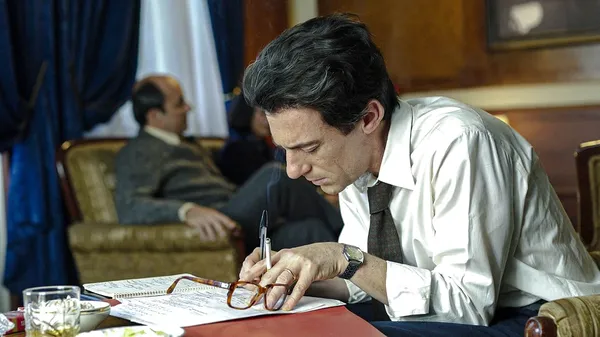
| Elio Germano as Enrico Berlinguer in Andrea Segre’s historical drama The Great Ambition |
Andrea Segre’s The Great Ambition (Berlinguer: La Grande Ambizione), a highlight of Cinecittà and Film at Lincoln Center’s 24th edition of Open Roads: New Italian Cinema, centres on Elio Germano as Enrico Berlinguer, the leader of the Italian Communist party between 1973 and 1978. The epigraph from Antonio Gramsci explains the title; “Usually we witness the struggle of small ambition linked to individual private ends against the great ambition which is inseparable from the collective good.”
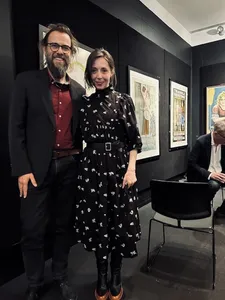 |
| Andrea Segre with Anne-Katrin Titze on The Great Ambition: “It’s a universal, not only an Italian film.” Photo: Anne Katrin Titze |
With the use of carefully chosen and placed archival footage, Segre makes come alive a man who changed Italian politics, in 1975 graced the cover of Time Magazine and headed the Italian Communist Festival with 20 Million attendees, and is by now largely forgotten for international audiences.
Political tactics, socialism in democracy, Gianni Agnelli’s revulsion towards a Communist Italy, historical compromise, the kidnapping of Aldo Moro - The Great Ambition explains the big picture as well as lesser known details.
Anne-Katrin Titze: We met here in 2012 for Shun Li And The Poet and I brought you a Chioggia beet!
Andrea Segre: Ahhh! I remember!
AKT: I had just been to the farmers market before the screening [the location of the film is Chioggia]!
AS: Ha! I remember the beet!
AKT: Archival footage is used by you in such an interesting way. It’s much more than an aside, it’s part of the body of the film.
AS: The body and the soul!
AKT: And the soul!
AS: We believed since the beginning and had this dream to find a balance between my footage, which is fictional footage and the archival footage. I knew it was very challenging because the archival footage could be an enemy to the fiction footage.
AKT: Enemy is a strong word.
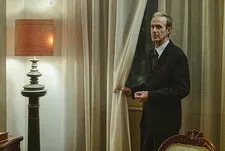 |
| Roberto Citran as Aldo Moro |
AS: Yeah, enemy, because if the archival brings the spectator out of the magic of the fictional relationships, the archival footage interrupts this magical relation, this created bubble. You have to believe that Elio Germano is Enrico Berlinguer. And if archival footage shows you a real someone else it could interrupt your relation with the fiction. That was the risk. But we decided to work a lot on the soul of coming from the real people, the faces, the eyes, the way of smiling, the way of crying of the real people in order to give to the spectators the feeling that something real but something emotional was happening to those persons.
That was the main intention we put on the archival footage in the editing. The archival footage was important during all the phases of the film and we always had an archival researcher with us. While we were writing, while we were preparing, they were with us. Shooting, editing, so the archival researchers were my consultants during all the processes.
AKT: That’s interesting, partly because of the choices. You start with archival footage from Chile in 1973, but your main character is in Bulgaria and it’s an Italian film. So immediately we get the sense that you’re not undermining your own film. Plus the locations make clear that what interests you is the big picture. It’s the great ambition, this is not a film about one country.
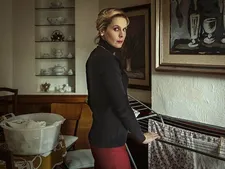 |
| Elena Radonicich as Enrico Berlinguer’s wife Letizia Laurenti |
AS: Of course, it’s a film about a particular side of Italian history that is not very known and that cinema didn’t tell before now. But this particular side of Italian history is very very important for the international political history. The Italian Communist party was the unique very huge Communist party in the Western societies and his rule in the Seventies was really important. That’s why it’s a film about the world. It’s a universal, not only an Italian film. It is also an Italian film.
AKT: His name is not the most known to many people internationally today, but there are moments of recognition. When, for example, the name Aldo Moro is mentioned for the first time in the film, there’s likely a shiver going through the audience. Even if you know very little about Italy in the Seventies, this is the name you will know!
AS: The killing of Aldo Moro is very known.
AKT: Yes, the kidnapping. It’s one of my early childhood memories .
AS: That is another goal of the film. We wanted to tell this very known moment of Italian history from the point of view of Berlinguer and the Communist party, because everyone knows internationally the kidnapping of Aldo Moro and the Red Brigade doing the kidnapping. And they were Communist terrorists. But actually what is not very known internationally speaking is that this kidnapping was a way to stop the project of the Italian Communist party.
 |
| Andrea Segre on the Chioggia beet I gave him in 2012 for Shun Li and the Poet: “Ha! I remember the beet!” Photo: Anne Katrin Titze |
Kidnapping and killing Aldo Moro was a way to kidnap Enrico Berlinguer and to stop their idea of historical compromise. We have a lot of very good Italian films about the kidnapping of Aldo Moro, made by masters of Italian cinema, like Marco Bellocchio [Good Morning, Night and Exterior Night], but the point of view of the Communist party and Enrico Berlinguer was never told in Italian cinema. His role in the history of the kidnapping is very important and it’s incredible that we were never told about it.
AKT: You explain the politics to us in an entertaining way. At one point Moscow wants the same from him as Andreotti. Both signal to Berlinguer to stay neutral. There’s a mirroring of the needs of others onto him. He is the figure in-between, who has to balance so much.
AS: Berlinguer and all the leadership of the Italian Communist party had a very clear project. They wanted to take the power democratically, not through an armed revolution, not through violence but through elections and they were sure that they could reach the majority of the people and actually they won the elections in ’74 and ’76. They were the first party democratically elected but they were also conscious that because of the Cold War it was not possible for a Communist to take the power in congress.
But they didn’t stop, they knew it was impossible, but they didn’t stop. They were really challenging the world powers. That’s why Berlinguer was a problem both for Washington and Moscow. Because he wasn’t respecting the priorities of the two big powers. He thought his way, the Italian way to create socialism in democracy was able to obtain his goal also without the two big powers. Of course he didn’t do it because they were much more powerful than he. And for sure the kidnapping of Aldo Moro is connected to the influence of the two big powers that allowed the Red Brigade to do what it did.
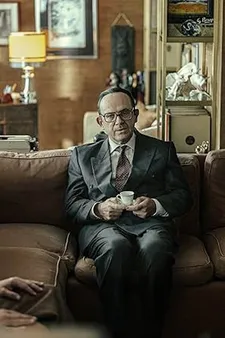 |
| Paolo Pierobon as Giulio Andreotti |
AKT: You allow for a political imaginary and for the audience to think, how could it all have been, had this not happened.
AS: Yes!
AKT: Rosa Luxemburg and the money Berlinguer hid in The Accumulation of Capital! Is that your invention?
AS: That’s my invention! Everything happening in the film is real, apart from the Rosa Luxemburg book. It’s real that he lost a banknote in a book but no one in the family remembered which one, so I decided on Rosa Luxemburg.
AKT: And probably the car accident didn’t happen when he was asked about Fellini?
AS: No it didn’t.
AKT: But then Fellini shows up in the end in the archival footage from Berlinguer’s funeral with Mastroianni and Gorbachev.
AS: Yes, he’s there with Mastroianni and Ettore Scola.
AKT: I liked how you shot the picnic scene with Berlinguer and his family and the comment about gender. The males are not seen, playing ball off screen, talking, and the women are seen sitting silently on the picnic blanket. Was that a little hint?
AS: Yeah, because Italy was quite misogynist until the big feminist movement in the Seventies changed a lot the society and the families in Italy. And Berlinguer inside the Communist party, which was a quite patriarchal party, he was the one who understood the importance of including the issues of the feminist movement in the Communist party.
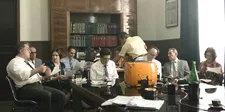 |
| Andrea Segre on The Great Ambition: ”We have a lot of very good Italian films about the kidnapping of Aldo Moro, made by masters of Italian cinema, like Marco Bellocchio, but the point of view of the Communist party and Enrico Berlinguer was never told in Italian cinema.” |
Also because he had three daughters and a wife who wasn’t Communist. She wasn’t a member of the Communist party and quite critical. That helped Berlinguer understand the importance of being open to the changing of society.
AKT: Film at Lincoln Center is showing the first US Monica Vitti retrospective. Do you have a favourite Monica Vitti film?
AS: Il Deserto Rosso (Red Desert)!
AKT: Because?
AS: Because I love it!
AKT: I love it, too! Thank you!
AS: Thank you!