





Eye For Film >> Movies >> Wind, Talk To Me (2025) Film Review


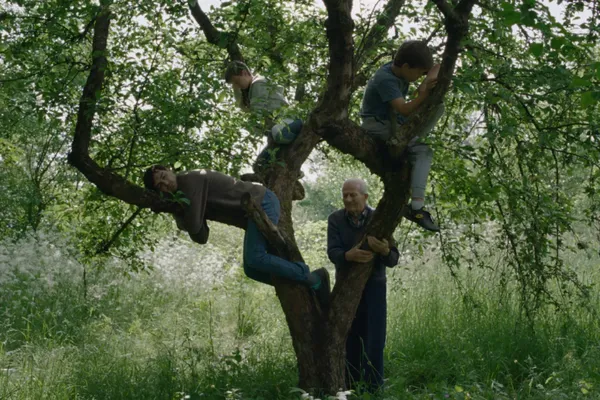

“Close your eyes, and believe; the wind makes your wishes come true,” says the ailing mother to her filmmaker son in a gently wistful moment that carries all the emotional weight of knowing that nothing lasts, and that the time for letting go is around the corner. In his directorial docu-fiction feature film, Stefan Đorđević finds the expression for the sense of striving to keep and preserve the memory of a loved one in the face of unrelenting force of time, as well as the acceptance and the surrendering to those forces of time.
Wind, Talk to Me continues its international festival run, recently winning the MIOB New Vision award at the Crossing Europe Film Festival in Linz (Austria). MIOB (Moving Images – Open Borders) is a network of seven European film festivals dedicated to promoting emerging European cinema.
The story follows the director of the film, Stefan, as he is preparing to go to the countryside with his extended family to renovate the house where his late mother spent many of her last days before her death to cancer. However, on his way to the countryside he hurts a stray dog with his car. Overwhelmed with guilt, he returns for the limping dog, determined to help it heal and very soon the dog Lija (Foxy) becomes a part of the family who are still reconciling with the loss of Stefan’s mother.
Throughout the movie, we see different manifestations of grief, from Stefan’s brother, who finds calm in keeping his feelings to himself, to the grandparents, who in the twilight of their lives have to find the strength to keep going through the motions in the face of their daughter slipping toward death by “skipping turns”, as old people in Serbia have a habit of saying. However, the position we most identify with is Stefan’s, who was making a documentary about his mother while she was still alive and is now struggling to find a way not only to finish the film, but also to move on with his life. Much of his time is consumed by all kinds of documents, proprietary media, and other remnants of his absent mother, trying to sort through it all to keep her memory alive. However, once he lets Lija into his life, his view of the problem is challenged.
In the opening image, we encounter a calm moment of Stefan hugging a tree, whispering the before mentioned line about the wind, which will recur as a leitmotif throughout. A beat or two later, a police officer interrupts him because he has parked improperly on the side of the road. The whole scene carries the feeling of presence of some third, other, spectator. Soon after,it is revealed that indeed, we have been watching everything unfold through the POV of the camera placed in the back seat of Stefan’s car. This feeling of unease, that there is a constant presence looming over the lives of these people, is present throughout the film. The further transcendent feeling of presence through absence is amplified by the relationship between Stefan and his mother, as presented in the documentary material, where we witness that, while she was fighting her illness, she was also deeply invested in a psychosomatic fear of radiation, as well as in the belief that the wind is an ever-present, almost divine force capable of granting wishes. In a pivotal and touching moment, where at first Stefan displays skepticism towards the wind and the overall condition, he lets go of his presuppositions, and completely surrenders to it. One can feel the burden and tension of knowing what is coming, and what is at play, but nonetheless participating and surrendering as a final gesture of love.
Stefan’s first introduction to the world of cinema came through acting in Nikola Ležaić’s debut feature, Tilvaroš (2010) which wasn’t only a skate, coming-of-age movie set in the south-eastern Serbian city polluted by mining industry, but is also a docu-fiction hybrid about the memory of times past. Since then, Ležaić, along with several other filmmakers, has continued to explore this approach, using cinema not merely as a tool of preservation, but as a way of articulating the human impulse to hold on to what inevitably slips through our fingers. Đorđević’s feature debut not only fits into this lineage while remaining wistfully intimate, but also has honesty and courage in dealing with grief and acceptance of the inevitable in the final moments of one's life.
This shouldn’t heave the impression of overwhelming sadness, but much of it is, in fact, effortlessly and spontaneously hilarious: from a cornbread birthday cake scene, to the grandpa bossing everyone around during renovations, to a coffee-cup fortune telling, or even young cousins calling Stefan out because his shot set-ups are “boring”. In this way, Wind, Talk to Me not only deals with cinema as an expression of our desire to desperately try to hold on, but also as an attempt to control and impose order on the environment, with the environment responding in a hilarious fashion. As Kierkegaard wrote: “Time stands still and I with it. All the plans I form fly straight back at me, when I want to spit in my own face”. Đorđević’s movie embodies this line of thought in a humble and authentic fashion that celebrates life in face of loss.
Reviewed on: 04 May 2026


