 |
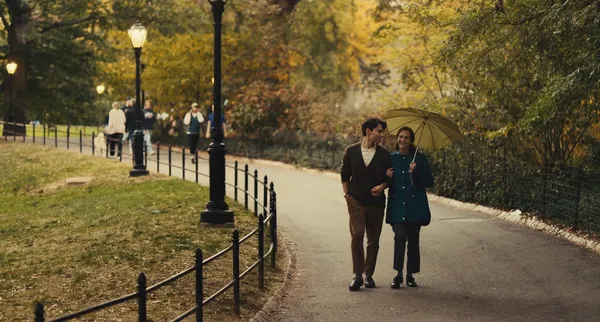
| Tom Koch and Leslie Ann Warren in Olive |
“The seed of the film was in a museum where I saw a grandmother and her grandson looking at a painting,” says Tom Koch. “They were discussing a painting, and I sort of crafted that maybe she was sick. Maybe she had some sort of memory loss or dementia. My grandma was sick. When I was 14, she passed away. And my girlfriend's grandmother has Alzheimer's right now, and I lived with them in England for three weeks. I always wanted to talk about a grandson and his grandmother. And I started writing the film like she had dementia and he was taking care of her.”
He’s talking about Olive, a handsomely crafted short which just missed out on the most recent stage of Oscar selection but won Best Short Film at the 2025 Young Director Awards. It’s a story about caring for someone with memory loss, but appropriately, the situations it depict are not what they first seem to be.
“At some point during the writing process, I found the twist,” Tom explains. “I discovered that actually it would be very interesting to talk about it in this way, playing with the concept of an unreliable narrator and maybe tricking the audience a little bit and making the audience feel like they maybe have some sort of dementia. So when you watch the film for the first time, it's a little bit confusing, and it cuts very quickly, and you don't really know where you are, and so on. It was very personal, but it became a goal of trying to create an effect and a twisted reality more than talking about a personal story.”
I tell him that something that I really liked about it was quality of the cinematography, and the colour grading. Colour is very important often for people with Alzheimer's to help them make useful associations. To what degree was that visual language was central to the storytelling as it developed?
“There were so many layers as to why the colour and the aesthetic of the film had to be on point,” he says. “I wanted to create a home that felt colourful, vibrant, loving; and show that those two people were still very in love with each other. I didn't want to show a house that was decaying or not really well maintained, or, like, ‘Oh, you know, he's sick, so therefore there's tissue everywhere.’ No. She cares about him so much, she loves him so much. The home that they've lived in for 50 plus years is still a romantic place.
“It was important for her to create an environment that was beautiful and for me to make a film that was aesthetically beautiful and to have that olive taste and coming back to nature, the heart chakra, every colour that's very natural. For me, it was a little bit of a nostalgia thing as well, where the house feels old, but it also feels lived in. It worked on me, so I was hoping it could work on other people.”
I observe that the color choices in the home and the types furnishings helped us to be uncertain what time we were in.
“Yeah, we were playing with that a lot as well. And we shot some scenes. You know the scene where she comes in and she says ‘You need to eat this sandwich,’ and they have this back and forth and he says ‘No, I've already eaten it,’ or whatever. We shot it during the night and it's just lights outside the window that we blasted to make it look like it was daytime. But it create this studio light, almost like, is it really daytime? Is it all in his mind? Is it night? At what point are we in the day? Has he eaten anything? Is the sandwich fresh? Or is it, you know, two days later? For me, time is like the third character of the film because it is a film about memory, so there are three in this apartment. There's always the clock ticking. There's always an aspect of time reminding him, time passing, but also, you know, time of the day.”
Both main characters seem to have some memory issues, I suggest.
“Yeah, maybe. They're so lonely. I crafted that they didn't have kids and that they didn't necessarily have the family financial support to go to the best doctors, to go to a house where he would have the support he needs. And that madness of loneliness made them who they are. And so she wants to help him, she gets in her own way. He wants to help her, and they're both kind of losing it. They're both wanting to care for one another, but they're both so much in their own ways. And that's due to a lack of means, but also a lack of time with other people and family and care and friendships.
“There's actually a moment when we shot the film where Leslie Ann Warren, the actress, said - as her character in a scene – ‘I wish I was young.’ I didn't keep it in the film because I didn't know if it was going to land the way it felt in the room, but there's definitely that madness aspect of it: do you want him to come back or do you want to join him in his madness? As long as you guys are together, what's the most important thing? Is it to be clear-minded and sane together, or is it ‘Even if we're two crazy people and we both think we're young, as long as we're together, it works.’?”
We discuss the support that made it possible for him to produce a film of this quality on a small budget.
“It really was like a small village getting together and adding strong pieces one at a time. Having Leslie allowed us to have more support. We had support from a sponsor and we had the support of the Alzheimer's Association, that reviewed the script. I tried to tell people, every artist who worked on the film, but also every donor, that this was the final product. You know, we're not trying to make a feature. We're not trying to make a proof of concept of something or prove the world that this is good idea. No, this is the film, you know, and hopefully it feels like you're watching a film and not like you're watching a clip of a feature or a clip of something that could be a good idea. It has the finality in the last scene as well. It feels like the end a little bit, I hope.”
We talk about the casting of older and younger actors in the film – one of whom is Tom himself – so that the characters feel consistent.
“That's kudos to the actors, to be honest,” he says. “Especially Jeffrey, who has no lines in the film as older Sam. I wrote inner monologues that I gave him to read and maybe to think about when he was acting. I don't know if it helped at all. I don't know if he did it, but just so he could feel the confusion of being that character.
“I also have to give a bit of a shout out to Leslie again, because she is such a grounded, believable human being when she acts that being in a scene with her, it makes acting a little bit easier. And so maybe she grounded me as a character and she grounded Jeffrey as a character, and because she was giving the same attention and love and passion to us, we were just responding the same way. I think there was a bit of that as well. A lot of my work as an actor was just looking at her and responding. Plus, we're playing people who have some sort of memory loss, and therefore they're very much in the present. They're almost like puppies. It's. They're not really planning or plotting. They're just looking around and trying to figure out what's happening.”
There’s also some clever work getting shots to resemble one another as memory and perception play tricks.
“To be honest with you, it doesn't really translate that way, but it's the same room,” he says. “We transformed a gallery into a doctor's office with props that we brought in and furniture that we brought in. It was very important that those two locations feel the same in a weird sort of mental way where you're looking at it and you're like, ‘Huh, it feels the same because of the painting, but it's not quite the same. Did they change the lens? Did they change something?’
“We changed a little bit of a lot of the colour grading, because in the ending, when we change POV and we're on Leslie, everything feels a little bit whiter, and it's more raw. Whiter lights, overhead lights. And so it feels a little bit like a different room, and yet it is the same room with just different furniture.”
He’s thrilled that Olive made it as far as it did in the Oscar race.
“It's surreal, to be honest. I wish I could be more in the present and just feel it more and just be grateful and happy that the film has spoken to so many people. It feels great. I'm very, very grateful for this thing, and it makes me want to make another film. Not that it would be Oscar qualified, but you know what I mean? The process is so fun. For me, the best part is the writing and going into production. It's the moment where it's the most thrilling.”
He now intends to use the film to educate people.
“That was always the goal: to bring it to care homes in America and in the world and do activation screenings. We're talking with the Alzheimer's Association about them. We're talking. We're actually doing a screening in March in Maine for an Alzheimer's festival. I want to leverage that as much as possible and screen the film for free for people to watch it, for caregivers to see that they're being represented in films as well. And hopefully people resonate with it and learn something from it.”