 |
| Christian Petzold on Miroirs No. 3 (Mirrors No. 3): “For me the idea came from an old diary by Heinrich von Kleist, which I used during rehearsal for Afire.” |
In the first installment with Christian Petzold on Miroirs No. 3 (Mirrors No. 3, a highlight of the 63rd New York Film Festival) starring his frequent collaborator Paula Beer (Transit, Undine, Afire), opposite an equally excellent Barbara Auer, we talk about re-enchantment through tales, lullabies, and cinema history, the rehearsal process with the actors, Otto Preminger’s Laura and Alfred Hitchcock’s Rebecca, shoes, apples, cars, Heinrich von Kleist on falling fates, Gay Talese on clothes, Paula Beer’s expensively distressed sweater and The New York Times T-Magazine’s upcoming Style Detective research, wind from Nuri Bilge Ceylan’s About Dry Grasses, birdsong, music (Frankie Valli and the Four Seasons’s The Night and Mathilde Santing’s You Go To My Head), and a Bertolt Brecht/David Lynch combination soon to happen.
 |
| Christian Petzold with Anne-Katrin Titze on The Night by Frankie Valli and the Four Seasons: “It’s a fantastic song. I love it.” Photo: Anne Katrin Titze |
Miroirs No. 3 begins on an urban bridge. A woman, whom we will later get to know as Laura (Beer), stares down at the water. Her pale sweater (costume design by Petzold regular Katharina Ost) looks torn and frayed at the edges, so that it takes a second glance to realise that the garment is made of precious yarns. The deconstructed duck in the front hints at a style choice and not a sign of wear but we cannot be certain. Beer’s expression, equally illegible, only hints that we are watching someone on the brink.
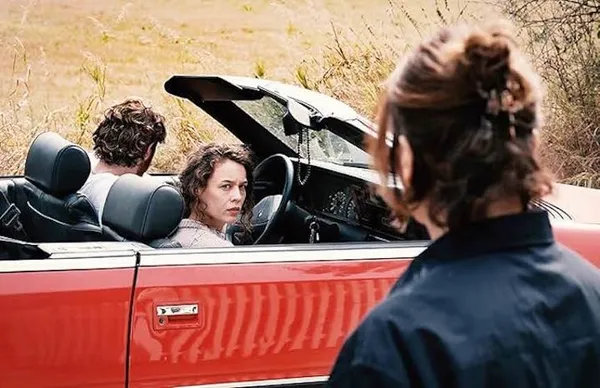
A man in a black wetsuit paddles by, standing in his canoe. He could equally be an athletic citizen or Charon and brings to mind how, as in Petzold’s Undine, the worlds of lore flow so effortlessly into the everyday. The film’s title refers to the third movement of Maurice Ravel’s suite, “Une barque sur l'océan,” and the curtains in Laura’s apartment that twice prominently fill the screen, have a big blue border at the bottom, as if half under water. A weekend trip is planned and she finds herself in a red cabriolet with her boyfriend Jakob (Philip Froissant) and a couple whom he is eager to impress in a work related matter.
As they pass by a lovely house at the side of a road, she exchanges a foreboding glance with Betty (Auer), the second person in the film dressed in head-to-toe black, who is painting her fence. More than in his previous films, Petzold here offers us a homecoming to a place we never knew and maybe always knew. A peace in knowing you are allowed to be taken care of or, the other trajectory, allowed to take care of someone.
In New York, during the 63rd New York Film Festival, Christian Petzold and I met for an in-depth conversation on Miroirs No. 3.
Anne-Katrin Titze: This film had a different feel for me, although I could see the strings that connect it to Undine, for instance. It has a tone of a special enchantment.
Christian Petzold: I said to myself the next three movies I want to do - Undine, Afire, and this movie - it’s about re-enchantment. It’s not so hard to make a love story in Paris in the Jardin du Luxembourg, but it’s very hard to make a love story in Germany in, for example, November in the suburbs. So I tried to re-enchant the world with the help of tales, lullabies and cinema history.
When I started thinking about this movie, I knew it was about people who are traumatised, who lost their senses. Depressed people like Laura, Paula Beer in this case, don’t have an open window to the world anymore. Their senses are dead. Nothing gets inside, their mind is a jail. This movie is about these windows being reopened. The senses are working again.
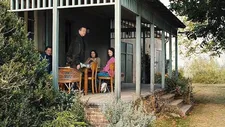 |
| Max (Enno Trebs), Richard (Matthias Brandt), Betty (Barbara Auer), and Laura (Paula Beer) on the veranda |
AKT: Reawakened.
CP: Yes, so the world around them - you have to hear and see the world. The world has to be authentic. On the other hand this world also has to be enchanted. I like this title Mirrors, because behind the mirror there is another world. It’s a world like Alice in Wonderland, the world under the rabbit hole, but the world must be real at the same time. The wind, the birds, everything must be absolutely real. You can find some signs, though. The Cinderella shoe, the fence from Tom Sawyer, the red car from Jean-Luc Godard, you can find them in this world.
AKT: Where is the Cinderella shoe?
CP: After the accident she lost one of her shoes.
AKT: I didn’t catch that.
CP: In the end she takes the shoe and throws it against her false lover. It’s not for the audience, it’s just for the feeling.
AKT: You get the sense of tales from the start. The figure in black.
CP: Yeah, I forgot this.
AKT: I wondered, is this some sporty Berliner on his kayak, or is it Charon, the ferryman?
CP: Who guides dead people over the Styx?
AKT: Yes, and I noticed that Barbara Auer, painting the fence, is also wearing black. The two figures connecting.
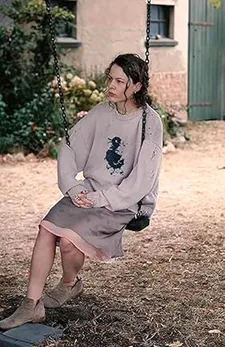 |
| Christian Petzold on Laura (Paula Beer) in the deconstructed duck sweater: “A Japanese designer. I like it because she is wearing something she doesn’t like.” |
CP: That’s right.
AKT: So many so called “updates” on fairy tales focus on the horror elements in them. I loved that you unearthed the gentleness they hold instead.
CP: That’s right.
AKT: In tales people meet, if they are in need, they simply move in. The house of the Seven Dwarfs? In she moves!
CP: Ha, yes, that is happening here. Two weeks before shooting I had a long weekend rehearsal with the actors. On the first day of our rehearsal I’m talking about the script and we have a cold reading and I’m talking about all the things on my mind while working on the script. Then I show them one, two, or three movies. Because we are making a movie.
AKT: I noticed the name Laura for the protagonist. Was the Preminger film one of them?
CP: Preminger’s Laura was one! In Laura it’s about falling in love with someone who’s dead.
AKT: That’s why you named her Laura?
CP: Yes. And the second movie was Rebecca by Hitchcock. In Rebecca, there’s a castle, a house, and somebody died in this house and is missing. There is this governess, she’s dressed in black, she’s hard, and she doesn’t accept the new Rebecca.
AKT: The new Mrs. de Winter.
CP: Because she loves the dead one. She wants the new Rebecca out, she wants to kill her. This is a horror movie. So I said to the actors, we make it the other way around. This time the governess, Betty [Barbara Auer] is also in black, but she wants the new. This is not a horror movie then, it’s something else of a traumatised paranoid subject, but her targets are not “horrorful” targets.
AKT: In Hansel And Gretel the witch at first gives the children apples and pancakes with nuts and fresh bedding. And here are the apples next to her bed in your film, and coffee and tea.
CP: Yes, these are all the little signs! I also told the actors and they liked it. Actors like when a director opens up. These are signs everybody can read, and if you miss them it’s not a problem. For me the idea came from an old diary by Heinrich von Kleist, which I used during rehearsal for Afire. We are sitting around the table in Afire, we have a rehearsal about Heinrich Heine and Heinrich von Kleist. Sometimes I’m a little vain, because I have studied literature and I want to show it.
AKT: And show off a little?
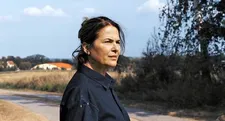 |
| Barbara Auer as Betty |
CP: Sometimes. The actors know this and make jokes about it. I told them this story from Kleist’s diary in one of his letters, where he says, I can’t sleep during the night. My body was on heat. I was in a small village. I can’t sleep and I open my shirt and run outside the house, through the night, through the village. At the end of the village there was this big gate in the wall where you can leave the village. In Europe we have these towns surrounded by walls.
AKT: He reaches the “Stadttor,” a town gate.
CP: Yes, so he runs through the gate, looks up to the ceiling and sees that all the stones want to fall. But because all the stones want to fall at the same moment, there is a hollow space, a cavity. Everything is in depression and falling but because it’s in the same moment, we can, I can live on. Is literature not the same? Isn’t all literature, all fiction, all features, telling us about falling people, falling fates, but when they are coming together they have a time and a space to live on?
The actors liked this metaphor and I told them that this next film is about a traumatised family that is falling apart and a young girl who is falling into depression with suicidal tendencies. Both falling energies come together and they rebuild something new. So many people say, you have to be authentic, you have to be real, you have to be true. But sometimes the lie and the masquerade and the artificial things can help people.
AKT: I believe in that. You can go back to Kleist and the Marionette Theater.
CP: Same thing, yes!
AKT: Only by going through artifice, you can find the lost grace again and the truth.
CP: When you are out of the paradise, out of the innocence, you can’t come back. You have to go through everything, perhaps there’s another entrance to paradise, but it’s work, it’s education and playing and everything.
AKT: It’s good that you don’t give us any background for the character of Laura. We find her in her depressed state.
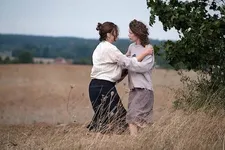 |
| Betty (Barbara Auer) with Laura (Paula Beer) |
CP: I did shoot a biography in the beginning, I didn’t use it in the end. There was one day of her at the Academy of Music and she can’t play the piano anymore and has a conversation with another student.
AKT: Much better that we don’t see this! But you needed to film it?
CP: I knew from the beginning, but I do need it. I tell the actors that I cut it out, and Paula said, oh, but it wasn’t so bad! And I said to her: Alice in Wonderland, do you know anything about Alice? Can you tell me, Paula, if Alice has parents? Is she rich, is she poor? Tell me something about her! And Paula said, I don’t know, she is falling through the rabbit hole and then the story starts.
AKT: I want to talk about the sweater that Paula wears at the start of your film. In my review I wrote it has a deconstructed duck in the front. Is it that?
CP: It’s a deconstructed duck, that’s right.
AKT: It looks like one of those expensive pullovers that are distressed on purpose. I remember having a conversation with Gay Talese about that. You know his work?
CP: Yes.
AKT: He is a friend since we were on a film festival jury together. Which, by the way, is another place where you can meet people and talk about not yourself immediately.
CP: Perfect place, yes.
AKT: Anyway, we talked about clothing and he said that sometimes walking around in New York, he notices what someone is wearing and doesn’t know if it is a homeless person or someone very fashionable. Because of interesting colour combinations and clothes that are distressed. Sometimes you can’t tell if it is a very fine mud-coloured cashmere or was found in the garbage. Is that what you were going for with the sweater for Laura?
 |
| Betty (Barbara Auer) with Laura (Paula Beer) on the bicycle |
CP: This was something [costume designer] Katharina Ost and I were talking about. Because the very rich can play with signs like this. They could play that they could be homeless. The heroin chic in the Nineties, jeans with holes. During our first screening in Paris, a woman asked why she’s wearing such an old garbage sweater. And I told her that this sweater costs more than $1000. “Ahh, I understand” she said.
AKT: Who made it?
CP: A Japanese designer. I like it because she is wearing something she doesn’t like.
AKT: That’s an excellent point of self-negation.
CP: I have written down a biography for her. She’s the daughter of a very rich guy. She’s in Berlin and plays the piano because the mother left the family and she used to play the piano. She doesn’t know where she is coming from, she doesn’t know where she is going to, she is wearing sweaters like this and doesn’t know if she likes it or not. I like this sweater.
AKT: I do, too. Actually, it might show up in The New York Times. T-Magazine has a brand new series, called Style Detective, where they ask you to submit questions about objects you saw somewhere, the more obscure the better, it seems. And they will do research and find out for you who made it, plus “affordable alternatives.”
CP: That’s great!
AKT: The column is going to start in November. So I sent in, “In Christian Petzold’s new film Miroirs No. 3 there is this sweater …” I’ll let you know!
CP: Oh that would be great. Please send it to me!
AKT: Will they find it out? Will they read this and we end up on a Möbius strip?
 |
| Miroirs No. 3 Poster |
CP: Anyway it’s great. Let’s see.
AKT: Also there are the underwater curtains.
CP: They were made. Very, very expensive! She is an artist who makes curtains. If you close the curtain, you have the feeling there could be the sea. Like the paintings by Turner. Two-thirds are sky, the other is land. She batiked the curtains, very expensive, but I liked that you have this cold apartment with these curtains and the wind. The first movie I saw in a cinema after Corona was by Nuri Bilge Ceylan.
AKT: I like his films very much.
CP: It’s about a writer who comes back to his small town in Turkey and he takes a walk. There is a field with women working on the field and one of the women is looking at him and he is looking at her. Instinctively you know that they know each other and that they are lovers from old times. She asks him for a cigarette and they are standing under a tree.
He lights her cigarette and then the camera is showing the tree above them and then there’s a wind coming for 45 seconds. The wind is telling the whole story. They missed each other. She is marrying another guy. But these 45 seconds are fantastic. Therefore I rented two ventilators, because I wanted to have this with the big tree in the garden.
AKT: You wanted the wind.
CP: And then the wind was coming by itself! I didn’t need the ventilation. The producer said, it was so expensive! But we don’t need it. We had 14 days of really strong wind there. As if the wind were on our side. When you are in a world of tales and lullabies, then things like the wind take care. And the birds! We were shooting in September, October and on the fields all the birds were congregating to go to the South. So we have the real birdsongs in the background. If you have a story like this you have to surround it with reality.
AKT: Your music choices are always very specific.
CP: There is no score. Because of what I told you, I want to hear the wind, the birds, the sound of the voices. I don’t want to produce the emotion, I want to see people who try to reproduce their emotions.
AKT: The songs are chosen for what these people would listen to, You Go To My Head, for example.
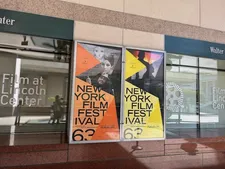 |
| New York Film Festival 63 at the Walter Reade Theater Photo: Anne Katrin Titze |
CP: I like this version by Mathilde Santing. I want to make a portrait of people who come back to life, and it would be obscene for me to put music into a score.
AKT: The Night (by Frankie Valli and the Four Seasons) is another song, they hear. It works so well with the two of them.
CP: It’s a fantastic song. I love it.
AKT: What’s coming next?
CP: I’ll make a Polizeiruf in Munich with Barbara Auer and Mathias Brandt, and Johanna Wokalek in the summer, and then I have to finish the script for the next movie. It’s about a shaman mother, she’s blind, and her daughter. They are thrown out of their flat in Berlin and the mother has the power to curse people. The people who threw her out are cursed by her and have to die. Mother and daughter are living in Kuhle Wampe, the place where the communist movie was made in the 1930s. The daughter wants to come back to life. She’s not full of hate against the capitalist system, sometimes she wants to be a part of it. But she has to show solidarity and be loyal to her mother. So she has to fight against the mother witch and also against the capitalist world. And she has to find herself.
AKT: Is there something of Mother Courage to it?
CP: Yes, it has something to do with this. It’s a Bertolt Brecht story.
AKT: It sounds Brechtian. At the same time, the supernatural is there again.
CP: A Bertolt Brecht/David Lynch combination!
AKT: That sounds fabulous!
Coming up: Christian Petzold on language details, changing to the other side of the mirror, conversations without identity and war-friends, Babybel and growing up fast, James Bond versus films that repair and repairing in films, vegan Königsberger Klopse and more.